

The latest figures from the Ministry of Agriculture and Environment show that in November, the country recorded 402 outbreaks in 31 provinces. Since the beginning of the year, there have been 2,495 outbreaks in 34 localities, causing 1.23 million pigs to be destroyed. This is the largest number of pigs to be destroyed so far due to this disease.
The reason for the rapid spread of the epidemic is that most of the disease outbreaks are in small-scale farms where disinfection and control of vehicles entering and leaving the barns have not been strictly implemented. Heavy rain and high humidity create favorable conditions for the virus to survive and spread. Veterinary agencies have recorded the appearance of a new, more virulent strain of the virus, increasing the risk of controlling the epidemic.
The herd rebuilding process is uneven. Some localities recover quickly, but the Central region is disrupted by the impact of floods, causing the scale of livestock farming to shrink.
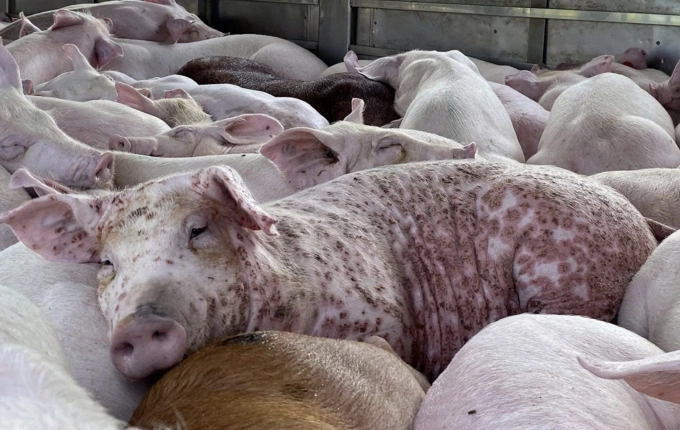
Since mid-November, the price of live pigs has started to increase again as the supply from small households has decreased sharply. Compared to October, the price in the North has increased to 52,000-54,000 VND per kg, the Central Highlands - Central region 49,000-53,000 VND and the South 51,000-54,000 VND. This development is considered short-term, reflecting an immediate decrease in supply rather than a sign of sustainable recovery.
Mr. Nguyen Kim Doan, Vice President of Dong Nai Livestock Association, warned that if imports are not regulated and domestic consumption is not promoted, the livestock industry may enter a new crisis cycle. He proposed adjusting retail prices reasonably and increasing communication on food safety to restore consumer confidence.
In contrast to pig farming, the poultry industry recorded a steady increase in output thanks to good disease control. In contrast, cattle farming continued to decline due to low economic efficiency and narrowed grazing areas.
The Ministry of Agriculture and Environment said that from now until the end of the year, it will strengthen disease surveillance and gene sequencing to provide early warning of new variants, while supporting businesses and localities in building disease-free zones to maintain production.
According to vnexpress.net
Source: https://baodongthap.vn/tieu-huy-hon-1-2-trieu-con-heo-benh-trong-11-thang-a233601.html


![[Photo] Cat Ba - Green island paradise](/_next/image?url=https%3A%2F%2Fvphoto.vietnam.vn%2Fthumb%2F1200x675%2Fvietnam%2Fresource%2FIMAGE%2F2025%2F12%2F04%2F1764821844074_ndo_br_1-dcbthienduongxanh638-jpg.webp&w=3840&q=75)









































![[VIMC 40 days of lightning speed] Hai Phong Port determined to break through, reaching the target of 2 million TEUs by 2025](https://vphoto.vietnam.vn/thumb/402x226/vietnam/resource/IMAGE/2025/12/04/1764816441820_chp_4-12-25.jpeg)


















































Comment (0)