

The Ho Chi Minh City People's Committee has officially approved the investment plan for the Ben Thanh - Can Gio high-speed railway project with a preliminary total investment of over 102,430 billion VND, excluding land acquisition costs.
On December 8th, information from the Ho Chi Minh City People's Committee indicated that Vice Chairman Bui Xuan Cuong had signed a decision approving the investment policy and simultaneously approving Vinspeed High-Speed Railway Investment and Development Joint Stock Company as the investor to implement the Ben Thanh - Can Gio railway project.
This is a large-scale transportation project, expected to realize the strategy and planning for the development of the transportation and railway system, thereby promoting socio -economic development of localities in the Southern key economic region in particular and the Southeast region in general.
With a length of over 54km and a design speed of 350km/h.
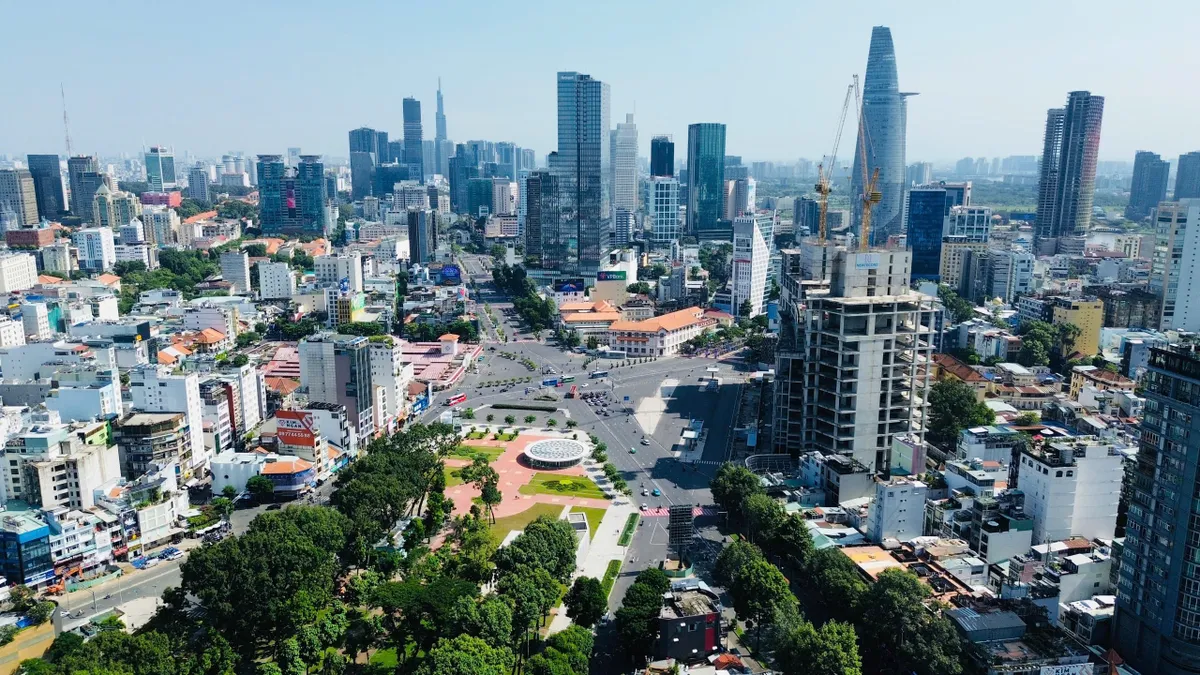
The starting point of the Ben Thanh - Can Gio railway line at 23/9 park. Photo: My Quynh.
According to the decision, the project will construct a double-track railway with a gauge of 1,435mm, a main route length of over 54km, a design speed of 350km/h, and an axle load of 17 tons/axle.
The station project consists of two stations in phase 1: Ben Thanh station and Can Gio station. Phase 2 (when needed) will add four more stations: Tan Thuan, Tan My, Nha Be, and Binh Khanh. A depot is planned to be located in Can Gio commune, along with an operations control center (OCC) also located there.
The preliminary total investment for the project is approximately 102,430 billion VND. This figure does not include approximately 12,784 billion VND for land clearance costs, which are guaranteed from the State budget. The project's operating period is 70 years from the date the investment policy decision was issued.
The target is to complete construction by 2028.
Regarding the schedule, compensation and land clearance work is expected to begin in Q4/2025. Basic construction and commissioning of the project will be carried out within 30 months from the date of land allocation, ensuring operational commencement in 2028 (excluding the 4 stations in phase 2).
During implementation, investors are responsible for ensuring their capacity and self-balancing of investment capital to execute the project according to the committed schedule, and are also responsible for determining the total investment capital in accordance with regulations.
The Ben Thanh - Can Gio railway project has its starting point at September 23rd Park (Ben Thanh Ward), and its ending point at a 39-hectare land plot adjacent to the Can Gio coastal urban tourism project (Can Gio Commune).
The basic route of the project, according to the plan, starts at Km0+00 in 23 September Park, runs along the park's land parallel to Le Lai Street, to Nguyen Thai Hoc Street, then turns along Ky Con Street, crossing Ben Nghe Canal.
After crossing the Ben Nghe canal, the route turns northeast onto Hoang Dieu Street, follows this road to the intersection with Nguyen Tat Thanh Street, then turns southeast, closely following the corridor of Doan Nhu Hai Street.
The route runs straight through the Nha Rong port area to near Tan Thuan 2 bridge, then turns southeast onto Nguyen Van Linh road, passing the intersection with Nguyen Thi Thap road to Tan My ward.
Continuing south, the route crosses the intersection of Nguyen Van Linh Street and Phu My Bridge to Nguyen Luong Bang Street. The route then turns southeast, passing between Nguyen Luong Bang Street, Road 15B, and Road D1 to the Rach Dia River overpass at Km9+800, entering Nha Be commune.
After passing through Nha Be commune, the route turns southeast through the Van Phat Hung resettlement area, Phu Xuan residential area, crosses the Soai Rap river to Binh Khanh commune, and runs towards Can Gio station.
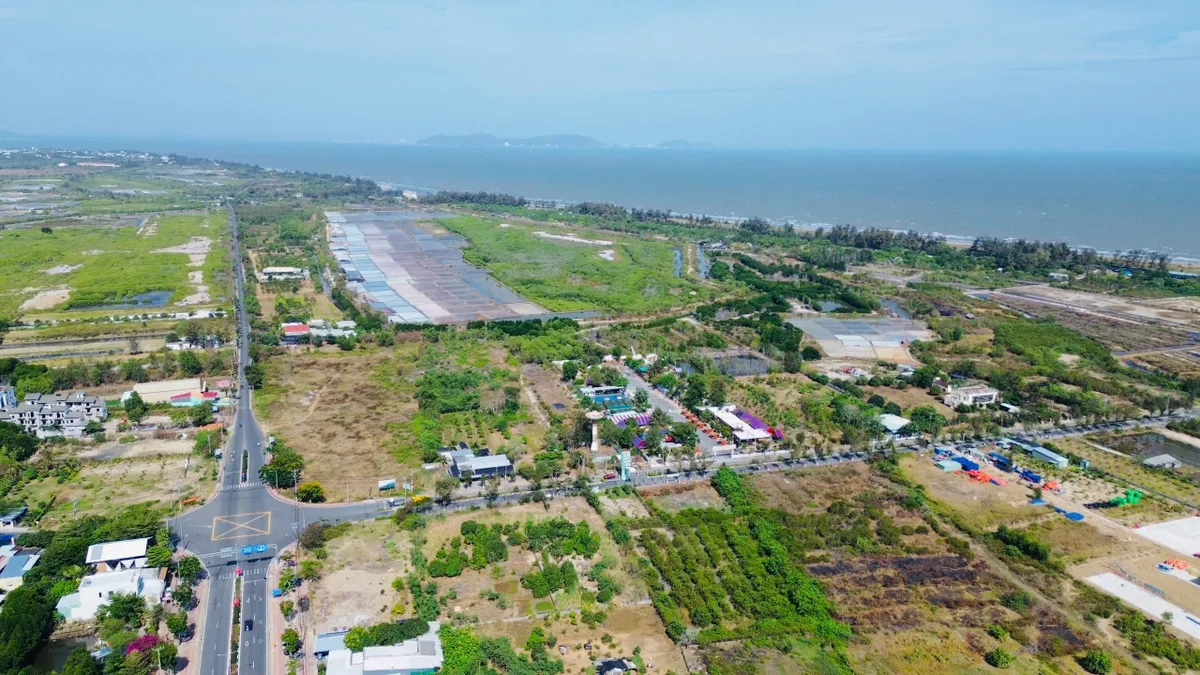
The area is identified as the final station of the Ben Thanh - Can Gio metro line. Photo: My Quynh.
The Ho Chi Minh City People's Committee has instructed relevant departments and agencies to guide investors in completing all necessary procedures regarding land, construction, environment, national defense and security, and the specific technical requirements of the high-speed railway project. Specialized agencies are responsible for appraising infrastructure connections, planning indicators, and design options, and for updating the route in the city's revised master plan.
The city requires investors to ensure financial capacity, comply with technical procedures, protect the landscape and environment, and have plans to reduce noise and vibration during operation, ensuring synchronization with the existing metro system and other planned railway lines.
The project is expected to create a breakthrough in urban-tourism connectivity, promoting sustainable development of Can Gio district and the southern area of Ho Chi Minh City.
Source: https://vtv.vn/tp-ho-chi-minh-chap-thuan-chu-truong-dau-tu-tuyen-metro-ben-thanh-can-gio-1002512091508112.htm


![[Photo] Explore the US Navy's USS Robert Smalls warship](/_next/image?url=https%3A%2F%2Fvphoto.vietnam.vn%2Fthumb%2F1200x675%2Fvietnam%2Fresource%2FIMAGE%2F2025%2F12%2F10%2F1765341533272_11212121-8303-jpg.webp&w=3840&q=75)

![[Photo] The captivating scenery of the fragrant maple forest in Quang Tri](/_next/image?url=https%3A%2F%2Fvphoto.vietnam.vn%2Fthumb%2F1200x675%2Fvietnam%2Fresource%2FIMAGE%2F2025%2F12%2F10%2F1765353233198_lan09046-jpg.webp&w=3840&q=75)

















![[Video] The craft of making Dong Ho folk paintings has been inscribed by UNESCO on the List of Crafts in Need of Urgent Safeguarding.](https://vphoto.vietnam.vn/thumb/402x226/vietnam/resource/IMAGE/2025/12/10/1765350246533_tranh-dong-ho-734-jpg.webp)
























































Comment (0)