

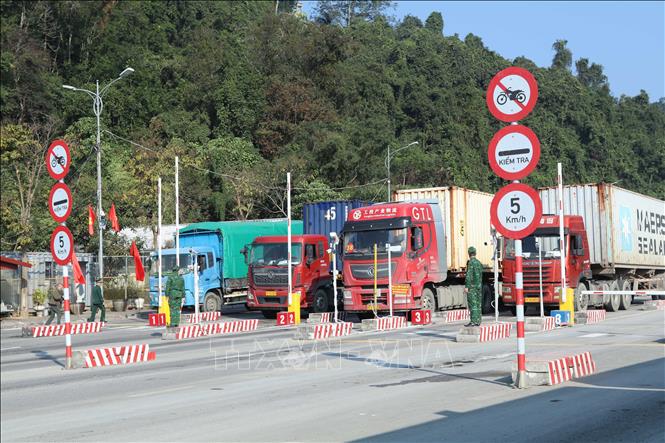
The Huu Nghi (Vietnam) - Huu Nghi Quan (China) international border gate pair includes a dedicated cargo transport route in the area of border markers 1119-1120 (Huu Nghi - Huu Nghi Quan), a dedicated cargo transport route in the area of border markers 1088/2-1089 (Tan Thanh - Po Chai), and a customs clearance point in the area of border markers 1104 - 1105 (Coc Nam - Lung Nghiu).
On the first day of the pilot program, customs clearance for import and export goods at dedicated lanes and customs checkpoints proceeded smoothly and safely, without major problems. This was due to the proactive efforts of the functional forces at the border gates in disseminating information about the policy to businesses, cargo owners, and drivers, allowing them to adapt and make timely adjustments.
Mr. Luong Duy An, representative of FTC Hanoi Construction and Transportation Joint Stock Company, said that the company is currently conducting one-way import and export, resulting in significant import and export costs because the vehicles returning to the country are empty. "When we were informed about the two-way import and export transportation option, we found it quite convenient, especially in reducing costs. Our company will consider registering," Mr. An shared.
According to Mr. Ngo Lam Son, Deputy Team Leader of the Huu Nghi International Border Gate Customs Team, Lang Son province, the Customs agency has disseminated information about the policy to businesses in the area through direct and indirect means, enabling them to proactively prepare for the two-way goods delivery method. This delivery method will reduce costs for businesses during import and export processes and simultaneously enhance the capacity for cross-border trade between the two sides in the future.
Prior to the one-year pilot program for two-way cargo transportation, customs, border guard, and border gate management centers actively informed transportation businesses that they must register and declare their transportation needs with the authorities to ensure smooth inspection and supervision. Vehicles participating in two-way cargo transportation were only allowed to stop for a maximum of 36 hours at opposite docks, ensuring quick customs clearance. Goods on board, when delivered or received in each direction (export or import), had to belong to a single business or consignor.
For agricultural products, only one item per vehicle is allowed; for electronic components and other goods, they must be transported in standard containers or vehicles that meet the technical safety requirements of each party… To date, all information regarding this activity has been actively disseminated by authorities to 100% of relevant businesses.
Major Duong Thanh Tiep, Head of Tan Thanh Border Gate Border Guard Station, Lang Son province, said that the unit has instructed all officers and soldiers to organize and implement traffic flow management, ensuring security and order in the area to facilitate the pilot program of two-way goods delivery and receipt. During the pilot program, the unit always creates the most favorable conditions for businesses to achieve efficient customs clearance capacity…
It is estimated that in 2025, more than 5,500 businesses will be involved in import and export activities through Lang Son province, an increase of approximately 35% compared to the same period last year; more than 425,000 vehicles transporting goods have been cleared through border gates in the province. The pilot program for two-way goods transportation, which will last until December 9, 2026, is expected to bring positive changes in vehicle management and goods documentation inspection, while promoting trade and economic development in border gate areas.
Source: https://baotintuc.vn/kinh-te/thong-suot-van-chuyen-hang-hoa-hai-chieu-qua-cap-cua-khau-tai-lang-son-20251210153221518.htm





























































![[Infographic] Many activities at the 96th anniversary commemoration of the death of Deputy Scholar Nguyen Sinh Sac](https://vphoto.vietnam.vn/thumb/402x226/vietnam/resource/IMAGE/2025/12/11/1765441454787_infographic-nhieu-hoat-dong-tai-le-gio-lan-thu-96-cua-cu-pho-bang-nguyen-sinh-sac20251211010322.webp)












Comment (0)