

Ethics, the foundation of sustainable digital education.
Associate Professor Dr. Nguyen Van Vu, Deputy Head of the Faculty of Information Technology at the University of Science (Vietnam National University Ho Chi Minh City), warned that without an ethical framework, AI could cause harm instead of assisting humanity. He proposed ensuring principles of transparency, fairness, accountability, and humanism in the development and use of AI.
Sharing the same viewpoint, Professor Hoang Van Kiem, Senior Advisor on Information Technology at Saigon International University, stated: "If we teach AI to 'speak correctly' but forget to teach humans to 'live correctly,' the danger doesn't come from AI, but from humanity itself." According to him, the important thing in the AI era is not "who is smarter," but "who is more humane."
Dr. Tran Van Tung, former Deputy Minister of Science and Technology, commented: "Technology can help people learn better, but it can also make them dependent if they lack digital skills and proper guidance." The story of a student seeking advice from AI and suffering heartbreaking consequences serves as a wake-up call about the responsibility of adults in educating children emotionally and digitally. Ultimately, education is not just about imparting knowledge, but about nurturing human beings, something no algorithm can replace. AI can provide support, but the teacher remains the "heart" of education, and human emotions are what give knowledge its value.
This is further confirmed by the fact that teachers always hold a core position within the entire national education system. Resolution 57 clearly states: "Teachers are the decisive factor in the quality of education; building a team of teachers with sufficient qualities, capabilities, and prestige to meet the requirements of fundamental and comprehensive reform of education and training."
This is not just recognition, but also a strong political commitment: that all reforms and innovations must begin with the teacher. Over the years, Vietnamese educators have faced numerous pressures of the times: the demand for innovative teaching methods, adaptation to digital transformation, and maintaining their role as "guides" in a world where knowledge changes daily. Many teachers have pioneered the application of technology, incorporating artificial intelligence (AI) into teaching, developing digital learning materials, and creating open learning spaces where students are encouraged to be creative and self-learn. However, it is precisely in this context that the traditional role of the teacher—teaching ethics, humanities, emotions, and responsibility—becomes more sacred and necessary than ever before.
As technology increasingly dominates the classroom, Resolution 57 emphasizes the need for holistic human development, not only in knowledge but also in character, lifestyle, ethics, and civic spirit. This is the "soul" of humanistic education, and teachers play a crucial role in fostering it. Today's teachers need not only to be highly skilled in their subject matter but also to possess the ability to guide values – helping students learn to love, respect differences, and live responsibly towards the community and themselves.
"Education is the most important field; it requires the human heart."
A highly controversial comment by Professor Dr. Le Anh Vinh, Director of the Vietnam Institute of Educational Sciences: "Teachers use AI to teach, students use AI to learn, but in the end, nobody teaches, nobody learns, only technology does the work."
According to him, AI can create lessons, grade papers, and even write essays, but it cannot replace the teacher-student relationship in education. "No one wants their essay graded by a machine. Education is not just about imparting knowledge, but also about emotions, beliefs, and character."

Mr. Vinh warned that if schools, teachers, and parents are only preoccupied with technological conveniences and forget the core goal of character development, then education will fall into the "illusion of effectiveness." "Technology is everywhere, except in education, because education is the field that needs the human heart more than anything," he emphasized.
In fact, AI can replace teachers in grading papers, it can teach students how to solve math problems or write essays, but it cannot teach students how to love, how to choose what is right, or how to live with purpose. These core values can only come from humans – from teachers.
As artificial intelligence becomes increasingly powerful, the role of teachers does not diminish; on the contrary, that role becomes more profound. Teachers not only impart knowledge but also guide, inspire, and awaken the self-learning ability, compassion, and critical thinking in each student.
Associate Professor Dr. Luu Bich Ngoc, Chief of the Office of the National Council for Education and Human Resource Development, also pointed out a thought-provoking reality: “If three years ago AI was still a foreign concept, now this technology is present in thousands of EdTech products. It can grade assignments and personalize knowledge, but it cannot replace humans. Will there still be teachers in a few years when there are classrooms with ‘virtual teachers’?”
In response to that question, Associate Professor Dr. Le Hieu Hoc (Hanoi University of Science and Technology) affirmed: "AI can prepare lessons and grade papers, but it cannot teach how to be a good person. The role of teachers is not only to impart knowledge, but also to guide and help students understand technology so that they are not controlled by it."
According to Associate Professor Dr. Le Hieu Hoc, a humanistic education cannot rely solely on data and tools; it must have people, teachers who teach with their hearts. Accordingly, teachers in the AI era need three new levels of competence: The knowledge level: AI provides unlimited access to data, but the teacher is the one who "connects" that data into meaningful knowledge. The teacher is no longer just a "speaker," but a "guide." The emotional level: AI can simulate emotions, but it cannot truly feel. A look of encouragement, a nod of support, a handshake of trust... these are things only the human heart can provide.
Personality level: AI is intelligent, but lacks human compassion. A teacher should teach students to live kindly, responsibly, and with empathy; that's what makes education important. According to a SuperCharger report, 66% of current educational technology has "gone AI-driven." A range of tools like ChatGPT, Khanmigo, Cognii, and Elsa are changing the way people learn globally. Some tools can even create video lectures with virtual teachers.
At that time, AI was not a replacement, but a mirror that helped teachers become more insightful. In the technological world, "being human" is the most difficult lesson. Because the further humanity advances intellectually, the more it must return to morality. If we let machines make decisions for humans, we will lose our ability to reason, lose our identity, and become dependent. A sustainable education must be one that knows when to "stop," that knows how to balance knowledge and emotion, data and compassion, the genuine feelings of human beings.
Professor John Vu, Director of the Institute of Biotechnology at Carnegie University (USA), stated: "What truly defines a person's value is not how quickly they can access data, but their character, ethics, and responsibility to society."
Learning is not just about receiving data, but also about reflection, analysis, and transforming it into skills, attitudes, and actions. It's a process that only teachers, through their experience and character, can guide their students through. If education focuses solely on cramming knowledge through machines, neglecting character development, we will create generations who know a lot but live impoverished lives, intelligent in data but powerless in interpersonal relationships. Teachers, families, and communities must play a leading role in nurturing the spirit, character, and compassion of the younger generation. This is something no technology can replace.
A strong education system cannot rely solely on tools; it must rely on teachers—those who sow the seeds of knowledge, inspire, and cultivate morality in their students. If this element is lost, any technological progress will only lead humanity astray.
Education in the age of AI is therefore not a race between humans and machines, but a journey to rediscover the human essence in knowledge. As technology becomes increasingly human-like, teachers must become more "human" than ever before. Because only heart, compassion, and character can make knowledge a valuable part of life. And ultimately, in a world of intelligent machines, what we need most is a teacher, someone who helps students learn to "use technology to be human" with all their aspirations, desires, and gratitude in their hearts. mature...
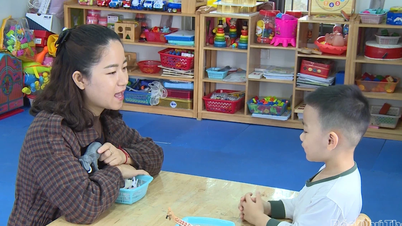
In an AI-powered learning environment, students can easily look up knowledge and complete assignments using smart tools, but no algorithm can replace the empathy, patience, and character of a teacher. It is the exemplary conduct, love of the profession, and compassion of a teacher that leave the deepest impression on students throughout their lives. Because people grow up carrying with them ethics, emotions, responsibility, and gratitude towards their teachers from these emotional connections, when a teacher, through their belief, can change a person's life, their role becomes more sacred than ever.
And so, regardless of the era, teachers retain their value as inspirers; there will be teachers that students will forever remember and carry with them throughout their lives...
Associate Professor Pham Manh Ha (Hanoi University of Science and Technology) believes that technology forces teachers to become role models of innovation. “Only by daring to apply technology can teachers lead in the digital age. But innovation does not mean being replaced. Teachers remain the ‘heart’ of education.”
Source: https://baophapluat.vn/trai-tim-nguoi-thay-dieu-ai-khong-the-thay-the.html
























































































Comment (0)