

Surely, somewhere in your memory, you have heard the catchy melodies of the male and female singers from Kinh Bac region interacting with each other, offering each other betel nuts or cups of water to show their hospitality.
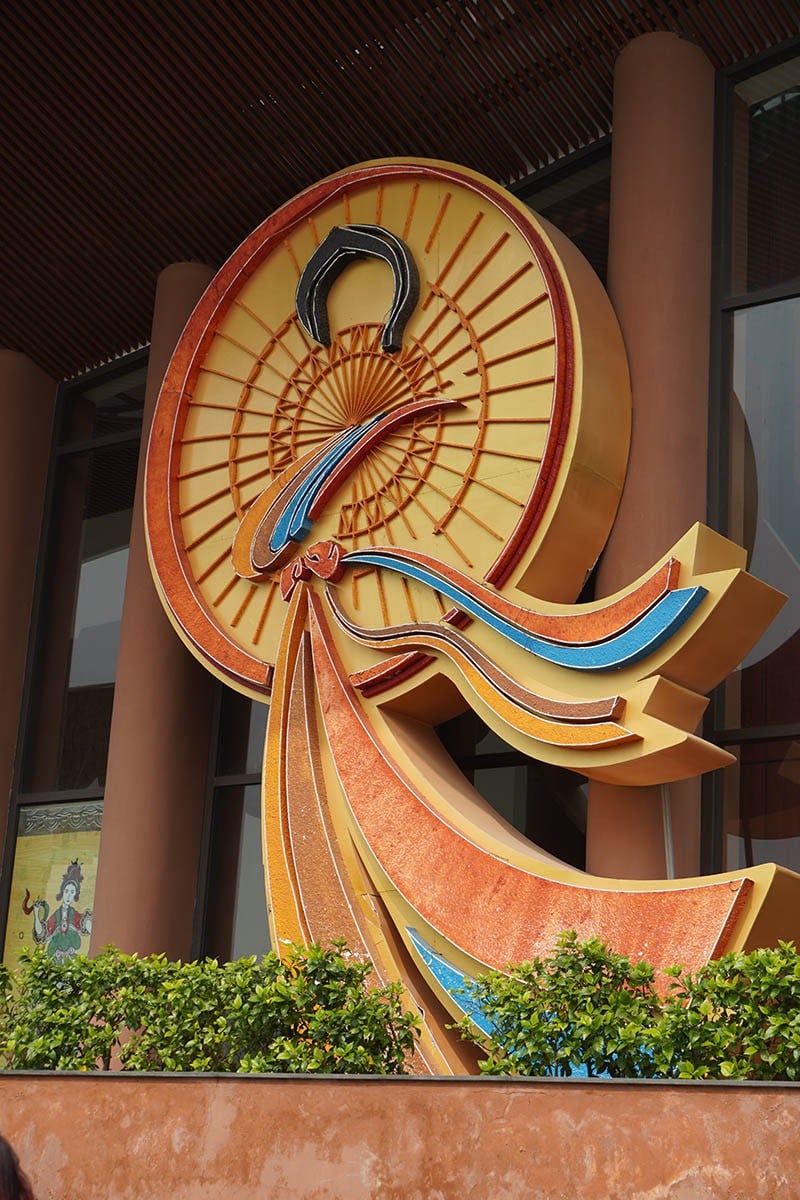 |
| Main entrance of the Bac Ninh Quan Ho Theater. |
"Let's chew a betel nut together."
Don't eat it, take it. Don't eat it, take it.
Giving each other betel leaves signifies mutual affection and affection.
This betel leaf symbolizes affection and love.
Eat it to get red, eat it to get red
"Our lips, your lips, the betel quid is a golden betel quid."
When mentioning the Kinh Bac region - Bac Ninh, it would be a great oversight not to mention the intangible cultural heritage "Bac Ninh Quan Ho Folk Songs". Bac Ninh Quan Ho folk songs have a long history, created by the Vietnamese (Kinh) community in Quan Ho villages and some neighboring villages.
Unlike other forms of folk singing, in the beginning, Quan Ho folk songs were simply informal songs sung during the daily life of the people in the Kinh Bac region. These were call-and-response songs used for communication and interaction in eating, sitting, standing, inviting, and bidding farewell… Gradually, these songs of courtship became a source of pride for the local people.
Quan Ho folk songs from Bac Ninh are call-and-response songs between male and female singers. They usually sing Quan Ho in early spring and autumn during festivals or when friends come to visit, to express their friendliness. The male singers, dressed in traditional turbans and silk robes, and the graceful female singers, in their traditional multi-layered dresses and conical hats, sing together in simple, heartfelt verses. Their traditional style, without musical accompaniment, is full of musicality, showcasing the refined culture of the Quan Ho people.
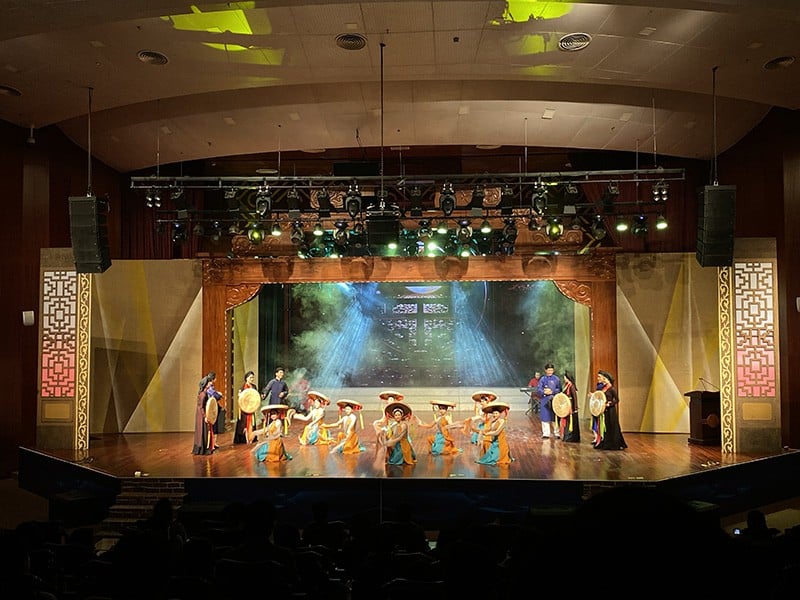 |
| A performance by male and female folk singers at the Quan Ho Theater in Bac Ninh. |
Quan Ho folk songs are incredibly diverse, with over 500 songs and 213 melodies performed using a unique and distinctive singing art. The distinctiveness of Quan Ho singing lies in the combination of music , poetry, and the vocals of the Quan Ho artists. A song's lyrics have two parts: the main lyrics and the supporting lyrics. The main lyrics are the core, reflecting the song's content, while the supporting lyrics include all sounds outside the main lyrics, such as interjections and vocalizations like "i hi," "ư hư," "a ha," etc. The art of Quan Ho singing requires artists to use these supporting sounds and lyrics alongside the main lyrics to make the main lyrics smoother and enhance the musicality of the song, making the melody more lively.
The lyrics of Quan Ho folk songs are usually carefully crafted verses and rhymes, using clear and exemplary language. The content of the songs often expresses human emotions such as longing and sadness at separation; joy at reunion between lovers; ...
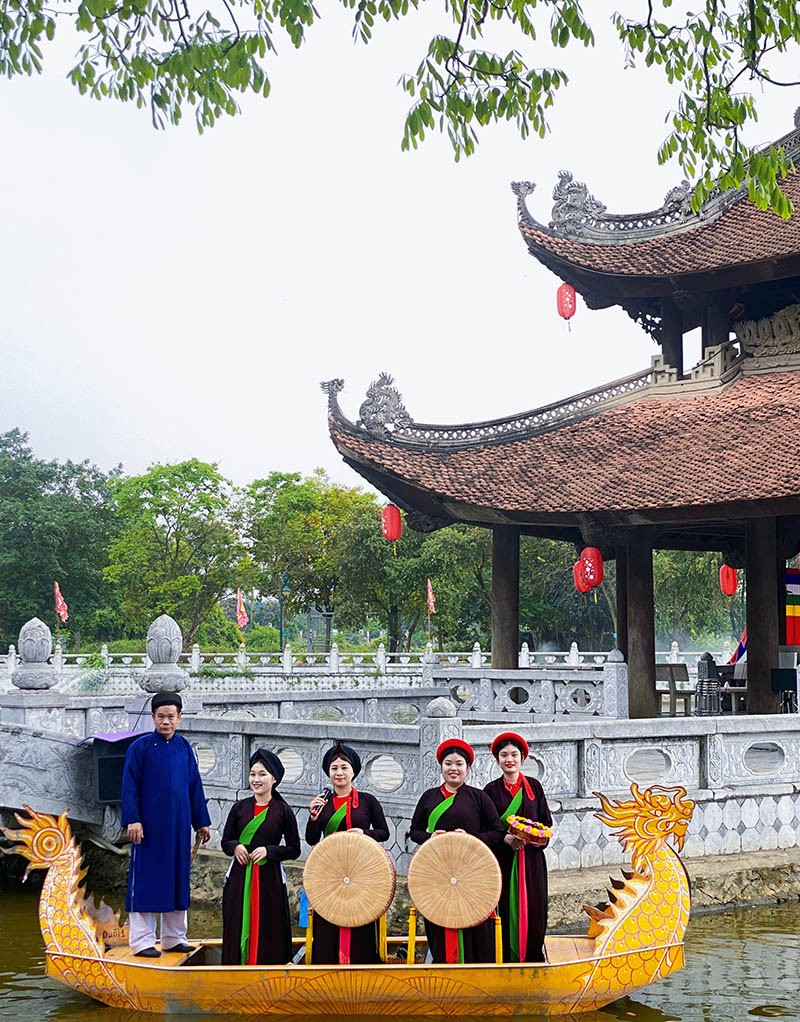 |
| The charming young men and women share their songs. |
The Hanoi delegation had the opportunity to experience Quan Ho folk singing with the artisans of the Quan Ho Folk Song Club at the Do Temple. The lyrics of the song "Guests Visiting the House," sung by the female singers, deeply moved the Hanoi delegation as they listened to the ancient Quan Ho folk melody.
Lyrics: Guests Visiting the House (Ancient Quan Ho folk song)
"Guests come to visit our house, they come to play at our house."
Burn charcoal by the fence and fan the water to make tea.
I offer this cup of tea to the guest.
How precious, oh how precious you two are!
Each person gets to drink their own cup.
Please give it to her, please, she wants to give it to me.
The river is drying up, oh the river is drying up, oh the land.
Let me go back and forth a little, lest I be bothered by the ferry crossing, or I'll go to the temple.
I see it, oh, I see the words Linh A Nhang.
Near the temple, there's not much incense burning, not even a little bit of light in the morning, the moon shines down, and the peach garden is also bright.
Three or four people were sitting there—how many people?
Is it still available or not? Should I ask?
"The thread cart, oh the thread cart, oh the pink thread?"
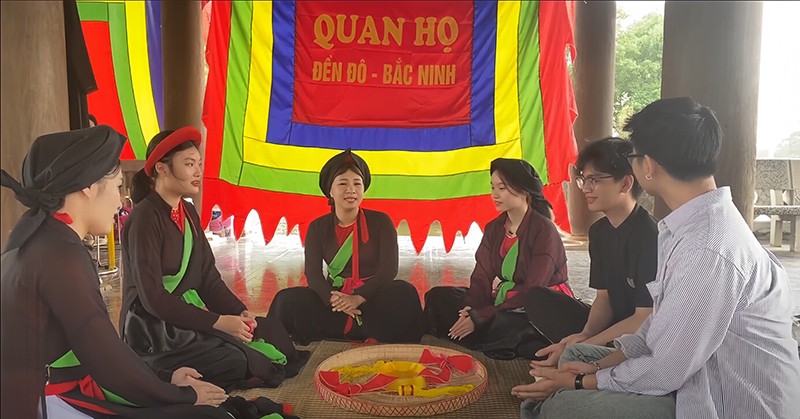 |
| The Hanoi delegation experienced Quan Ho folk singing with the female singers of the Quan Ho Folk Song Club at Den Do Temple. |
According to the Quan Ho singers, "When visiting someone's home, the custom of offering tea and betel nut cannot be missed"; "Regarding offering tea, there's an old saying: 'With both hands, one lifts the betel tray - the fragrant tea fills all ten fingers'"; "Regarding offering betel nut, there's a saying: 'Green betel, white areca nut, pink lime - lime mixed with meaning, strong tobacco with charm'." One can see the "charm" in each verse of the Quan Ho folk songs, simple yet deeply heartfelt. They pour their feelings and hearts into these songs, hoping to express mutual affection.
During a conversation with Ms. Nguyen Thi Xuan Lan, Head of the Quan Ho Folk Song Club at Do Temple, Dinh Bang, Tu Son, Bac Ninh, who inspires younger generations with a passion for Quan Ho folk songs, the Hanoi delegation had the opportunity to hear Ms. Lan sing Quan Ho with great emotion. She shared:
"The common people don't know what the standard is. When it comes to Quan Ho folk singing, the etiquette is the difficult part; singing requires hard work. Youth should be joyful, and I really appreciate the way young people maintain their cultural identity. In Quan Ho villages, they say 'eat half, eat half,' so when eating with friends, you can eat a whole meal or half a meal to chat and drink together."
At the beginning of the table is a plate of salt, at the end is a plate of pickles. Please, everyone, raise your bowls and chopsticks so that the Quan Ho singers can continue their performance. In the Quan Ho style, there is a "la loi" style; when meeting, they sing in the "la loi" style (some of the songs in the "la loi" style are extremely difficult), then they begin the "van" style, followed by the "gia ban" style (the final style).
There are many ways to introduce a Quan Ho folk song, but I want to include some introductory remarks to draw the listener's attention, so they can hear the song itself: Introducing the song "Con Duyen" (Still in Love) - With the presence of so many esteemed guests, we, the hospitable people of Bac Ninh - Kinh Bac, sing with joy that only those who love each other would come to visit our home. In the Quan Ho folk song of Bac Ninh, there is a line, "Don't be fooled by the many friends I have; even with many friends, I still wait for a good person." Ladies and gentlemen, everyone likes a beautiful person because a beautiful voice is also beautiful, and a cheerful personality is also cheerful. Why do the men and women of Bac Ninh only sing about good people? Because the people of Bac Ninh believe that beauty is only about outward appearance, like a flower that easily fades with time, while a good person is about inner moral character and wisdom, living a fulfilling life and spreading their influence throughout generations. The elders used to say, "Good wood is better than good paint, a person with a beautiful character is better than a beautiful person with a beautiful appearance." If a person possesses both physical beauty and moral character and intelligence, how much more valuable is that? This is the message of the famous song in the call-and-response style of Quan Ho folk music from Bac Ninh - the song "Con Duyen" (Still in Love).
The group gained more knowledge not only about Quan Ho folk songs but also about the cultural exchange among the people of Kinh Bac region. Ms. Lan has been involved in performing arts since 1986, and with 28 years of experience, she doesn't want to keep these melodies to herself, but wants to pass them on to future generations so that Quan Ho singing will be preserved forever, as she shared.
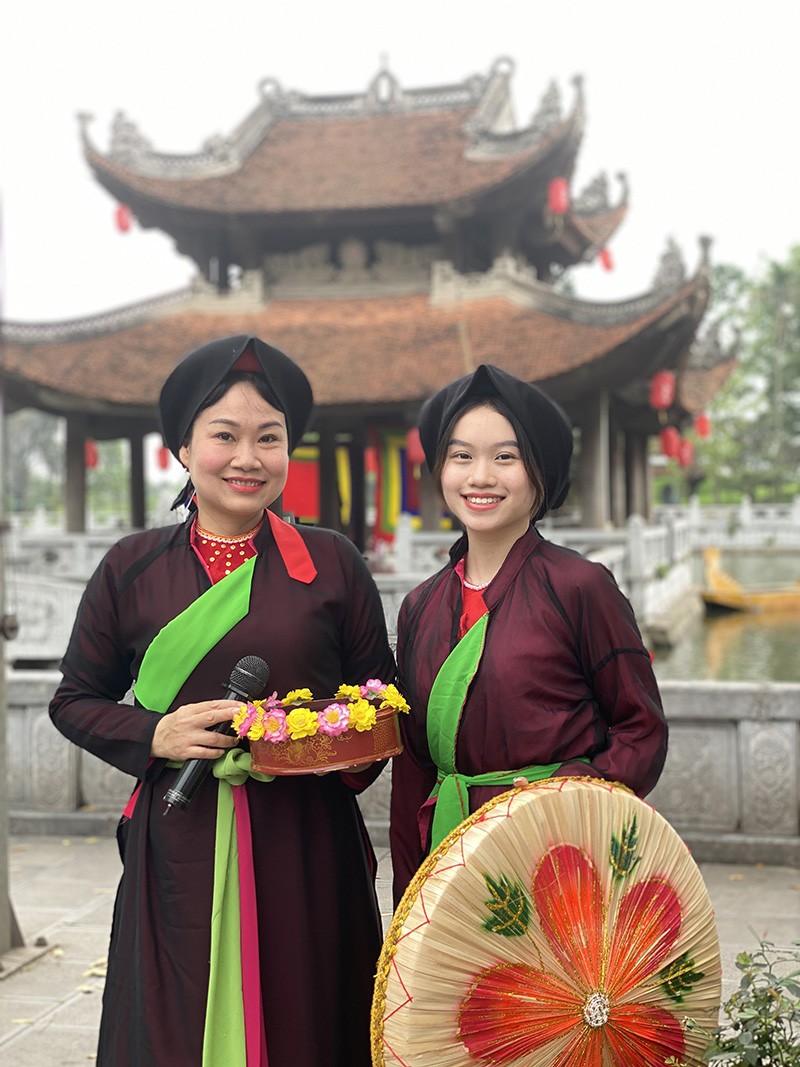 |
| Quan Ho folk singers and the featured individuals. |
Today, many villages in Bac Ninh still maintain the Quan Ho folk singing tradition with hundreds of traditional songs that are tender, rustic, and simple, carrying within them the sacred beauty of the Kinh Bac region.
The beauty of Quan Ho folk singing in Bac Ninh lies in the harmonious blend of sweet melodies sung by the male and female singers, unique traditional costumes, and culturally refined manners during courtship. These images have become familiar to both domestic and international tourists, evoking a peaceful village in Northern Vietnam, graceful girls in traditional attire and conical hats, and young men in silk robes and turbans.
As a unique cultural feature of the people of Kinh Bac, Quan Ho folk singing from Bac Ninh has been passed down from generation to generation, yet it retains its intact spiritual value, not only for Bac Ninh province but also internationally renowned. In 2009, Quan Ho folk singing from Bac Ninh was recognized by UNESCO as an Intangible Cultural Heritage for the spiritual values that this art form brings.
Despite the increasing modernization of life, Quan Ho folk songs remain deeply ingrained in the consciousness of the people of Bac Ninh in particular and of Vietnamese people in general. The enduring vitality of this art form throughout its long history continues to attract and impress tourists from all over the country.
(*): Faculty: International Relations - Specialization: External Information - Academy of Journalism and Communication
Source: https://baoquocte.vn/trao-duyen-qua-lan-dieu-dan-ca-quan-ho-bac-ninh-272532.html


![[Photo] Prime Minister Pham Minh Chinh holds a phone call with the CEO of Russia's Rosatom Corporation.](/_next/image?url=https%3A%2F%2Fvphoto.vietnam.vn%2Fthumb%2F1200x675%2Fvietnam%2Fresource%2FIMAGE%2F2025%2F12%2F11%2F1765464552365_dsc-5295-jpg.webp&w=3840&q=75)






































































Comment (0)