

Modern journalists with artificial intelligence tools; image generated by ChatGPT. (Illustrative image) |
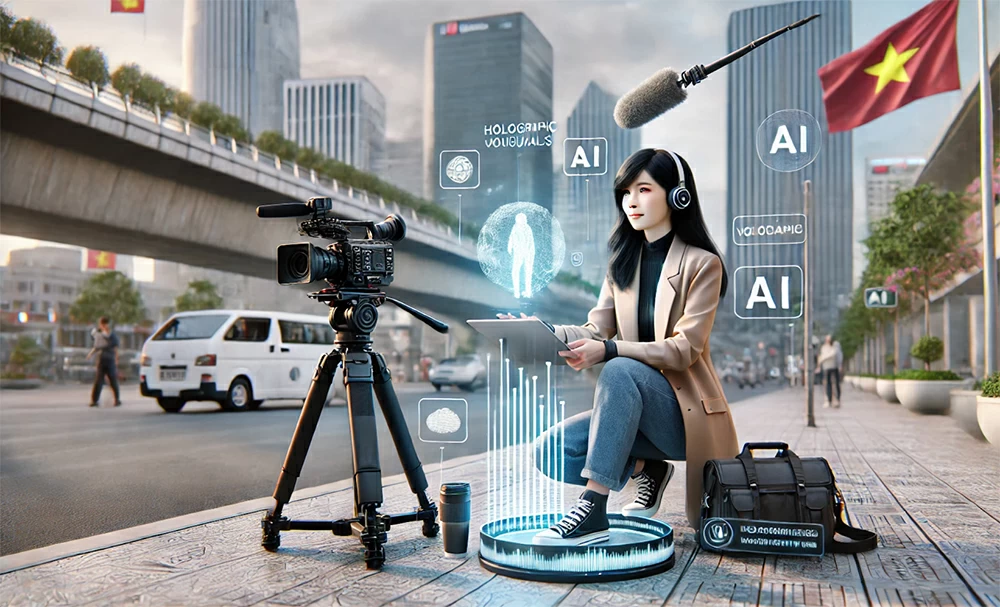
At the individual level, journalists can also use free AI tools such as ChatGPT, Gemini, DeepSeek, Canva, Magisto, InVideo, PressAssistant… in the basic tasks of the profession: searching, discovering, and developing topics; collecting and processing information and data; and producing work. In an instant, ChatGPT can write a 2,000-word commentary, provide 5-10 headline options for an article, and proofread all spelling errors… This “capability” of AI has led many to exclaim: Can artificial intelligence replace the role of journalists?
AI can write articles, but…
Artificial intelligence (AI) is merely a tool. It lacks the ability to assess social context or the motives behind information, easily leading to the reproduction of fake news or biased content without verification. AI doesn't "understand" the world like humans do. It only learns to predict the next word based on probabilistic models from learned data, but cannot distinguish between right and wrong. If the user's question lacks sufficient information in the training data, the AI may... fabricate content to "fill the gap." Experts call this phenomenon AI hallucination – a serious and common problem in the use of language models like ChatGPT.
And it's clear to everyone that AI cannot replace journalists in gathering data on events and experiencing things firsthand – from investigating the scene and interviewing witnesses to understanding the social context – something that professional journalists always have to do.
Furthermore, there is the risk of plagiarism or copying information without proper attribution. AI lacks professional ethics—the very qualities that define a journalist's integrity and responsibility in serving the truth and the public. In addition, the misuse of AI can lead to content homogenization, killing off creative individuality and the distinctive voice that is the soul of journalism.
Therefore, AI can create journalistic works, but for those works to be usable, they need the "directing" hand of a journalist; that is, the journalist must know how to control AI as a tool.
What can't AI replace journalists in?
AI lacks the intuition, social sense, or "professional gut feeling" of a real investigative journalist. Journalists shouldn't worry about AI replacing them; it can replace some repetitive tasks (like correcting spelling errors, for example), but it cannot detect and pursue the truth.
AI is a robot, so it cannot build relationships with sources, or ask tricky questions, counterarguments, or challenge information during investigations. Modern journalism needs the role of writers who can advise, critique, and guide. AI cannot replace journalists in their life experiences to deeply understand social issues, ethics, prejudices, history, and gray areas in information. And because AI is a robot, it cannot convey emotions, personal tone, or empathy—elements crucial for moving the public.
And of course, journalists and news organizations are personally and legally accountable to the public and the law. AI is not. Issues of inaccuracies, biases, or fake news all require ultimate verification by a human.
Furthermore, while AI can simulate, it cannot create a new style, proprietary language, or unprecedented approach. Excellent writing often stems from personal experience and encounters with reality. In other words, AI lacks the ability to tell unique and creative stories, a crucial requirement for producing good journalistic work.
Journalists in the age of AI
Clearly, journalists now have to live with AI in their work. However, AI only provides good support for individual journalists in tasks involving the automation of repetitive duties such as automatic translation, spell checking, compiling press releases, summarizing financial reports, or writing descriptive, neutral articles that don't require emotion or investigation.
Journalists can use AI to assist in rapid analysis and research, synthesize documents, extract key points from thousands of documents in a short time; and automatically create charts and infographics.
As mentioned, AI cannot replace journalists, especially in the process of creating journalistic works, including opinion pieces and investigative journalism.
However, to effectively utilize AI, journalists also need to be equipped with specialized knowledge and technological thinking. Journalists must thoroughly understand the principles of AI to formulate effective questions (prompting). Modern journalists must know how to integrate AI to support information gathering, content analysis, and data building, while still ensuring the editing and verification roles of humans are maintained.
Journalists must master technology instead of becoming dependent on it: avoid relying on AI to mass-produce content without censorship, guidance, or creativity from journalists. AI can synthesize information quickly, but it cannot replace the role of human verification. Journalists must ultimately be responsible for accuracy and truthfulness.
Experts recommend that if AI is used to generate part or all of an article, this information should be transparent (to varying degrees) in the article.
In short, AI is a tool – not a journalist. Future journalists cannot simply "write well," but must also "write intelligently," knowing how to combine technology, data, and humanistic values to create reliable, insightful, and inspiring information.
Phan Van Tu
Source: https://baodongnai.com.vn/xa-hoi/202506/tri-tue-nhan-tao-co-thay-the-duoc-vai-role-nha-bao-ee105c1/

![[Photo] Closing Ceremony of the 10th Session of the 15th National Assembly](/_next/image?url=https%3A%2F%2Fvphoto.vietnam.vn%2Fthumb%2F1200x675%2Fvietnam%2Fresource%2FIMAGE%2F2025%2F12%2F11%2F1765448959967_image-1437-jpg.webp&w=3840&q=75)
![[Photo] Prime Minister Pham Minh Chinh holds a phone call with the CEO of Russia's Rosatom Corporation.](/_next/image?url=https%3A%2F%2Fvphoto.vietnam.vn%2Fthumb%2F1200x675%2Fvietnam%2Fresource%2FIMAGE%2F2025%2F12%2F11%2F1765464552365_dsc-5295-jpg.webp&w=3840&q=75)














![[Infographic] Preventing students from making their own firecrackers: 7 things parents need to know](https://vphoto.vietnam.vn/thumb/402x226/vietnam/resource/IMAGE/2025/12/11/1765466656703_img_0320_20251211183542.jpeg)






![[Photo gallery] Long Thanh Airport 'lights up' ready to welcome its first flight](https://vphoto.vietnam.vn/thumb/402x226/vietnam/resource/IMAGE/2025/12/11/1765467251707_bia_20251211222704.jpeg)



![[Infographic] Personal Income Tax Law 2025: How much tax will employees pay?](https://vphoto.vietnam.vn/thumb/402x226/vietnam/resource/IMAGE/2025/12/11/1765445652282_9abd1bf33581badfe390_20251211152612.jpeg)






















![[OFFICIAL] MISA GROUP ANNOUNCES ITS PIONEERING BRAND POSITIONING IN BUILDING AGENTIC AI FOR BUSINESSES, HOUSEHOLDS, AND THE GOVERNMENT](https://vphoto.vietnam.vn/thumb/402x226/vietnam/resource/IMAGE/2025/12/11/1765444754256_agentic-ai_postfb-scaled.png)











































Comment (0)