

Mr. Tran Van Vien's family in Thanh Tam hamlet, Thanh Binh town, Bu Dop district ( Binh Phuoc province) has been involved in vegetable farming for over 30 years. With 5 sao (approximately 0.5 hectares) of safe vegetables grown in greenhouses, he harvests 150-200 kg of vegetables daily, bringing his family an income of about 1.7 million VND per day.
In order to produce safe and hygienic food products for the market, several units, businesses, and individuals in Binh Phuoc province have invested in building models for producing clean and safe vegetables according to VietGAP, GlobalGAP standards, hydroponic technology, etc., contributing to higher income and protecting public health.
Growing safe vegetables according to VietGAP standards.
Previously, people in Loc Thai commune, Loc Ninh district (Binh Phuoc province) mainly grew vegetables using traditional, small-scale methods, resulting in low yields, low profits, and even losses. With the desire to open up a new direction for vegetable growers, the Loc Thai Commune Vegetable Growers' Association was established in 2018.
To improve productivity and product quality, the branch association has encouraged its members to apply science and technology to vegetable production.
First, they built greenhouses and irrigation systems, then used bio-fertilizers, reduced pesticide residue, etc., so the yield, quality, production, and number of harvests increased compared to before.
Mr. Nguyen Dinh Sanh, residing in Hamlet 8, Loc Thai Commune, and a member of the Loc Thai Commune Vegetable Growers' Association in Loc Ninh District (Binh Phuoc Province), stated that his family owns 2 sao (approximately 0.2 hectares) of land. For many years, he primarily grew vegetables based on experience, resulting in low yields.
Since joining the association, adopting organic farming practices, applying science and technology, and benefiting from the project "Building a model for growing several fruit and vegetable species in border districts of Binh Phuoc province according to Good Agricultural Practices (VietGAP) and Global Good Agricultural Practices (GlobalGAP)" under the Program to support the application and transfer of science and technology to serve socio -economic development in border districts of Binh Phuoc province giai đoạn 2020-2025, led by the Provincial Science and Technology Center, vegetable yields have increased significantly, and every harvest is profitable.
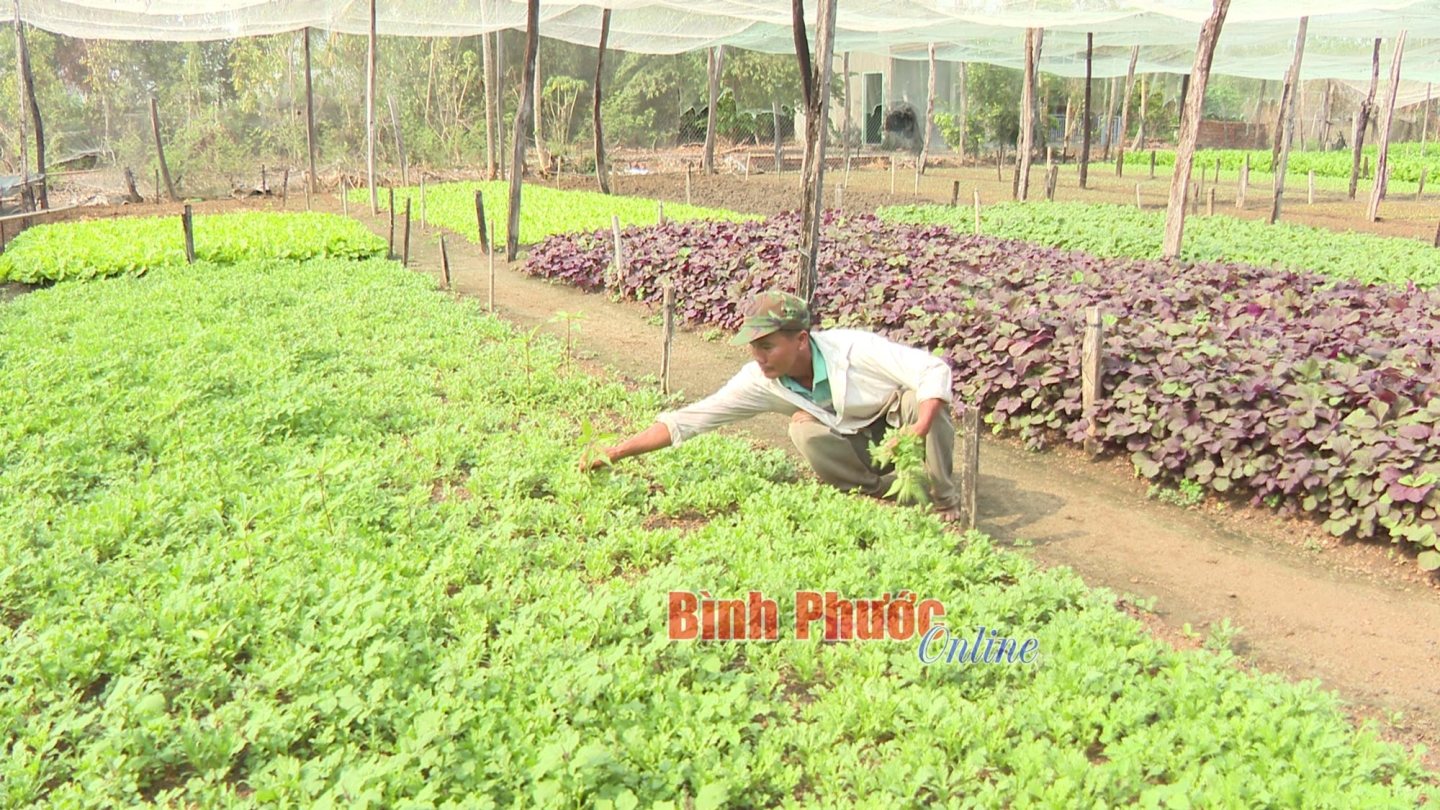
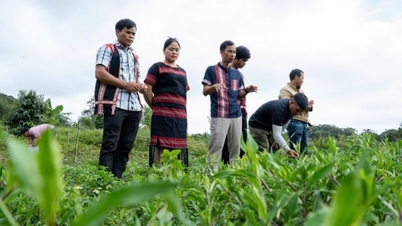
Mr. Tran Van Vien, residing in Thanh Tam hamlet, Thanh Binh town, Bu Dop district (Binh Phuoc province), tends to his family's safe vegetable garden. With this safe vegetable farming business, growing seasonal vegetables, Mr. Vien's family earns an average income of 1.7 million VND per day.
On average, Mr. Sanh sells about 70kg of clean vegetables to wholesale markets every day. All the vegetables he produces are sold immediately; sometimes he doesn't have enough to meet demand.
He is also one of the eight members of the Loc Thai Commune Vegetable Growing Association who received VietGAP certification for 11 types of vegetables, including: sweet cabbage, green cabbage, Chinese cabbage, jute mallow, amaranth, lettuce, chrysanthemum greens, coriander, scallions, mustard greens, and jute leaves. "By adhering to the VietGAP process, we have a safe vegetable garden, ensuring the health of consumers and those directly involved in cultivation," Mr. Sanh affirmed.
Growing safe vegetables is highly economically efficient.
Considered one of the localities with the largest area of safe vegetable cultivation in Bu Dop district, Thanh Tam hamlet, Thanh Binh town, has developed 13 households growing vegetables on approximately 4 hectares. Currently, this safe vegetable growing area mainly produces leafy vegetables such as amaranth, jute mallow, lettuce, herbs, and various types of cruciferous vegetables,...
To produce safe vegetables, farmers adhere to procedures from the very beginning, including soil preparation, planting seedlings in nurseries, using clean water for irrigation, and controlling pests and diseases with biological pesticides.
Ms. Do Thi Sim's family in Thanh Tam hamlet cultivates 4 sao (approximately 0.4 hectares) of vegetables, including about 1 sao of herbs. Each day, she supplies the market with about 150 kg of various vegetables, selling them at prices ranging from 12,000 to 15,000 VND/kg depending on the type; herbs sell for around 30,000 VND/kg.
Ms. Sim always adheres to safe vegetable production procedures. Especially for leafy vegetables, the application of organic and microbial fertilizers must be completed 15-20 days before harvesting. The growth time from planting to harvesting for safe vegetables is 5 days slower than conventionally grown vegetables, but the leaves are thicker, the yield is higher, and they can be stored for 2-3 days without spoiling.
Mr. Tran Van Vien's family in Thanh Tam hamlet has been involved in vegetable farming for over 30 years. With 5 sao (approximately 0.5 hectares) of safe vegetables grown in greenhouses, he harvests 150-200 kg of vegetables daily, bringing his family an income of about 1.7 million VND per day.
According to Mr. Vien, growing vegetables is not difficult, but it requires diligence. Growing safe vegetables requires a meticulous process. In particular, the planting and care process must absolutely not involve spraying pesticides or using chemical fertilizers, but only using microbial fertilizers.
Growing clean and safe vegetables is one of the agricultural economic development goals being implemented and expanded by people in the border district of Bu Dop to increase income and stabilize their lives. Bu Dop currently has 830 hectares of various vegetables, accounting for nearly 20% of the annual crop area; with an average yield of about 80 tons/ha/year of root and fruit vegetables and 200 tons/ha/year of leafy vegetables.
According to Mr. Do Huu Duc, a technical officer at the Agricultural Service Center of Bu Dop district (Binh Phuoc province), in order to help farmers change their perceptions and old farming practices, and grasp new production processes towards safe organic farming, in 2021, the Department of Science and Technology selected the Agricultural Service Center of Bu Dop district to implement the project "Building a specialized area for growing safe organic vegetables" in the district.
Immediately after being selected, the project members proceeded to build 3 model farms, each with a scale of 3,000 m2. At the same time, they trained 120 farmers in the district on organic vegetable farming techniques.
Mr. Do Huu Duc, a technical officer at the Agricultural Service Center of Bu Dop district, said: "Over the past two years, the project 'Building a specialized area for growing safe organic vegetables' has yielded high efficiency, especially in pest and disease control, contributing to the formation of a specialized area for growing safe organic vegetables."
This helps increase vegetable productivity and ensure public health. Specifically, economic efficiency increased by 42.4%, with each household earning an average of nearly 757 million VND/hectare/year, a profit 3-4 times higher than traditional vegetable farming.
In order to improve productivity, product quality, and reduce labor, most vegetable growers in the province are actively applying scientific and technological advancements to production.
However, the biggest challenge is planning concentrated production areas because the farming practices of farmers are still small-scale and fragmented, failing to ensure a stable supply volume for businesses, which would allow for attracting businesses to cooperate and invest in creating supply chains and guaranteeing product sales.
To further develop concentrated, large-scale, high-tech vegetable production areas, all levels of government, sectors, and localities need to support farmers in accessing science and technology, improving management skills to gradually change their mindset and production methods. At the same time, emphasis should be placed on training high-quality human resources and building a team of technical staff with sufficient capacity to adopt and operate the technology.
Source: https://danviet.vn/trong-rau-cai-trong-rau-den-du-thu-rau-theo-mua-mot-nguoi-binh-phuoc-he-di-ngu-la-cat-17-trieu-20241120191911432.htm
![[Image] Vietnam's colorful journey of innovation](/_next/image?url=https%3A%2F%2Fvphoto.vietnam.vn%2Fthumb%2F1200x675%2Fvietnam%2Fresource%2FIMAGE%2F2025%2F12%2F14%2F1765703036409_image-1.jpeg&w=3840&q=75)



















































![[Image] Vietnam's colorful journey of innovation](https://vphoto.vietnam.vn/thumb/402x226/vietnam/resource/IMAGE/2025/12/14/1765703036409_image-1.jpeg)



























Comment (0)