

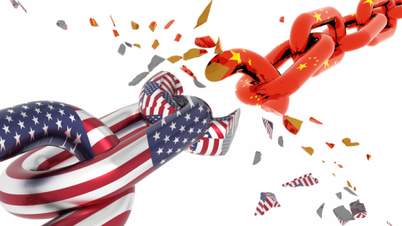
Chinese Premier Li Qiang's European tour is seen by observers as Beijing seeking a shorter path to strengthening ties with its two "big brothers," Germany and France, in the face of increasing pressure from the United States.
For Germany, France, and Europe in general, Chinese Premier Li Qiang's first official foreign visit after the formation of his new government (March 2023) was not only a journey to promote traditional friendship and deepen cooperation, but also a crucial visit to implement the top Chinese leader's proposal to boost the development of China-Europe relations.
Mr. Li Qiang will also pay an official visit to France shortly afterwards and attend the Summit on the New Global Financial Pact (June 22 and 23).
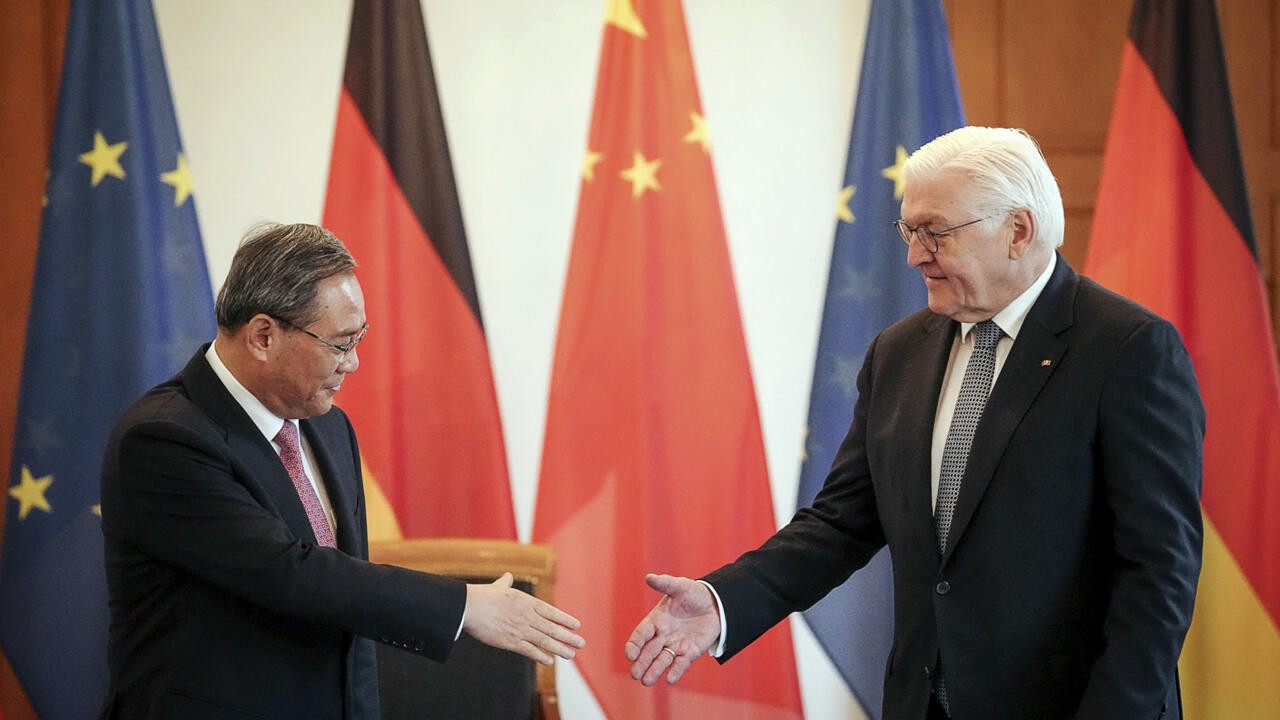 |
| German President Frank-Walter Steinmeier (right) greets Chinese Premier Li Qiang at Bellevue Palace in Berlin, Germany, on June 19. (Source: AP) |
China is prepared to make every effort.
What is even more noteworthy about Prime Minister Li Qiang's visit to the two European powerhouses is that it took place right after French President Emmanuel Macron's visit to China in April and German Chancellor Olaf Scholz's trip to Asia's number one economy at the end of 2022.
The Global Times commented that the event created a rare opportunity to eliminate internal and external influences, and to dispel complex and stereotypical European thinking about China. "Europe should not miss this opportunity," advised the Global Times.
The Chinese newspaper emphasized that this is not a so-called "charm offensive" by China against Europe, and Beijing has never exploited Europe. Simply put, Beijing's genuine and straightforward sentiment is that they genuinely do not want to see a strategic partner, with whom they have no fundamental conflicts of interest, being "shaken" by external influences and irrational internal emotions, leading them down a path that causes harm instead of mutual benefit.
To avoid this situation, China is prepared to make every effort.
And in fact, immediately after arriving in Berlin on Sunday evening (June 18), Premier Li Qiang met with German President Frank-Walter Steinmeier, held talks with German business leaders, and co-chaired the seventh China-Germany intergovernmental consultation with German Chancellor Olaf Scholz.
The Chinese Premier directly conveyed the goodwill and sincerity of the Northeast Asian nation, while explaining Beijing's views on a range of major issues. Premier Li Qiang highlighted that there are no fundamental conflicts of interest between China and Germany; the greatest risk between the two countries is a lack of cooperation, and the greatest security threat is a lack of development.
Li Qiang affirmed that the seventh Sino-German intergovernmental consultation was the first comprehensive connection since the new governments of the two countries were formed, and Beijing is ready to have frank and in-depth exchanges with Berlin on the basis of mutual respect, seeking common ground, setting aside differences, and mutual benefit.
From there, both sides delved deeper into exploring cooperation potential, resolving disagreements and differences amicably, enriching the substance of the comprehensive strategic partnership between the two sides, and sending a positive and strong signal about maintaining the stability of international production and supply chains as well as world peace and prosperity.
These efforts appear to have had a positive effect. The most direct manifestation of the visit is that European public opinion regarding China has become more pragmatic and rational, at least in the short term. Business leaders, in particular, have become especially enthusiastic. Chancellor Scholz stated that Germany rejects any form of decoupling and risk reduction, but not "separation," from China.
According to reports, the two countries have signed more than 10 cooperation agreements in areas including advanced manufacturing and environmental protection, while also fostering further consensus on cooperation in addressing climate change and promoting green development, among other fields.
This realistic message has boosted confidence that China-Europe relations and substantive cooperation between the two sides still have bright prospects.
Previously, observers suggested that relations between China and Europe had shown signs of strain. Chinese direct foreign investment in Europe in 2022 reached over $8.6 billion, down 22% from 2021 and the lowest level in a decade, according to the New York-based consulting firm Rhodium Group.
Germany, Europe's industrial powerhouse, has in recent months shifted its trade flows away from China and toward the United States. German exports to China fell 12% in the first three months of this year, to just over $26 billion. Meanwhile, German exports to the US increased 14% during the same period, to over $43 billion, according to the German Federal Statistical Office.
The Global Times emphasizes that, without a doubt, there are differences between China and Europe on a number of issues, some old and some new. The biggest obstacle is certainly at the political and ideological level, and some anti-China forces will not miss any opportunity to stir up trouble. We must do our best, but we must also be prepared to "embrace" the complexities and twists and turns in current and future China-Europe relations.
In reality, the label of "soft on China" remains a difficult obstacle for most politicians in some European countries to overcome. This can put them in a politically passive position, so they often choose to satisfy populist sentiments. They may also have to compromise, which will certainly create unnecessary difficulties for China-Europe relations.
Have China and Europe grown closer?
In theory, misunderstandings and misconceptions can mostly be resolved through enhanced communication and exchange, a principle Beijing is striving to apply in its relations with Berlin. During this European visit, the Chinese Premier made efforts to express goodwill and strengthen communication and exchange. In response, Li's message that "the greatest risk is non-cooperation and the greatest potential security danger is lack of development" received considerable attention in Europe.
So, does this mean that the path to developing China-Europe relations is getting shorter?
It seems that Europe's biggest challenge right now isn't whether or not to cooperate with China, but rather where to find that cooperation.
A Chinese newspaper commented that Beijing will remain concerned that, once mutually beneficial cooperation is replaced by politicization, ideology, and comprehensive security, the cooperative environment will inevitably be affected, and the scope of cooperation will be significantly narrowed, whether both sides want it or not.
From that perspective, Europe needs to clarify its understanding, because missing opportunities means non-cooperation, instability, and reduced development, the Global Times stated.
Beijing is changing, Europe is changing, and so is China-Europe relations. China-Europe relations are not about going back to the past, nor can they go back to the past; they are about moving forward.
Moving forward requires a joint effort from both sides to continuously manage change. While the key to mastering change lies in adhering to key principles that will foster stable cooperation—the principles of mutually beneficial collaboration, seeking common ground, but preserving differences and treating each other equally—are inviolable elements.
As long as these principles remain unchanged, the future of China-Europe relations is still promising.
Source
![[Photo] Closing Ceremony of the 10th Session of the 15th National Assembly](/_next/image?url=https%3A%2F%2Fvphoto.vietnam.vn%2Fthumb%2F1200x675%2Fvietnam%2Fresource%2FIMAGE%2F2025%2F12%2F11%2F1765448959967_image-1437-jpg.webp&w=3840&q=75)
































![[OFFICIAL] MISA GROUP ANNOUNCES ITS PIONEERING BRAND POSITIONING IN BUILDING AGENTIC AI FOR BUSINESSES, HOUSEHOLDS, AND THE GOVERNMENT](https://vphoto.vietnam.vn/thumb/402x226/vietnam/resource/IMAGE/2025/12/11/1765444754256_agentic-ai_postfb-scaled.png)




































Comment (0)