

Ecosystems not only provide habitats for living organisms but also generate many essential benefits for humans and the economy , from food and clean water to building materials, medicinal plants, climate regulation, and land and water resource protection.
However, over the years, Vietnam's natural ecosystems have been under immense pressure from land-use change, overexploitation of resources, environmental pollution, and the invasion of alien species.
In response to this reality, the Institute of Surveying and Mapping Science has intensified research and application of geospatial data analysis technology, integrating GIS, remote sensing, and quantitative models to quantify ecosystem services (ES), contributing to providing scientific databases for land use planning, water resources, and guiding the development of green agriculture . This is clear evidence of the role of science and technology in implementing Vietnam's green growth goals.
Ecosystem services are understood as the benefits that humans receive from the natural processes of an ecosystem, including provision, regulation, cultural, and support services. Evaluating these services helps raise public awareness and support the implementation of conservation policies, especially in the context of Vietnam's implementation of the National Strategy on Green Growth, the National Strategy on Biodiversity, and numerous international commitments on sustainable development.
The valuation of ecosystem services is also an important basis for integrating environmental values into the socio-economic development planning process, and supports the identification of priority areas for protection, restoration, and sustainable exploitation of biological resources.
The data used for evaluating ecosystem services is diverse, including geographic databases, topographic maps, soil maps, geological maps, land use maps, forest status maps, geomorphological maps, hydrological maps, climatic maps, remote sensing images, and ecological-environmental data. Of these, remote sensing data plays a leading role due to its broad scope, rapid update times, and high objectivity.
By analyzing vegetation indices such as NDVI, EVI, digital elevation models, land cover information, and surface temperature, scientists can assess the availability of food, energy, and clean water; estimate forest biomass; predict species distribution and biodiversity levels; and identify areas vulnerable to erosion, flooding, or land degradation.
Regulatory services, such as water purification, climate regulation, or disaster risk reduction, are also estimated through the combination of multitemporal remote sensing data with ecological models and hydrological simulations.
In the support services and cultural sector, overlay data and ecological indicators help identify areas with high landscape value, potential for ecotourism development, or those associated with natural heritage sites.
Data derived from geospatial analysis plays a crucial role in the entire ecosystem service evaluation process. This data enables the standardization, synchronization, and automation of many evaluation steps, minimizing reliance on traditional surveys which are costly and prone to errors.
When integrated with GIS models, the derived data helps analyze ecosystem structure, simulating ecological flows such as water storage and drainage, carbon sequestration, land cover changes, or habitat boundary shifts. Monitoring changes over time helps detect degradation risks early, thereby supporting management agencies in making sound conservation or resource management decisions.
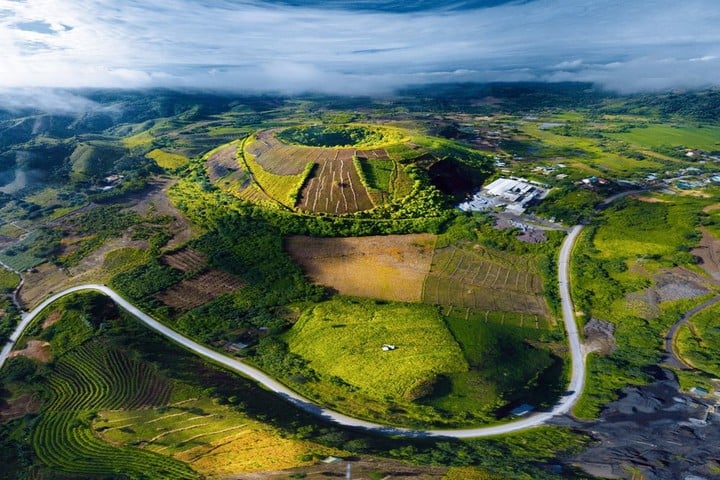
One of the typical applications of the Institute of Surveying and Mapping Science is the result of the project "Research on developing technological processes and technical guidelines for creating maps of natural ecosystem service supply areas based on satellite data and geographical-landscape data".
In Ninh Binh province, the integration of remote sensing data, field surveys, and spatial analysis has helped identify three main ecosystem groups: wetland ecosystems, which account for over 47% of the province's total area; marine ecosystems; and rocky mountain-cave ecosystems. Based on this, thematic maps reflecting the service provision capacity of each ecosystem group have been developed, serving planning, resource management, and conservation efforts. This is an important prerequisite for standardizing ecosystem service maps at the provincial level nationwide, and also serves as a basis for implementing ecosystem service payment policies in the future.
The research results not only improve the efficiency of environmental management but also contribute to the digital transformation of the natural resources and environment sector.
The application of remote sensing, big data, and GIS in the evaluation of ecosystem services reflects the inevitable trend of modern resource management, based on data and scientific evidence. To further enhance effectiveness, stronger investment is needed in digital data infrastructure, satellite systems, and data processing technology; while also strengthening coordination among state management agencies, research institutes, businesses, and the community in data sharing, technology transfer, and human resource training.
Green transformation is not only a national commitment but also the path to sustainable development for Vietnam in the coming decades. Integrating the results of ecosystem service valuation into socio-economic development planning, nature conservation strategies, and green agriculture programs will help ensure harmony between economic growth and environmental protection.
The application of geospatial data analysis in the valuation of ecosystem services is therefore not only a technical solution, but also a crucial driving force in promoting the achievement of green growth goals, creating a foundation for a sustainable economy, effectively adapting to climate change, and moving towards a prosperous future for Vietnam.
Source: https://mst.gov.vn/vai-role-phan-tich-du-lieu-khong-gian-dia-ly-197251210185832286.htm














![[Video] The craft of making Dong Ho folk paintings has been inscribed by UNESCO on the List of Crafts in Need of Urgent Safeguarding.](https://vphoto.vietnam.vn/thumb/402x226/vietnam/resource/IMAGE/2025/12/10/1765350246533_tranh-dong-ho-734-jpg.webp)


















































Comment (0)