In the ever-changing landscape of the digital age, reading culture is no longer confined to reading physical books but is expanding to many new forms of access such as e-books, audiobooks, and online reading applications. However, no matter how the methods change, the core values of reading culture – nurturing thinking, cultivating character, and creating a foundation of knowledge – will always be preserved.
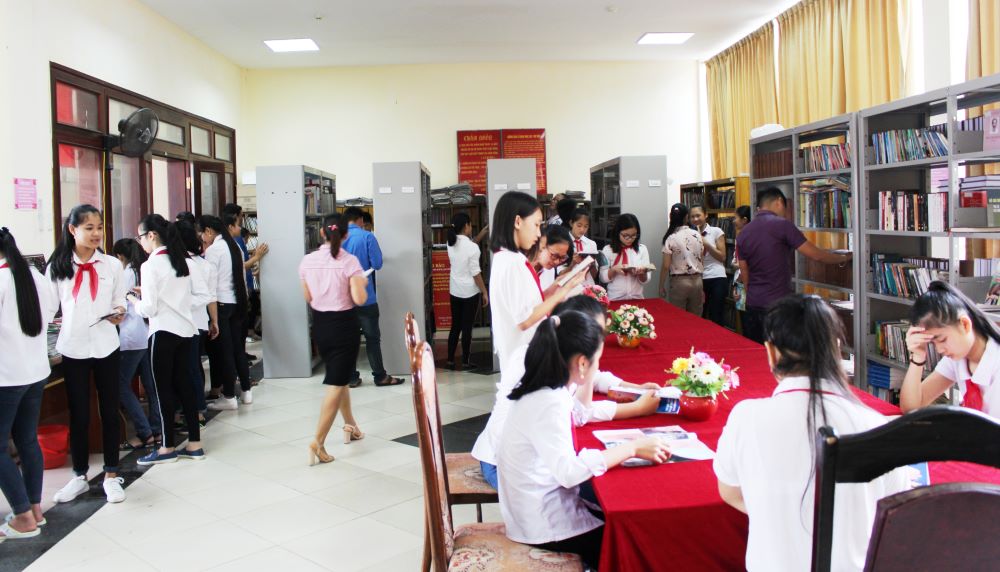
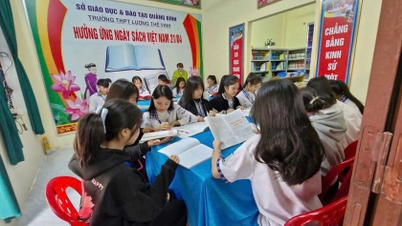
Reading books at the Dam Ha District Library ( Quang Ninh Province). Photo: HĐH
A long-standing tradition
The Vietnamese people have long had a tradition of valuing literacy and loving books. The image of a teacher at his desk, and students diligently reading from thin pages, encapsulating the aspirations for a better life through literacy, has been etched in the memories of many generations. Reading culture was once a source of pride for many families and clans, nurtured through small bookshelves and bedtime stories.
However, with the rapid development of technology, especially the explosion of social media and mobile devices, reading habits are facing many challenges. Young people are increasingly drawn to short, quick, and easily digestible content – but also easily forgotten, lacking depth and critical thinking.
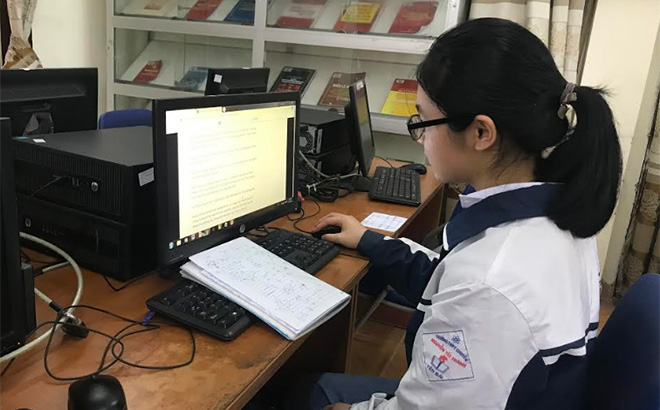
The Yen Bai Provincial Library has boosted the operation of its internet access room to serve the needs of readers in the digital age. Photo: Yen Bai Newspaper
Reading culture in the digital age
Dr. Vu Thuy Duong, Head of the Publishing Department at the Academy of Journalism and Communication, stated: "We are living in an era where information is always readily available, but that doesn't mean readers are becoming more insightful. Reading culture isn't just about what you read, but more importantly, how you read—to understand, to critically analyze, and to develop."
She also argued that the publishing industry is facing a strong demand for innovation to adapt to the new era. Undeniably, formats such as e-books, audiobooks, and digital reading platforms are opening up opportunities for easier and more flexible access to knowledge, especially for the younger generation – who are more attached to smartphones than to paper books.
However, according to Ms. Duong, maintaining a sustainable reading culture requires close cooperation between families, schools, media agencies, and public policies. "We cannot expect children to love reading if there are no books at home, if their parents don't read; or if school libraries are empty and teachers don't encourage reading beyond textbooks," Ms. Duong said.
Ms. Nguyen Thi Hoa (75 years old, retired official, Hanoi ) shared: “I still maintain the habit of reading physical books and newspapers every day, even though there are so many e-books now. The feeling of holding a book, smelling the new paper, turning each page one by one, is like having a close friend throughout my life. Books teach me how to be a good person, help me understand the past, appreciate the present, and hope for the future. I always teach my grandchildren that reading is a way to slow down, think more deeply, and love more.”
According to Tran Gia Han (19 years old, Information Technology student at the University of Technology - Vietnam National University): “The digital age makes accessing books easier than ever before; with just a few taps, I can read thousands of books on my phone. But I think reading culture isn't just about reading a lot, but about reading selectively and reflecting on it. Social media brings information quickly, while books give me a solid foundation. No matter how technology changes, the habit of reading deeply and thinking carefully is something I want to preserve.”
Although reading formats have changed, from paper books to e-books, reading culture retains its core values: nurturing knowledge, developing critical thinking, and connecting people with the world . Whether young or old, reading remains a journey of discovery and continuous growth.

The "Every young person a book as a companion" program was organized to raise awareness of the value of reading culture. Photo: CP Newspaper
Read to grow
Reading culture is not just a personal matter. It is the foundation for building a learning society and a knowledge-based economy. A nation that wants sustainable development needs citizens who know how to receive and process information scientifically, who possess critical thinking skills, and who are adaptable – qualities that largely come from reading.
In fact, many countries have considered developing a reading culture as a national strategy. In Vietnam, the Vietnam Book and Reading Culture Day (April 21st), established in 2014, has become an occasion to honor the value of books and encourage reading in the community. Many localities, schools, libraries, etc., organize book fairs, reading festivals, and book storytelling competitions – contributing to fostering a love of books from an early age. However, challenges remain: the reading rate in the community is still low; there is a disparity in access to books between different regions; there is a lack of good, high-quality books; and the phenomenon of rampant publishing and commercialization distorts the true value of books.
Photo: Nghe An
The digital age presents challenges, but also great opportunities for reading culture to enter a new phase. Modern technological platforms can absolutely become tools for spreading reading culture if properly guided. And above all, reading culture needs to originate from each individual – from choosing to read instead of browsing the internet, from moments of contemplation with a book instead of quickly skimming through brief news articles.
Reading is not about competing, but about understanding oneself, understanding life, and continuously growing intellectually. Because a strong nation cannot be strong only economically, but must also be strong in spirit and knowledge – and that begins with the quiet yet profound pages of books.
The Resolution of the 13th National Congress of the Communist Party of Vietnam clearly stated: "Developing well-rounded individuals and building an advanced Vietnamese culture imbued with national identity so that culture truly becomes an intrinsic strength, a driving force for national development and defense." Therefore, building a culture, including a reading culture, that is inclusive of the entire population and society is a task that "needs to be done immediately."
Source: https://thanhtra.com.vn/an-sinh-AFA9C5670/van-hoa-doc-nen-tang-tri-thuc-cua-mot-xa-hoi-phat-trien-d8caa5504.html



![[Photo] First session of the 14th Congress of the Vietnam Trade Union](https://vphoto.vietnam.vn/thumb/1200x675/vietnam/resource/IMAGE/2026/06/03/1780465947883_ndo_br_img-3852-jpg.webp)


![[Photo] General Secretary and President To Lam presides over a meeting with the Central Organizing Committee.](https://vphoto.vietnam.vn/thumb/1200x675/vietnam/resource/IMAGE/2026/06/03/1780482764658_a1-bnd-4741-3342-jpg.webp)
![[Photo] Secretary of the National Assembly Party Committee, Chairman of the National Assembly presides over the meeting of the Standing Committee and Executive Committee of the National Assembly Party Committee.](https://vphoto.vietnam.vn/thumb/1200x675/vietnam/resource/IMAGE/2026/06/03/1780480353201_ndo_br_bnd-2585-jpg.webp)









































![[Video] Sunset at Lap An Lagoon – Where the sun sets over the fishing nets](https://vphoto.vietnam.vn/thumb/1200x675/vietnam/resource/IMAGE/2026/05/31/1780192137701_beach-landscape-sea-water-nature-grass-745871-pxhere-com.jpeg)




































Comment (0)