

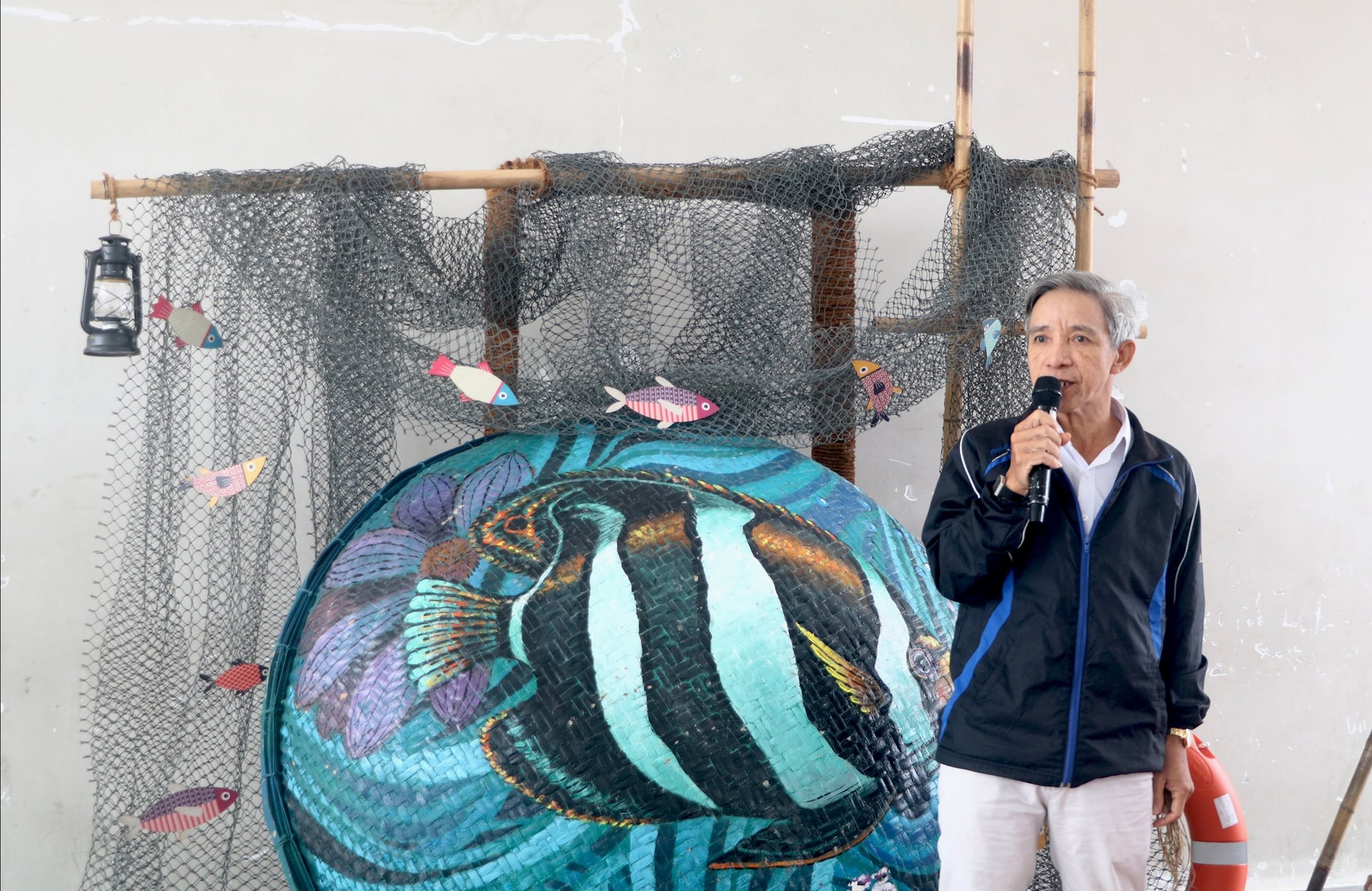
The soul of the sea, the soul of the fishing net.
From its early days as a small fishing village nestled at the foot of Son Tra mountain, Tan Thai has been inextricably linked to net weaving as an essential part of life. In the recollections of Mr. Huynh Van Muoi (Son Tra ward), every morning, the men of the area would set sail in their boats.
And in the low houses with thatched roofs, the sounds of spinning, knotting, and the lively laughter and chatter of mothers and sisters echoed leisurely, steadily, and persistently, like the eternal rhythm of the sea.
Back then, no one called net weaving a profession. For the fishermen of Tan Thai village, it was a necessary task to create fishing gear and a natural skill that flowed in the blood of those born and raised by the sea.
From young children to the elderly, everyone knows every mesh and every seam by heart. On those calloused hands are the marks of years of earning a living, of bustling fishing seasons and sleepless nights spent mending nets for the next morning's fishing trip.
Mr. Mười recounted that the fishing nets of those days didn't have the sheen of nylon or the smoothness of regular nylon threads like they do now. That's because the nets were woven from thorny plants, a wild plant with a stem covered in sharp thorns, but inside it yielded a strong, durable fiber, reflecting the resilience of the people who live by the sea.
Every day, the locals harvest hemp plants, strip the bark, soak them in water, dry them in the sun, and then rub them to soften them. Under the skillful hands of the men and women of the coastal village, these rough hemp fibers are gradually joined together, twisted into long, smooth strands, and rolled into large and small coils to weave nets. Thus, "hemp nets" and "hemp fishing nets" were born, becoming names associated with the early days of fishing for the fishermen.
“Hemp nets may look rustic, but they are very durable at sea. Each mesh is regular and sturdy. After each fishing trip, people often shake out the nets and hang them to dry in the sun on the sandy slopes. Later, when new materials appeared, hemp nets gradually faded into the past, remaining only in the memories of veteran fishermen,” Mr. Mười shared.
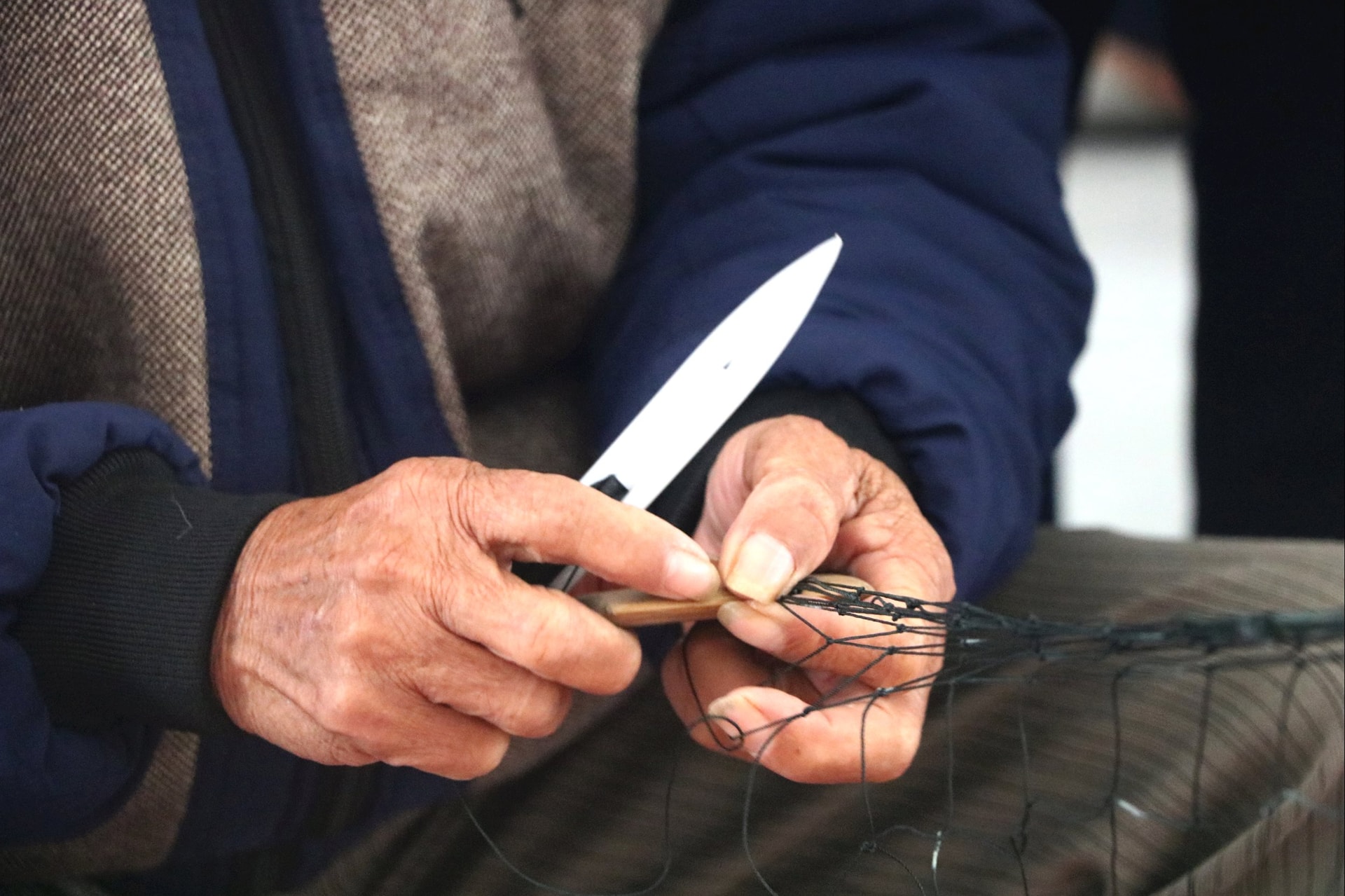
Photo: VAN HOANG
...gradually fading into memory
After the era of barbed nets, nets made of new materials gradually appeared in the lives of fishermen in Tan Thai village. However, the net-weaving technique did not change accordingly.
Having lived in Tan Thai fishing village for many years, "veteran fisherman" Nguyen Dang Hiep (Son Tra ward) demonstrated the net-weaving technique for us to observe. Mr. Hiep explained that to weave a handcrafted net, fishermen must know how to use pins and a "nây" (also known as a "cự").
These are indispensable tools, among which the "pin" is a small, sharpened bamboo or wooden shuttle used to secure the thread. The "nây" is a flat ruler used to measure the mesh size, which varies depending on the fishing method.
But most importantly, the weaver must understand the steps such as: tying the top knot, tying the bottom knot, threading the net, securing the lead weights… Thus, with one hand holding the "weight" and the other threading the pins, the movements of threading, tightening, and knotting… all occur according to the weaver's own rhythm.
“The fishing line, though seemingly lifelike, seems to possess a soul in my hands, moving swiftly like weaving the rhythm of the sea. Before you know it, the net is formed from the spool of line. But no matter what, the net maker must be patient, tighten the mesh, and remember the principle of 'floats on top' and 'lead weights underneath' to create a perfect and beautiful net,” Mr. Hiep said.
A skilled craftsman needs a considerable amount of time to complete a single mesh screen. Therefore, hand-woven mesh screens are very valuable, ranging from 10 million to tens of millions of Vietnamese dong.
While trawl nets (used for near-shore fishing) with machine-woven nets, where the fishermen only attach floats and weights, cost only about 3.5 - 4 million VND per net, the value of handcrafted nets has been left behind by the market and technology, and few people are interested in them anymore.
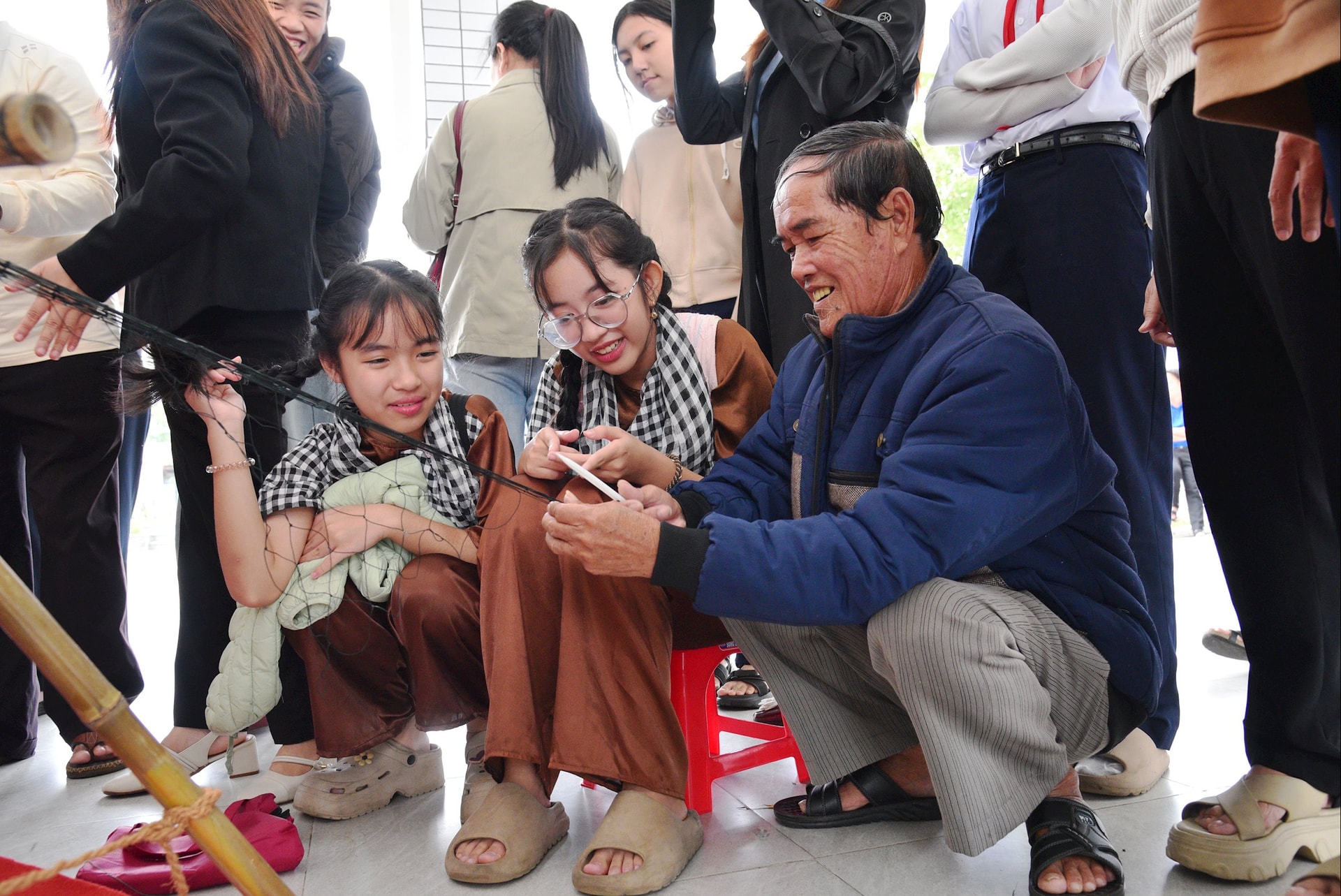
According to Mr. Hiep, compared to many other localities, the craft of net weaving in Son Tra seems to be falling into oblivion. The hands that were once patient and skillful now only sporadically perform small steps of the once-successful craft, such as attaching lead weights or floats.
In the golden twilight that bathed the sandy beach, the waves still lapped rhythmically, but the rustling sound of net weaving now only echoed in the memories of the elderly. Occasionally, when someone called for mending nets, memories of the seafaring profession and the skillful hands of their ancestors would come alive once again.
For Mr. Hiep, Mr. Muoi, and other elderly veterans in Son Tra, each mesh of the fishing net, each knot, is living proof of the diligence, skill, and love of the sea that the people possess. But now, it only exists in stories and in the eyes of those who still remember…
Culture will fade away if it is not preserved. Young people will never understand how our ancestors connected their lives to the sea. Therefore, I am passionate about sharing the story of maritime culture with everyone. I hope the city will soon have a maritime culture museum to preserve the soul of the village within the city.
Mr. Huynh Van Muoi, Son Tra Ward, Da Nang City
Source: https://baodanang.vn/ve-tan-thai-nghe-chuyen-luoi-bien-3312645.html

![[Photo] “Red Journey” 2026: Vietnamese Youth Continue Building the Bridge of Friendship Between Vietnam and China](https://vphoto.vietnam.vn/thumb/1200x675/vietnam/resource/IMAGE/2026/04/20/1776629730866_4055880775670638308-9618-4200-jpg.webp)


















































































Comment (0)