

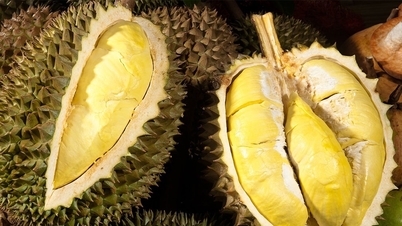
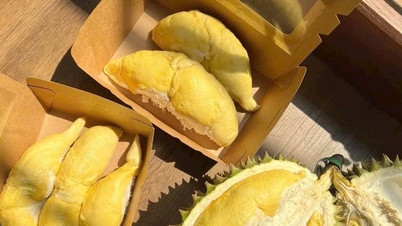
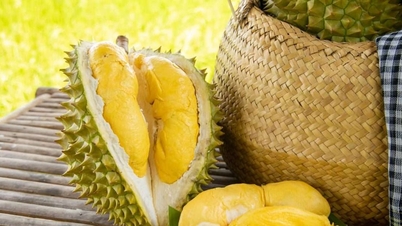
| New competitor for Vietnamese durian in the Chinese market; Vietnamese durian exported to the EU is subject to residue testing at border crossings. |
Mr. Ngo Xuan Nam, Deputy Director of the National Notification and Inquiry Point Office on Sanitary and Phytosanitary Measures of Vietnam (Vietnam SPS Office) under the Ministry of Agriculture and Rural Development, had an exchange with reporters and the press regarding this issue.
Recently, information about durian has surfaced. For the first time, Vietnamese exports to the EU are subject to residue testing at border crossings with a frequency of 10%. Could you share more details about this?
According to EU regulations, the European Parliament meets with relevant parties every six months to increase or decrease the frequency of border checks on agricultural products, food, and animal feed from third countries when importing goods into the EU market. This is an EU regulation and is applied regularly.
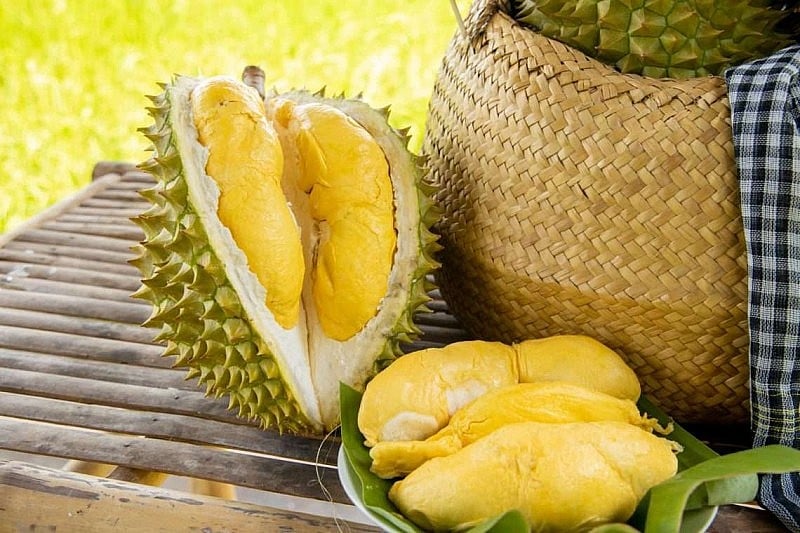 |
| Vietnamese durian exported to the EU is subject to weight checks right at the border. |
Based on export data from third countries to the EU, violations may result in the EU placing the goods in Annex 1 (border controls) or increasing the inspection frequency to 10%, 20%, 30%, 50%, or even up to 75%, or transferring them to Annex 2 (an annex requiring a certificate of analysis from samples taken before importation into the EU). Alternatively, the EU may remove the goods from the border inspection list and not require a food safety certificate or sample analysis before importation if the goods meet quality standards.
All third countries exporting goods to the EU must comply with this regulation.
Regarding the latest notification from the European Commission to the Secretariat of the World Trade Organization (WTO), I would like to reiterate that this is a notification from the European Commission to the WTO Secretariat to inform all WTO members to comply, and not a warning from the EU regarding agricultural products from other countries when imported into the EU.
Regarding this announcement, Vietnam has five items subject to EU controls when imported into the EU market. Specifically, in Annex 1, items subject to border inspection frequency include: bell peppers with a 50% border inspection frequency; and instant noodles with a 20% border inspection frequency. These two items were already subject to regulations in 2023. In 2024, the announcement remains unchanged according to the old regulations.
This Appendix 1 includes durian as an additional item, with an inspection frequency of 10%.
According to Annex 2, for agricultural and food products, in addition to border inspection frequency, certification of sampling and analysis results as required by the EU is also required. Vietnam has two items, okra and dragon fruit, with corresponding percentages of 50% and 20%. These two items are also included in the announcement for the last six months of 2023.
Thus, compared to the announcement for the last six months of 2023, we have four items including okra, instant noodles, bell peppers, and dragon fruit that maintain the same inspection frequency as before. Only durian has had its inspection frequency increased by 10%.
What is the reason why Vietnamese durian is being placed under border control this time, sir?
According to statistics from the Vietnam SPS Office, in the last six months of 2023, Vietnam unfortunately had only 3 shipments of durian that violated EU regulations. Therefore, the EU has placed them under control with a frequency of 10%.
Therefore, out of a container containing 100 cartons, the EU will randomly sample 10 cartons to test for pesticide residue levels according to EU regulations.
Will the increased controls on durian this time affect agricultural exports to the EU market, sir?
I believe this will not significantly affect the goods because in agricultural trade, border control for all agricultural products is perfectly normal. Even in Vietnam, when we import agricultural products and food, we control them according to Vietnamese law.
This is similar to other markets; they also have regulations to control goods at the border, at the customs checkpoint, or while the goods are circulating in the importing country's market.
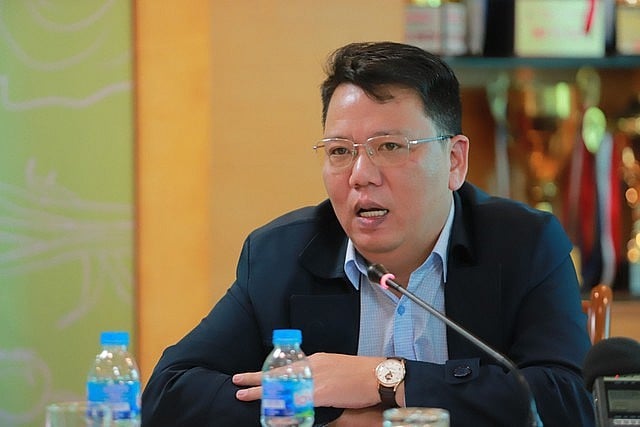 |
| Mr. Ngo Xuan Nam - Deputy Director of SPS Vietnam Office |
Regarding Vietnamese durian, we believe that Vietnam has done well in food safety recently. Numerous conferences, workshops, and programs have been held to advise farmers, cooperatives, and businesses to comply with market regulations throughout the entire process, from cultivation and agricultural practices to processing and packaging.
However, it is possible that the three durian shipments detected in the last six months of 2023 may have been due to negligence in our control process and violations of EU regulations, leading to the EU increasing the frequency of border checks to 10%.
However, if businesses and cooperatives coordinate and cooperate with each other in effectively controlling pesticide residue levels in durian in particular and agricultural products in general, I believe that in the last six months of 2024, the EU will be able to consider removing durian from this 10% inspection frequency list.
In fact, Vietnam still has 5 items under EU control. In your opinion, what are the solutions to gradually remove these items from the control list?
Previously, many of our products were subject to EU controls with relatively high border inspection frequency. However, by 2022, thanks to the efforts of agencies, businesses, and especially the farmers' effective control of pesticide residue levels, several Vietnamese vegetables and spices were completely removed from Annex 1 of the border inspection frequency list by the EU.
Therefore, we now only have four items from the previous phase left, plus durian. To gradually remove these items from the list of controlled items, we believe that, first and foremost, farmers need to strive to comply with EU regulations on pesticide control during their cultivation process.
During cultivation, farmers need to be aware of and thoroughly understand the active ingredients that the EU does not allow. For active ingredients that the EU or Vietnam allows, we must adhere to the "four correct principles" during cultivation. At the same time, actively transitioning to organic farming and using biological active ingredients and preparations will better meet market demands.
In addition, coordination and cooperation from local authorities and businesses are crucial. Currently, not only in the EU market but in most markets, if a business violates regulations or receives a warning, it will affect the entire Vietnamese agricultural sector.
Because if we don't manage it well, in the next six months, the EU could consider adding durian to Appendix 2 – meaning that in addition to the 10% border inspection frequency, Vietnamese durian would also be required to provide additional certificates for sampling and analysis of durian samples, which would be sent with the shipment when exported to this market. This would be costly for businesses.
Therefore, businesses need to be aware of international rules, especially with the EU market. Not only durian, but all Vietnamese agricultural and food products exported to other countries must comply with regulations on food safety and disease control. This will prevent being placed on control lists, increased border control frequency, and additional procedures and certifications, which would be costly for businesses.
Thank you, sir!
Source link















































































Comment (0)