

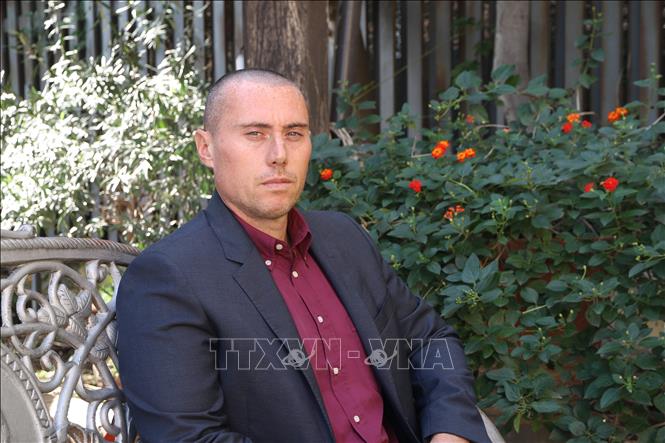
Mr. Stefano Bonilauri, Director of Anteo Edizion publishing house in Reggio Emilia, northern Italy, answers questions from a Vietnam News Agency (VNA) reporter. Photo: Thanh Hai/VNA correspondent in Italy.
During the conversation, Mr. Bonilauri offered insightful observations and emphasized the immense political significance of the historic victory on April 30th for the destiny of Vietnam as well as the revolutionary movement worldwide. Mr. Bonilauri stated that the event of April 30, 1975, marked the end of years of almost continuous war, during which the Vietnamese people were forced to confront three of the world's most powerful armies: first, the Japanese fascists in World War II; then, the French colonialists until 1954; and finally, the American imperialists. Not only the entire Vietnamese people, but also people around the world, youth, and anti-imperialists—forces that for many years had strongly fueled the solidarity movement with the Vietnamese liberation struggle—shared their joy in the victory at that momentous occasion.
During the first four decades of building socialism, in addition to national reunification, Vietnam achieved tremendous successes such as developing productive forces and universalizing primary and secondary education . However, advancing towards socialism also means knowing how to innovate and adapt to the times, eliminating all dogmatic ideologies, and, when necessary, engaging in self-criticism. In that spirit, the Sixth National Congress of the Communist Party of Vietnam highlighted limitations and shortcomings, while also identifying the remaining causes, thus initiating the Doi Moi (Renovation) period.
This capacity for self-criticism and innovation helped Vietnam overcome the crisis of the following years and develop successfully. Vietnamese socialism continues to achieve significant accomplishments, but the path to socialism is long and arduous. Only by maintaining the spirit of self-criticism and resolute innovation, considering the people as the end, not the means, can Vietnam continue on the socialist path that its people chose 80 years ago.
According to Mr. Bonilauri, the spirit of national unity not only led to the historic victory of April 30, 1975, but also played an extremely important role in the building and development of Vietnam. On May 10, 1969, about four months before his death, President Ho Chi Minh wrote in his will: “My last wish is: that the entire Party and all the people of Vietnam unite and strive to build a peaceful , unified, independent, democratic, and prosperous Vietnam, and make a worthy contribution to the world revolutionary cause.” To this day, thanks to the victory of April 30, 1975, the Socialist Republic of Vietnam continues to steadily advance on this path.
Similarly, following the victory of April 30th, the most prominent example of the skillful combination of military art and diplomacy was the "bamboo diplomacy," that is, Vietnam's ability to maintain positive bilateral relations with all world powers without submitting to them. Vietnam balanced various competing geopolitical forces, pursuing national interests through balanced relationships with all major powers without creating any form of dependence.
According to Mr. Bonilauri, to address current challenges in the context of the digital economy and the Fourth Industrial Revolution, Vietnam must always place national interests and the interests of its people at the center of all actions. By following this path, Vietnam can overcome all difficulties in a complex international context.
Regarding the lessons of the April 30th victory, Mr. Bonilauri stated that, first and foremost, it highlighted the Vietnamese people's unwavering determination to resist. Despite significant disadvantages in equipment and technology, the Vietnamese people demonstrated steadfast resolve to defend their country and national independence. This proved that the will of the people can overcome even the greatest power imbalances, creating immense confidence for other nations in Asia and Africa, which were then engaged in the struggle for decolonization and national independence.
Duong Hoa - Truong Duy - Thanh Hai (VNA)
Source: https://baotintuc.vn/phan-tichnhan-dinh/y-nghia-chinh-polit-sau-sac-cua-chien-thang-304-qua-goc-nhin-cua-chuyen-gia-italy-20250331150845160.htm







































































Comment (0)