

Despite not experiencing the price surges seen in coffee, pepper, or rice, Vietnam's cashew industry quietly achieved a record export value of $4.34 billion in 2024, while maintaining its position as the world's number one supplier for 18 years.
Lesson 1: The spectacular breakthrough of the 'fruit king', Vietnamese fruits and vegetables rapidly reach a record
Lesson 2: Vietnamese coffee becomes 'ATM' earning billions, most expensive in the world
Editor's note: 2024 is a 'bumper harvest' year for Vietnam's agricultural sector. Many traditional industries will regain their position, earning record amounts of foreign currency. Farmers in many places have changed their lives thanks to this. In addition, there are new industries that also have bright prospects for acceleration.
Join VietNamNet in looking back at the bright picture of Vietnam's agricultural sector last year with the belief in a breakthrough year in 2025 through the series of articles 'The Road to Records of Vietnamese Agricultural Products'.
Set a historical record, regain the billion-dollar trade surplus position
According to statistics from the General Department of Customs, in 2024, Vietnamese businesses exported more than 723,800 tons of cashew nuts, earning $4.34 billion, an increase of 12.4% in volume and a sharp increase of 19.2% in value compared to the previous year. This is a record high since Vietnamese cashew nuts entered the international market.
Over the past 30 years, exports of this super-nutritious seed have maintained steady growth over the years. Notably, the turnover of 520 million USD in 2006 made Vietnam the world's number 1 cashew exporter. By 2010, this item earned 1 billion USD for the first time, joining the "billion dollar club" of the agricultural sector.
Subsequently, cashew exports surged from $2.84 billion in 2016 to $3.36 billion in 2018. During the 2019-2020 period, export turnover tended to stagnate and slightly decline. However, for three consecutive decades, Vietnam's cashew industry has consistently maintained a trade surplus.
At the end of 2021, cashew exports still set a record of 3.64 billion USD, up 12.9% compared to 2020. However, for the first time in history, the Vietnamese cashew industry fell into a trade deficit when it spent up to 4.185 billion USD to buy 2.87 million tons of raw cashews from other countries.
In 2022, despite regaining its trade deficit position, cashew exports only reached $3.08 billion. In 2023-2024, cashew exports returned to strong growth and, for the first time in history, exceeded $4 billion, with a trade surplus of $1.12 billion.
Mr. Tran Huu Hau - Deputy General Secretary of the Vietnam Cashew Association - acknowledged that in 2024, despite facing many difficulties in terms of crops and markets, cashew nut exports still set a record. Vietnam continues to be the world's largest cashew nut exporter (for the 18th consecutive year) and accounts for over 80% of the total global cashew nut export output.
In recent years, this strength of Vietnam has confidently shouted the slogan: "When talking about cashews, think of Vietnam".
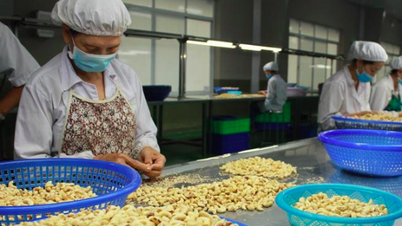
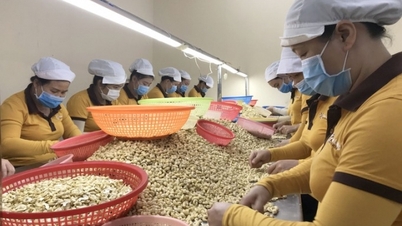
Because the biggest advantage of the Vietnamese cashew industry is the most advanced processing technology in the world, produced by Vietnamese people. With about 500 manufacturing and processing enterprises, a capacity of about 4 million tons of raw cashews per year, our country's cashew nuts are on the shelves of 90 countries and territories.
Notably, Vietnamese cashews account for 80-99% of the total import value of countries such as the US, Australia, China, and the Netherlands. In 2024, the US alone spent nearly $1.2 billion to purchase this super-nutritious nut from Vietnam.
Seize the opportunity to accelerate
According to the Vietnam Cashew Association (Vinacas), for many years, Vietnam has been leading the global cashew supply and value chain. The quality of cashew nuts grown in Vietnam is also the best.
The opportunity for the Vietnamese cashew industry to accelerate is also opening up as the growth driver of the cashew market is the development of the food processing industry, driven by urbanization, changing consumer lifestyles and the need for convenient food.
Accordingly, cashew nuts are widely used in the food processing industry to make snacks, confectionery, bakery products... With this trend, the demand for cashew nut imports from major markets will likely continue to increase in the coming time.
The global cashew market size in 2025 is forecast to reach US$8.14 billion and increase to US$11.67 billion by 2033.
However, to seize this opportunity, the Vietnamese cashew industry must solve the problem of raw material supply.
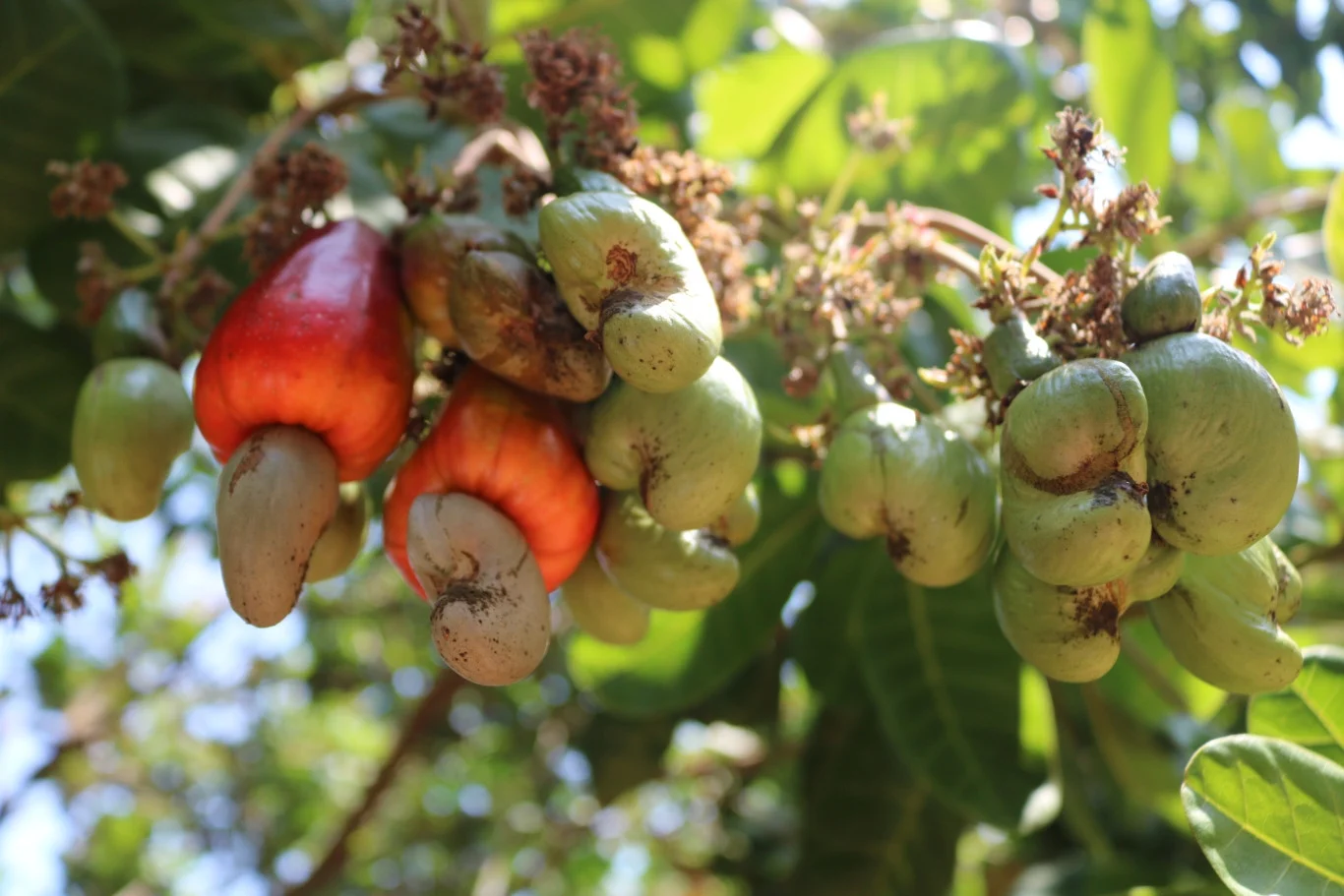
According to information from the Ministry of Agriculture and Rural Development, the cashew growing area in our country has a tendency to decrease steadily. From 440,000 hectares in 2007, by the 2019-2020 crop year, the area was only 302,500 hectares, with an output of 339,800 tons. In 2024, the cashew growing area will be about 316,100 hectares, with an estimated output of 348,000 tons.
Meanwhile, the import turnover of raw cashew nuts increased sharply from 1.66 billion USD in 2016 to 3.33 billion USD in 2024. At its peak, in 2022, the import turnover of this item jumped to 4.185 billion USD.
The concern about raw material supply is even greater, because in recent years, African cashew growing countries and Cambodia have had a policy of developing domestic processing industries, gradually reducing raw exports. They have introduced many preferential policies, attracting investment in cashew processing factories, while closely monitoring minimum export prices and imposing high export taxes on raw cashews.
In December 2024, a Cambodian cashew processing factory for export began operating. The first batch of processed cashew nuts from this factory was packaged and exported to the Chinese market, then targeting the Middle East, Europe, etc.
For stable growth and sustainable development, in addition to solving the problem of raw material supply, Ms. Dao Thi Lanh - Chairman of the Cashew Association of Binh Phuoc province - said that the cashew industry needs a systematic strategy to increase value in the world cashew industry chain. In addition, it is necessary to shift from preliminary processing of cashew nuts for export to deep processing, into food, and directly to supermarkets.
Sharing his experience regarding the cashew industry, Minister of Agriculture and Rural Development Le Minh Hoan once felt "heartbroken" upon receiving the response from cashew farmers: "Growing durian yields 1 billion VND/hectare, while growing cashews only yields about 35-40 million VND/hectare."
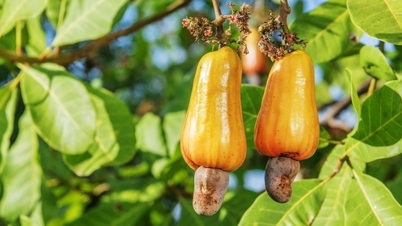
From the above story, according to the Minister, we must adapt to market rules, we cannot stop farmers, we need other economic tools. The cashew industry can exploit more layers of value, such as growing red lingzhi mushrooms in cashew gardens to increase income. Thus, people will stick with cashew trees, stabilizing the raw material area.
The cashew industry can also collaborate to exploit the potential of carbon credits. Each hectare of cashew trees grown using low-emission methods can generate $400 from the sale of carbon credits.
Mr. Tran Van Phuong, Deputy Director of the Department of Agriculture and Rural Development of Binh Phuoc province, said that developing cashew growing areas to create carbon credits and restructuring the cashew industry towards a green direction is the province's goal.
"If implemented effectively, it will contribute to increasing income and improving the living standards of cashew farmers. At the same time, it will build a sustainable raw material area, helping to attract investors into the cashew processing and export sector," he shared.
Next article: With the world's largest warehouse, Vietnam's 'black gold' is in high demand, in its heyday

Source: https://vietnamnet.vn/am-tham-thanh-nha-cung-ung-so-1-the-gioi-nganh-dieu-om-ve-ky-luc-4-34-ty-usd-2365053.html





























![[Video] The craft of making Dong Ho folk paintings has been inscribed by UNESCO on the List of Crafts in Need of Urgent Safeguarding.](https://vphoto.vietnam.vn/thumb/402x226/vietnam/resource/IMAGE/2025/12/10/1765350246533_tranh-dong-ho-734-jpg.webp)



























































Comment (0)