

 |
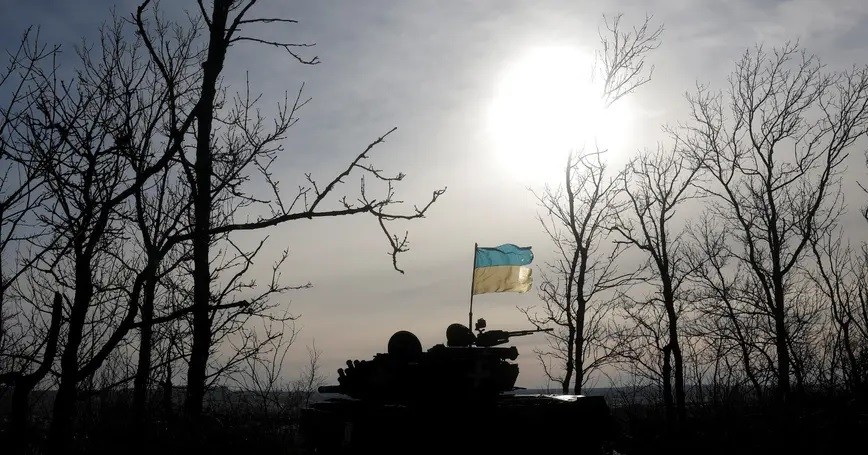
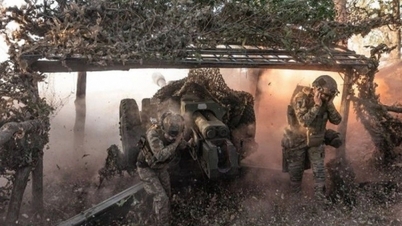
| Ukraine's reckless spending on the military has depleted more than half of its budget; who will pay the bill? (Source: Reuters) |
From January to July 2023, total state budget spending on security and defense in Ukraine amounted to 969.2 billion Hryvnia (26.2 billion USD), equivalent to 59.1% of the total budget. In July 2023 alone, Kyiv spent 150.2 billion Hryvnia, according to figures posted on Facebook by the Ministry of Finance .
The Ukrainian Ministry of Finance noted that the funds are used to provide financial support to military personnel and police officers, and to purchase military equipment. In particular, a large portion is spent on weapons, ammunition, defense products, personal protective equipment, fuel, food, medical care, and other expenses to ensure the operation of relevant agencies and units.
Total state budget spending in Ukraine from January to July 2023 was 1.64 trillion Hryvnia.
Previously, at the recently held 2023 Conference of Ukrainian Diplomats, Prime Minister Denys Shmyhal stated that covering the costs of the armed forces and other expenses during the conflict with Russia had cost Kyiv approximately 2 trillion Hryvnia (equivalent to 54 billion USD). This figure is equal to Ukraine's budget revenue during peacetime.
Currently, to sustain its budget, Ukraine relies heavily on financial support from partners, as well as grants and loans. "We lost about 30% of our economy and businesses. We lost 3.5 million jobs. In the first year of the conflict, we lost 29.5% of our GDP. This figure is lower than expected. Businesses have adapted and continue to adapt. This year, we expect a slight increase compared to last year," Prime Minister Shmyhal added.
He also revealed that Ukraine's gold and foreign exchange reserves have increased to unprecedented levels. "The national bank now has $39 billion (in foreign exchange reserves). This year, we have reduced the inflation rate to 12.8% on an annual basis," Prime Minister Shmyhal said.
More specifically, Prime Minister Shmyhal stated that in the first half of 2023, Ukraine's state budget collected over 600 billion Hryvnia, while the military received 672 billion Hryvnia (US$24.9 billion).
Assigning tasks to his diplomats at the aforementioned Ukrainian Diplomats Conference, Shmyhal stated, "In 2023, our task is to attract $45.8 billion for budgetary funding and $14 billion to accelerate the rapid recovery process."
According to Prime Minister Shmyhal, Kyiv has already attracted $28 billion this year. Their partners will continue to provide funding and reinforcements as the Russia-Ukraine conflict continues.
However, he also warned that once the Russia-Ukraine conflict ends, the level of foreign support will decrease significantly. "We will be left almost alone with our problems. Support will be much lower. This needs to be taken into account and we must make every effort starting today," Shmyhal revealed.
Therefore, Prime Minister Shmyhal urged ambassadors to actively work to draw the world's attention to Ukraine, so as not to diminish the level of interest. He emphasized the crucial role of diplomats today, who are multifaceted and multifunctional, as they must address everything, including weapons, medicine, and humanitarian issues. "For me, the diplomatic front is no less important than other fronts. Each ambassador is a 'guardian' on a diplomatic front," Shmyhal said.
Regarding aid to Ukraine, in 2022, the United States was the largest foreign contributor to the Ukrainian economy. However, a recent poll commissioned by CNN's Social Science Research Solutions (SSRS) revealed that only 45% of respondents believe the US Congress should authorize further funding for Ukraine; while 55% argue that Kyiv has already received sufficient aid. The US Congress should not authorize additional aid to support Ukraine.
On the European side, the European Union's (EU) cumulative support for Ukraine has reached 20 billion euros since February 2022, according to Peter Stano, a representative of the EU's External Relations Service. Germany leads among European countries, followed by Poland, the Netherlands, Denmark, and Sweden – each contributing more than 1 billion euros to Ukraine's military budget.
Last month, on July 20th, EU High Representative for Foreign Affairs and Security Policy Josep Borrell reiterated a proposal to create a special mechanism to pay for weapons, ammunition, and military aid to Ukraine, amounting to €5 billion per year, until 2027. This mechanism is expected to supplement the €50 billion budgetary aid package for Ukraine proposed by the European Commission, also over four years, to fill the gap that Belgium has called on EU countries to contribute to the community budget.
The European Commission is also planning further support programs for Kyiv over the next four years, from 2024 to 2027, as the current EU budget planning period ends in 2027.
In response to the above information, expressing concern about the aforementioned 20 billion euro funding over four years, Hungary's top diplomat called it a "truly shocking" proposal and warned that it could only prolong the military conflict in Ukraine.
"In short, I can share that they don't really want to talk about peace. What does the EU say? It will be a military conflict zone in Ukraine for four years," commented Hungarian Minister of Foreign Affairs and External Economic Relations Szijjarto Peter.
Meanwhile, according to the latest information, "big brother" Germany announced it plans to provide Kiev with approximately 5 billion euros (5.4 billion USD) in financial aid annually. In a statement just released, German Finance Minister Christian Lindner declared that Berlin will continue to support Kiev for as long as necessary.
However, according to observers, although Europe has reached initial consensus on increasing military funding for Ukraine, how member states will translate these goals into reality remains a difficult problem. There are growing concerns that the EU's overall plan will be hampered by disagreements among member states regarding funding and payment schedules.
In the current context, while many EU governments avoided an economic recession earlier this year, the threat of a new recession is now looming over the region. Given the bleak economic situation, can EU countries reconcile their individual interests and reach a common consensus, especially with persistent pressure from Ukraine and increasing domestic pressure?
Source














































































Comment (0)