

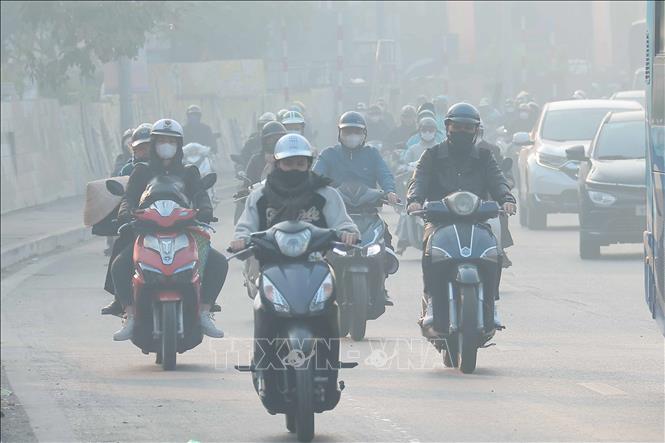
Air quality and its impact on human health are assessed by the Vietnam Air Quality Index.
According to the Department of Disease Prevention, air quality and the level of impact on human health are assessed by the Vietnam Air Quality Index (abbreviated as AQI).
The AQI index is calculated on a scale (6 AQI value ranges) corresponding to symbols and colors to warn of air quality and the level of impact on human health, specifically as follows:
At AQI values from 0-50, good air quality, shown in green, is good air quality, does not affect health.
At the AQI value range of 51 - 100, the air quality is average, shown in yellow, the air quality is acceptable. However, for sensitive people (elderly, children, people with respiratory and heart diseases).
At AQI values from 101 – 150, air quality is poor, shown in orange, sensitive people experience health problems, normal people are less affected.
At AQI values of 151 – 200, air quality is poor, shown in red, and normal people begin to experience health effects, while sensitive groups may experience more serious health problems.
At values between 201 and 300, air quality is very poor, shown in purple, health warning: people are more seriously affected by health.
At values between 301 and 500, air quality is hazardous, shown in brown shades, and is a health emergency: The entire population is seriously affected by health effects.
What should people do when the air is polluted?
Regarding preventive measures and general health protection, the Department of Disease Prevention guides people to regularly monitor air quality on the websites of the Ministry of Agriculture and Environment and the Department of Agriculture and Environment of provinces and cities to implement appropriate preventive measures and health protection;
When leaving the house, always wear a quality mask and wear it properly.
Regularly clean your room and house, keep your living environment clean and airy. You should use a mask and protective glasses when cleaning if there is a lot of dust or the air is polluted from poor to dangerous levels.
Limit the use or replace the use of honeycomb coal stoves, firewood, and straw burning with electric stoves, induction stoves, or gas stoves.
Planting trees helps prevent dust and clean the air.
For cigarette and tobacco smokers: should quit or limit smoking; should not smoke indoors. For non-smokers, should stay away from cigarette smoke.
Regularly monitor your health and have regular health check-ups.
For people who are sensitive to air pollutants (children, pregnant women, people with respiratory or cardiovascular diseases, the elderly), it is recommended to avoid exposure to sources of air pollution emissions from vehicles; construction sites; cooking areas using coal, firewood, straw or other areas at risk of air pollution;
During times of air pollution, if symptoms or acute illnesses such as fever, rhinopharyngitis, bronchial pneumonia, blood pressure, cardiovascular disease appear, you should immediately go to medical facilities for examination, consultation and treatment. At the same time, improve nutrition to improve physical condition and resistance; Pay attention to keeping the body warm in winter, avoid sudden cold.
For people with respiratory and cardiovascular diseases, it is necessary to comply with and maintain treatment as prescribed by a specialist. If there are signs of discomfort or worsening, they should immediately go to a specialized medical facility for examination, consultation and treatment.
The elderly and people with respiratory and cardiovascular diseases need to comply with regular health check-ups.
When the air quality index is at hazardous levels, sensitive people should avoid all outdoor activities.
Preventive measures to protect health when the air quality index is at an average level of 51 - 100, for normal people: participate in outdoor activities without restrictions.
For sensitive individuals reduce outdoor time and strenuous physical activities;
Monitor your health. If you experience acute symptoms such as difficulty breathing, cough, or fever, go immediately to a medical facility for examination, advice, and treatment.
Preventive measures to protect health when the air quality index is poor at 101 - 150, for normal people reduce the time participating in outdoor activities, especially for those with symptoms of sore eyes, cough, sore throat; Limit or avoid activities in areas with high risk of air pollution (such as streets, traffic intersections, construction sites, industrial production areas, craft villages and other polluted areas).
Students can participate in outdoor activities, but limit physical exercise or activities that require strenuous activity for a long time.
For sensitive individuals, limit outdoor activities and strenuous physical activity. Increase rest and light activity. Reduce or stop activity immediately if symptoms such as coughing, chest tightness, or wheezing appear.
Clean nose and gargle morning and night with saline, especially after going out.
Rinse eyes with saline solution at night before going to bed.
Monitor your health. If you experience acute symptoms such as difficulty breathing, cough, or fever, go immediately to a medical facility for examination, advice, and treatment.
Preventive measures to protect health when the air quality index is at a bad level of 151 - 200, for normal people, limit outdoor activities or participate in physical activities that require strenuous effort. If you have to work or do outdoor activities, you should arrange and choose a time of day with less pollution, need to rest more, perform activities with moderate intensity; Avoid activities in areas with high risk of air pollution.
If you have to travel, you should increase the use of public transport and limit the use of motorbikes and bicycles to reduce exposure to polluted air.
You should limit opening windows and doors when the air is heavily polluted, especially families near traffic routes or areas with air pollution.
Clean your nose and gargle with saline morning and night, especially after going out. Rinse your eyes with saline at night before going to bed.
For sensitive people, avoid outdoor activities or activities that require strenuous physical activity. Activities such as exercise and physical activity should be performed indoors. Limit opening windows and doors during times of heavy air pollution.
Clean your nose and gargle with saline morning and night, especially after going out. Rinse your eyes with saline at night before going to bed.
Monitor your health. If you experience acute symptoms such as difficulty breathing, cough, or fever, go immediately to a medical facility for examination, advice, and treatment.
Preventive measures to protect health when the air quality index is at very bad levels of 201 - 300, for normal people, avoid outdoor activities for long periods of time or participate in strenuous physical activities. Encourage indoor activities.
Avoid working in areas with high risk of air pollution. If you have to work in areas with high risk of pollution, you should use masks that can prevent fine dust (dust with aerodynamic diameter ≤ 2.5 μm).
If you have to travel, you should increase the use of public transport and limit the use of motorbikes and bicycles to reduce exposure to polluted air.
Limit opening windows and doors during times of heavy air pollution.
Clean your nose and gargle with saline morning and night, especially after going out. Rinse your eyes with saline at night before going to bed.
For sensitive people, avoid all outdoor activities, switch to indoor activities or postpone to another day when the air quality index is better. Limit opening windows and doors during times of heavy air pollution.
If you have to go out, you should minimize the time you spend outdoors and use masks that can prevent fine dust. Clean your nose and gargle with saline solution morning and night, especially after going out. Rinse your eyes with saline solution at night before going to bed.
Monitor your health. If you experience acute symptoms such as difficulty breathing, cough, or fever, go immediately to a medical facility for examination, advice, and treatment.
Preventive measures to protect health when the air quality index is at a hazardous level of 301–500, for normal people, avoid outdoor activities, switch to indoor activities or switch to another day when the air quality index is better; Close windows and doors to limit and avoid exposure to pollutants.
For sensitive people, avoid all outdoor activities and switch to indoor activities; Close windows and doors to limit and avoid exposure to pollutants; Monitor health, if acute symptoms such as difficulty breathing, cough, fever appear, go to medical facilities immediately for examination, advice and treatment.
*According to the Department of Disease Prevention, in case of serious air pollution (VN_AQI value of 301 or higher for 3 consecutive days), based on Consolidated Document 01/VBHN-BTNMT dated January 10, 2025 consolidating the Decree detailing a number of articles of the Law on Environmental Protection, it is possible to consider suspending or adjusting working hours of agencies, organizations and schools. If it is mandatory to go to school, it is necessary to avoid outdoor activities, switch to indoor activities or adjust school hours accordingly. Temporarily suspend activities that gather large crowds outdoors.
Source: https://baotintuc.vn/xa-hoi/bao-ve-suc-khoe-nguoi-dan-truoc-nhung-anh-huong-co-hai-cua-o-nhiem-khong-khi-20251204150604400.htm


![[Photo] Cat Ba - Green island paradise](/_next/image?url=https%3A%2F%2Fvphoto.vietnam.vn%2Fthumb%2F1200x675%2Fvietnam%2Fresource%2FIMAGE%2F2025%2F12%2F04%2F1764821844074_ndo_br_1-dcbthienduongxanh638-jpg.webp&w=3840&q=75)










































![[VIMC 40 days of lightning speed] Da Nang Port: Unity - Lightning speed - Breakthrough to the finish line](https://vphoto.vietnam.vn/thumb/402x226/vietnam/resource/IMAGE/2025/12/04/1764833540882_cdn_4-12-25.jpeg)







































Comment (0)