

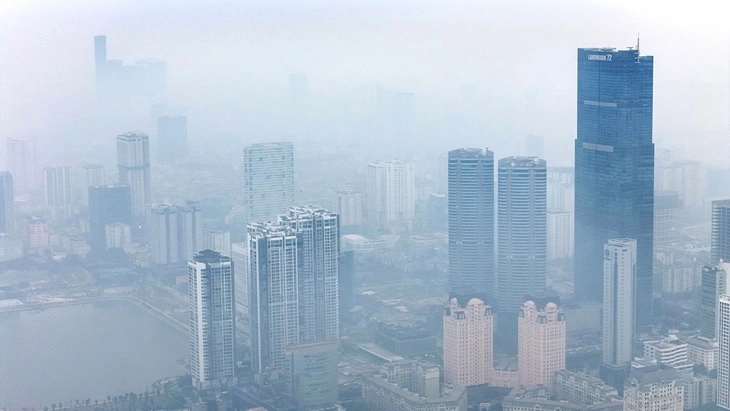
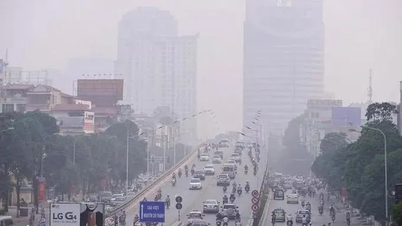
A corner of Nam Tu Liem, Cau Giay on an air polluted day - Photo: DANH KHANG
Air pollution is at very bad levels
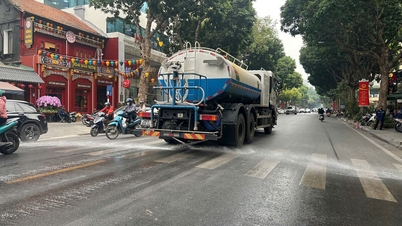
The Hanoi People's Committee has just issued a document on strengthening urgent measures to control air pollution in Hanoi.
The Hanoi People's Committee requested the Department of Education and Training to notify and instruct schools to limit outdoor activities for students during hours and days when air quality is at "bad" level or higher.
In case of serious air pollution (VN_AQI ≥ 301), instruct schools to temporarily suspend or adjust working and studying hours.
From late November to early December 2025, Hanoi experienced one of the most severe air pollution episodes in many years.
The pollution started on November 28 and lasted nearly a week, peaking on the morning of December 2 when the average air quality index (AQI) across the city reached about 283 - the "very bad" level, close to the "hazardous" threshold.
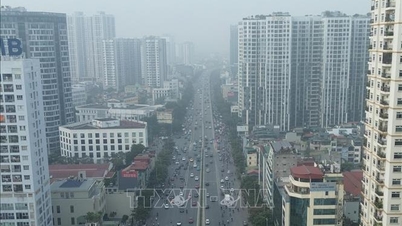
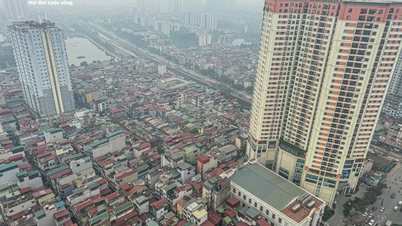
According to experts, this pollution is the result of a combination of temperature inversion, windless conditions, changing humidity and large amounts of internal emissions from traffic, construction, factories, craft villages and waste burning.
Dr. Nguyen Huy Hoang, a member of the Vietnam Association of Underwater and Hyperbaric Oxygen Medicine, said that in fact, data from many years shows that pollution in Hanoi tends to get worse towards the end of the year, and by 2025, only a very small number of days will meet WHO standards. The pollution in early December is just a temporary manifestation of a chronic problem.
When the AQI reaches 200-300, it is no longer a risk for sensitive groups but a public health issue. Healthy people may experience chest tightness, dry cough, and eye irritation; while people with underlying health conditions, the elderly, and children face the risk of hospitalization for acute asthma, pneumonia, stroke, or heart attack.
How dangerous is PM2.5 fine dust?
According to Dr. Hoang, the main cause comes from PM2.5 fine dust - a type of particle 30 times smaller than a strand of hair, small enough to penetrate deep into the alveoli and even into the blood.
On the surface of these dust particles often carry heavy metals and toxic organic substances, causing oxidative stress, damaging mitochondria and triggering widespread inflammatory responses.
Prolonged effects lead to chronic airway inflammation, increased plaque formation, blood clots and affect many organs such as the heart, brain and kidneys.
Therefore, air pollution not only causes coughs and sore throats for a few days but also contributes to increased rates of asthma, COPD, strokes and has long-term effects on lung and brain development in young children.
"The reality at hospitals in Hanoi during periods of heavy pollution shows that the number of children hospitalized for pneumonia, bronchitis, and asthma increases significantly; the elderly are susceptible to myocardial ischemia, stroke, or severe pneumonia.
Patients with underlying cardiovascular and respiratory diseases may experience an acute attack if the PM2.5 concentration increases slightly. Pregnant women are also at risk of premature birth, low birth weight or pre-eclampsia," Dr. Hoang warned.
How to protect your health when the air is polluted
In the context of continuous pollution, Dr. Hoang emphasized that self-protection strategies need to be implemented seriously and systematically.
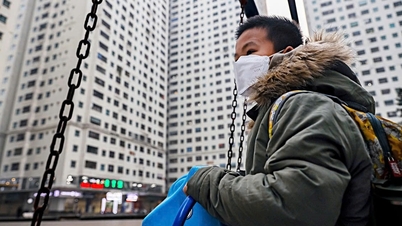
Masks are the first line of defense, but not all are effective. Regular cloth and surgical masks offer little to no protection against PM2.5, while N95, KN95 or FFP2 masks are only effective when worn properly and tightly. N95 masks can be reused several times but should not be washed, as this will destroy the electrostatic filter layer.
Indoors, people should keep windows closed when the outdoor AQI is high and use HEPA air purifiers on the appropriate setting. However, CO₂ can accumulate in closed rooms for a long time, so short ventilation periods should be used during periods of low air pollution. Keeping bedrooms clean is a priority.
Cleaning the nose and throat with salt water after returning from the street helps remove dust from the mucous membranes, reducing the risk of infection. A diet rich in vitamins and antioxidants such as vitamins C, A, E and foods such as ginger, turmeric, and garlic also helps the body fight oxidative stress caused by fine dust.
However, individual measures only have a mitigating effect and cannot solve the root cause of the problem. This expert believes that Hanoi needs stronger solutions in reducing traffic emissions, controlling industrial and construction emissions, limiting straw burning, garbage burning and developing green urban areas to improve sustainable air quality.
"The December 2025 pollution wave is a warning that the lung health of Hanoi residents is being challenged every day. This is not just a matter of "hazy skies for a few days", but a real risk factor for cardiovascular and respiratory diseases and the long-term health of the entire community.
We cannot change the weather overnight, but we can minimize the damage with the right knowledge and specific actions: checking AQI, using standard masks, keeping indoor air cleaner, taking care of the respiratory tract and proper nutrition," Dr. Hoang shared.
Source: https://tuoitre.vn/o-nhiem-khong-khi-nguy-hiem-the-nao-ma-ha-noi-yeu-cau-cho-hoc-sinh-nghi-hoc-neu-nghiem-trong-20251203131632406.htm


























![[Photo] Worshiping the Tuyet Son statue - a nearly 400-year-old treasure at Keo Pagoda](/_next/image?url=https%3A%2F%2Fvphoto.vietnam.vn%2Fthumb%2F1200x675%2Fvietnam%2Fresource%2FIMAGE%2F2025%2F12%2F02%2F1764679323086_ndo_br_tempimageomw0hi-4884-jpg.webp&w=3840&q=75)
![[Photo] Parade to celebrate the 50th anniversary of Laos' National Day](/_next/image?url=https%3A%2F%2Fvphoto.vietnam.vn%2Fthumb%2F1200x675%2Fvietnam%2Fresource%2FIMAGE%2F2025%2F12%2F02%2F1764691918289_ndo_br_0-jpg.webp&w=3840&q=75)

































































Comment (0)