

A female orcas may die from the carcass of an otter becoming lodged between her mouth and esophagus after eating six other otters.
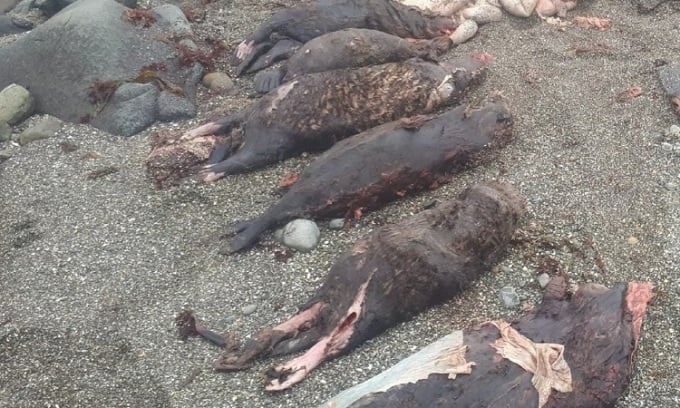
The intact carcasses of otters were removed from the belly of a stranded female killer whale. Photo: Sergey V. Fomin
Scientists in Russia discovered seven perfectly preserved otters inside the stomach of a stranded orca ( Orcinus orca ), according to research published on September 28 in the journal Aquatic Mammals. The carcass of the unfortunate orca was found far from its usual hunting grounds, raising questions about what it was doing there. The female orca was found in 2020 off the coast of the Commander Islands, off the Russian Far East in the Bering Sea.
The research team examined the carcass and found not only seven otter carcasses ( Enhydra lutris ) weighing a total of 117 kg, but also 256 beak fragments of cephalopods. One otter was stuck between the mouth and esophagus, which may have led to the death of the orca. There were a few things about the orca that puzzled the researchers. "The situation is very unusual because orcas don't usually eat otters," said Olga Filatova, a marine mammal researcher at Moscow University.
Instead, they hunt seals, sea lions, dolphins, and even other whales. Regardless of the species, they don't swallow the prey whole but always tear it apart and only eat the tastiest parts, according to Filatova. Swallowing an otter whole would likely be very difficult for a stranded orca, as adult otters can grow up to 1.5 meters long. The research team suggests the orca might do this because it is starving.
Researchers also analyzed the killer whale's DNA and determined that this individual belonged to the orcas Bigg's population, which has a vast range extending from the Aleutian Islands and the Gulf of Alaska to the California coast. This is the first time a member of this orcas population has been found in the western Pacific , leading Filatova and colleagues to hypothesize that the animal learned its hunting tactics elsewhere. Feeding strategies are always passed down from mother orcas to their offspring.
While the stranding of the orca raises some questions, it may help answer many others. Otter populations between the Aleutian Islands and the Gulf of Alaska are declining. Although some scientists suspect orcas are behind the otter population drop in the region, this is the first direct evidence of such behavior.
An Khang (According to Live Science )
Source link


































































































Comment (0)