

On March 8th, information from Can Tho Central General Hospital indicated that doctors at the hospital had successfully performed embolization on a grade 4 kidney injury case with a very large pseudoaneurysm of the renal artery.
The patient, TVC, 39 years old, residing in Bac Lieu , fell from a height about a month ago but did not seek medical attention. More than a week before admission, the patient experienced hematuria (blood in urine), painful urination, and burning sensation during urination. He was initially treated at a local hospital and then transferred to Can Tho Central General Hospital.
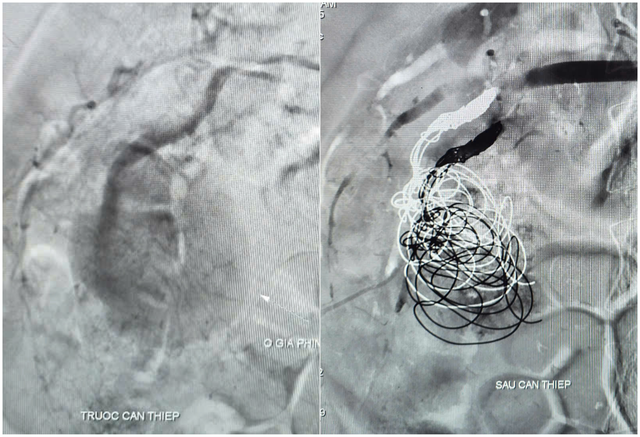
Images showing kidney damage in the patient before and after embolization intervention.
PHOTO: DT
Examination results revealed right renal pelvis effusion, right kidney trauma, bladder contents, and a pseudoaneurysm of the right renal artery measuring 65x48 mm. The patient was indicated for angiography and endovascular intervention, a minimally invasive treatment method.
The procedure was performed by Dr. Tran Cong Khanh, Specialist Level 2, Deputy Head of the Department of Diagnostic Imaging, Can Tho Central General Hospital, and his team.
The team observed a large, rapidly flowing pseudoaneurysm in the inferior branch of the right renal artery; a microcatheter was selectively inserted into the affected branch. This was a very challenging intervention requiring the deployment of four coils and embolization with a glue mixture. The procedure was successful after approximately one hour. During treatment, the patient received three units of packed red blood cells. Currently, the patient is conscious, responsive, vital signs are stable, abdominal and flank pain has decreased, and urine is clear.
Sharing more information about the above injury case, Dr. Truong Minh Khoa, Deputy Head of the Urology Department at Can Tho Central General Hospital, said that previously, the treatment of severe kidney injuries mainly involved open surgery to remove part or all of the kidney. Nowadays, there have been many changes in the conservative treatment of kidney injuries in general and in endovascular intervention in particular.
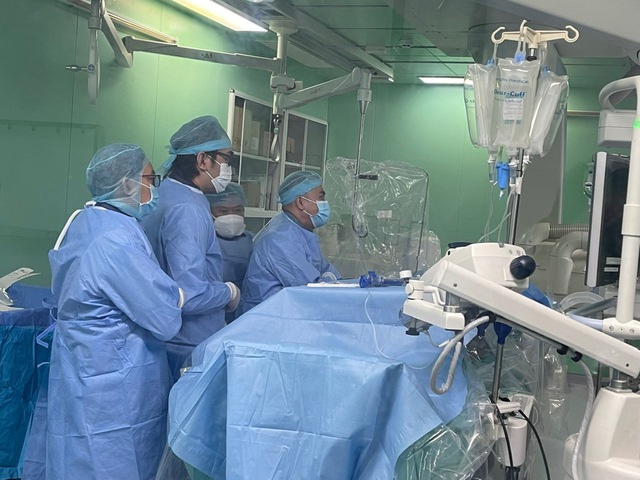
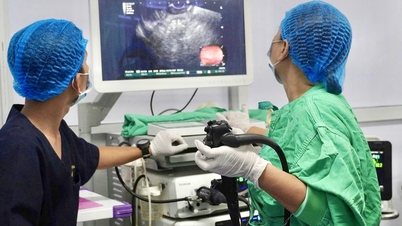
The team of specialist doctor Tran Cong Khanh performed embolization on the patient.
PHOTO: DT
In patients with renal trauma, the choice between surgery or embolization depends on the patient's condition and the capabilities of the hospital's interventional center. Patients with hemodynamic instability and multiple injuries may require emergency laparotomy to locate the source of bleeding, and sometimes nephrectomy to control the bleeding. Meanwhile, in cases of multiple injuries where other bleeding injuries have been controlled, the associated renal injury can be treated with embolization after the patient's condition stabilizes to preserve renal parenchyma.
According to Dr. Khoa, endovascular intervention has also been performed in many specialties and by multiple teams simultaneously to handle emergency cases such as: nosebleeds, stroke emergencies, treatment of ruptured cerebral vascular malformations, removal of blood clots due to large vessel blockages, angioplasty and stenting in emergency coronary artery disease, treatment of liver, spleen, and kidney injuries, embolization in hemoptysis, gastrointestinal bleeding due to vascular malformations… "Observations at the hospital show that emergency endovascular intervention not only provides high treatment effectiveness but is also minimally invasive, helping patients recover quickly. To date, many seriously ill and critical patients have been saved using the aforementioned endovascular intervention technique," Dr. Khoa said.
Source: https://thanhnien.vn/bi-nga-hon-1-thang-tieu-ra-mau-moi-phat-hien-chan-thuong-than-rat-nang-185250307211320683.htm

![[Image] Close-up of the newly discovered "sacred road" at My Son Sanctuary](/_next/image?url=https%3A%2F%2Fvphoto.vietnam.vn%2Fthumb%2F1200x675%2Fvietnam%2Fresource%2FIMAGE%2F2025%2F12%2F13%2F1765587881240_ndo_br_ms5-jpg.webp&w=3840&q=75)








































































Comment (0)