

Ho Chi Minh City – Mr. Tuyen, 38 years old, experienced burning pain in his genital area for 10 days, accompanied by 6-7 seizures per day and urinary and fecal incontinence. Doctors diagnosed him with complications from shingles.
A doctor at a clinic diagnosed Mr. Tuyen with shingles, but the treatment was ineffective. He then went to Tam Anh General Hospital in Ho Chi Minh City for examination.
On October 26th, Dr. Tran Nguyen Anh Thu, a specialist in Dermatology and Cosmetic Dermatology, stated that the patient's genital area showed signs of ulceration and infection, with slow-healing sores due to complications following shingles, not ordinary shingles. The virus attacked and damaged the nerves, disrupting nerve transmission, causing the patient to experience severe pain and occasional convulsions.
Doctors from the Dermatology - Cosmetic Dermatology and General Internal Medicine departments collaborated to treat the infected ulcers and complications following shingles in the patient. After three days, the lesions on the scrotal skin dried up, and the frequency of seizures decreased to 3-4 per day. He was discharged home for monitoring for 1-2 weeks, and if any abnormal signs appeared, he had to return to the hospital for treatment.
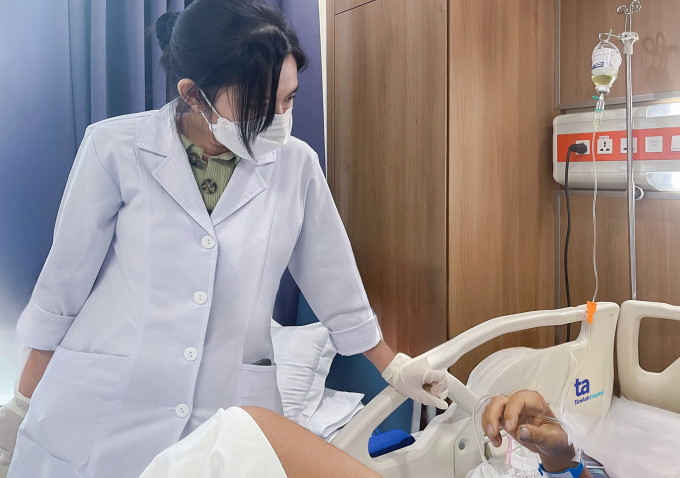
Doctor Anh Thu examines a patient. Photo: Pham Duy
Dr. Thu explained that shingles is an acute skin disease caused by the Varicella-Zoster virus (VZV). For those infected with VZV for the first time, the disease manifests as chickenpox. After complete recovery from chickenpox, VZV remains dormant in nerve ganglia for months or even years. When favorable conditions arise, such as weakened immunity, stress, or general weakness, the virus is reactivated, causing shingles.
People with shingles typically experience itching, burning, or soreness on the skin of one side of the body. Some people may also experience fever, fatigue, or headache. Within 1-2 days, a rash of blisters or vesicles appears in clusters, usually on one side of the body. Some patients develop post-herpetic neuralgia. Symptoms are usually limited to the area where the shingles first appeared, most commonly around the torso, usually on one side of the body. The pain significantly affects quality of life, mental well-being, and sleep.
Dr. Thu advises patients to seek medical attention early when skin lesions begin to appear. Treatment with antiviral medication during the "golden period," which is 72 hours after the onset of shingles, helps to limit the duration of the disease and prevent complications.
Do not apply leaves, mung beans, or any unknown remedies as these may worsen the infection in the affected area. Keep the skin clean and apply medication as directed by your doctor. Family members should limit contact with the patient's blisters that have not yet dried and scabbed over.
Pham Duy
Source link


![[Photo] Prime Minister Pham Minh Chinh attends the Conference summarizing and implementing tasks of the judicial sector.](/_next/image?url=https%3A%2F%2Fvphoto.vietnam.vn%2Fthumb%2F1200x675%2Fvietnam%2Fresource%2FIMAGE%2F2025%2F12%2F13%2F1765616082148_dsc-5565-jpg.webp&w=3840&q=75)



































































































Comment (0)