

Sophisticated script
After her mother became a victim of 3 resort card contracts worth more than 1 billion VND but could not be refunded, Ms. M. (31 years old, Hanoi ) decided to apply for a sales job in this industry to learn how the "gift giving, card selling" seminars really work.
Ms. M. said the scenario of the vacation companies that have signs of fraud starts with calling to invite customers to receive free vacation vouchers, customer appreciation, anniversary celebrations... then leading customers to private seminars. However, even the "3 days 2 nights free" vouchers that customers receive cannot be used because they buy less and give out more. For example, the company bought 100 gift card codes from partner resorts but gave them out to... thousands of people. Therefore, the rate of customers who can actually book a room is only about 1%, meaning that 99% will never be able to use the voucher as initially offered.
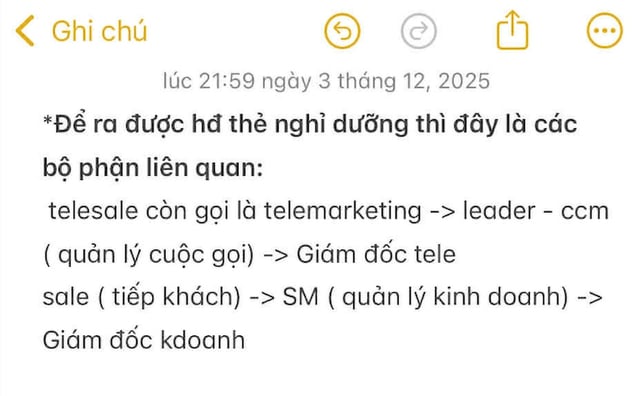
Documents provided by a sales staff who once "infiltrated" the industry reveal how the closed sales chain of the disguised "vacation - timeshare" market operates.
Photo: NVCC
In parallel with the voucher distribution, these units organize sales scenarios starting with consultants calling, leading customers to meet the team leader, meeting the "call center" manager (inviting department), then direct sales and finally a closed seminar. At the seminar, customers are guided by pre-made scenarios, from showing off images of luxury resorts, giving "huge" price lists and then suddenly offering deep discounts to create a feeling of excitement and luck.
"This mechanism is very sophisticatedly designed. The voucher creates the feeling of being given, the seminar creates pressure to buy, and the card price is pushed up high and then reduced dramatically to trigger the "bargain" mentality. If I hadn't worked in the industry myself, I wouldn't have been able to imagine how systematic and rigorous the process is," Ms. M. shared.
According to Ms. M., the most dangerous thing is that these fraudulent companies are still collaborating with each other to continue manipulating and finding ways to appropriate customers' assets. Because after being unable to collect money from the old company, her mother continued to be approached by another unit with the promise of "support in transferring and recovering capital", and was then lured into signing two new contracts worth 400 million VND. Only when the family hired a lawyer to intervene was the matter clarified and the company forced to refund the money.
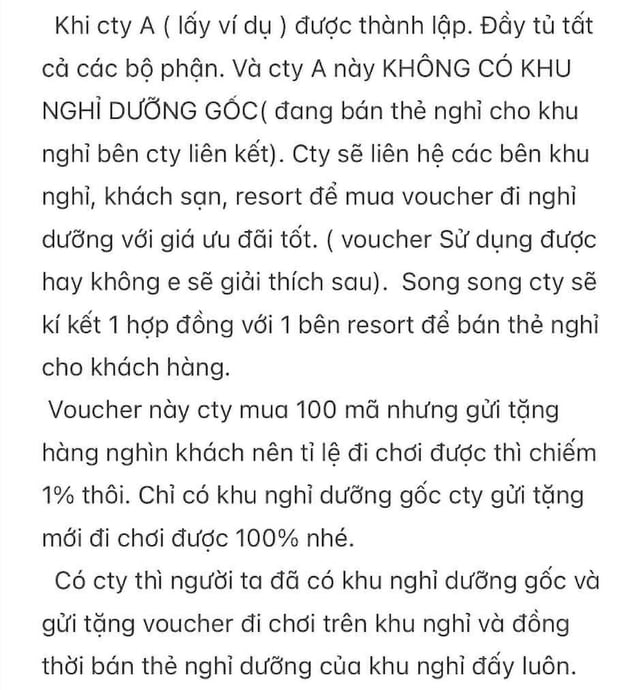
Many businesses selling resort cards do not actually own the resorts, they only link with outside resorts, buy cheap vouchers to "bait" for marketing.
Photo: NVCC
"Not all companies are scams, but the model has been distorted a lot. Sales groups only focus on selling at all costs. When enough sales are made in a period, the company changes its legal entity, stops cooperating with the old resort, and then joins hands with a new partner to issue another card. In the end, the ones who suffer the consequences are still the customers stuck with the contract," said Ms. M.
Mr. NK (40 years old, Khanh Hoi Ward, Ho Chi Minh City) also attended a seminar selling "vacation ownership" of this type. He was invited to receive a "free vacation" voucher on the condition that both husband and wife must be present. The venue was closed, and attendees were restricted from using their phones. The staff continuously presented about the "opportunity to own a vacation for life", advertised this as a product that "allows you to travel and make money", and urged listeners to sign a contract on the same day. "They strongly appeal to the fear of missing out. The package is quoted at a very high price, then deeply discounted on the spot, creating a feeling of a one-of-a-kind offer. While the contract is dozens of pages long, customers almost do not have time to read it carefully," said Mr. NK.
"When I used the voucher, I was shocked. To book a room, I had to pay a "reservation fee" of 1 million VND per night; breakfast was an additional 400,000 VND per person. The total cost was 1.8 million VND for a night's stay, more expensive than booking online at the same time. Going on vacation felt like continuing to attend a conference, because I was constantly invited to buy new packages. There were only invitations, but the actual experience was not as advertised," he said indignantly.
Many seminars also offer "investment vacation" packages, with commitments to buy back and share profits of 8-15% per year, or promote the profitable purchase of early tickets. However, these terms almost never appear in the contract, or are only written in general terms, without legal binding value. Some models have also transformed into a disguised multi-level model. Participants pay 50-200 million VND to "activate their accounts", then recruit others to buy cards to receive a commission of 10-25%, bonuses according to levels F1, F2... At this point, the activity has moved away from tourism services, becoming a form of financial mobilization.
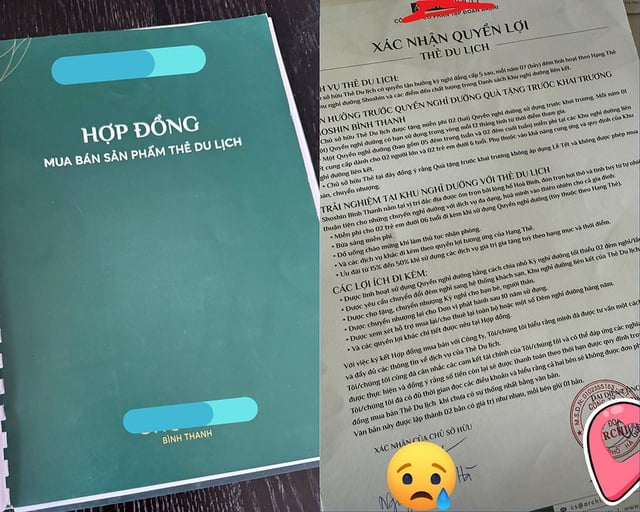
Vouchers are bought and given away everywhere, but the rate of actual vacations is very low, while at the same time, businesses are promoting the sale of long-term vacation cards.
Photo: NVCC
Holiday products are not allowed to pay interest
According to Master Tran Anh Tung, economic expert - Head of Business Administration at the University of Economics and Finance, Ho Chi Minh City, a true vacation (timeshare) product must ensure the legal transparency of the affiliated resort, have a contract clearly stipulating the number of days of use per year, room class, card term, and not come with any profit commitment or promotion that has the color of financial investment. "Vacation sales are essentially just a tourism service. Customers buy the right to stay, not buy assets that generate cash flow. Adding the element of interest payment and profitable investment is completely wrong with the nature of the product," he emphasized.
Lawyer Le Trung Phat (Ho Chi Minh City Bar Association) also affirmed: According to current legal regulations, this model is not a form of financial investment. The fact that businesses advertise profits or promise to buy back, or commit to profits has created false expectations for consumers. "Many customers only realize after signing the contract that the actual benefit is just to relax, and the re-renting or transfer depends entirely on the secondary market or the unsecured "support" from the business," lawyer Phat explained.
Associate Professor Dr. Nguyen Huu Huan (University of Economics, Ho Chi Minh City) emphasized that vacation ownership in the world is simply a form of sharing the right to use accommodation. The buyer only buys the right to go on vacation, it is not a financial product to receive interest payments. Therefore, all advertisements like "buy a vacation with interest payments, resell for double or triple the profit" are just an addition to lure consumers.
Answering the question of why this model in Vietnam is easily transformed, Mr. Huan said that the reason comes from both the business and the buyer. Some units intentionally "invent" investment elements, pushing the price of vacation packages higher than the real value, then applying shocking discount tricks, closing the seminar, forcing customers to sign the contract immediately, not giving enough time to consider. Meanwhile, in terms of management, this is a model in the "gray zone", organized in the form of customer conferences or giving gifts, so it is difficult for authorities to monitor regularly. "Only when people speak up to denounce, will authorities have a basis to handle it. Meanwhile, many people lack financial knowledge, hearing about interest rates makes them easily swayed," Mr. Huan explained.
In the short term, the most important measure is to increase warnings so that people understand the true nature of vacation ownership. If you are introduced to it as a profitable investment and profitable resale, then get up and leave because this model does not have that function.
Associate Professor, Dr. Nguyen Huu Huan , University of Economics, Ho Chi Minh City
Source: https://thanhnien.vn/bien-tuong-mo-hinh-so-huu-ky-nghi-giang-bay-trong-cac-hoi-thao-kin-185251204165936485.htm


![[Photo] Cat Ba - Green island paradise](/_next/image?url=https%3A%2F%2Fvphoto.vietnam.vn%2Fthumb%2F1200x675%2Fvietnam%2Fresource%2FIMAGE%2F2025%2F12%2F04%2F1764821844074_ndo_br_1-dcbthienduongxanh638-jpg.webp&w=3840&q=75)





































![[VIMC 40 days of lightning speed] Da Nang Port: Unity - Lightning speed - Breakthrough to the finish line](https://vphoto.vietnam.vn/thumb/402x226/vietnam/resource/IMAGE/2025/12/04/1764833540882_cdn_4-12-25.jpeg)



































Comment (0)