

 |
Chinese tourists take photos next to street vendors in the Myeongdong shopping district in Seoul, South Korea. Photo: Reuters . |
As Japan falls short as the top choice, South Korea, Thailand and many other destinations are quickly emerging as alternatives to the world's largest tourist market.
Over the weekend of November 15, data from travel platform Qunar showed that South Korea surpassed Japan to become the most popular overseas destination for Chinese tourists, based on both searches and flight ticket purchases. It was followed by Thailand, Hong Kong, Malaysia, Singapore, Vietnam and Indonesia.
From January to October, South Korea welcomed about 4.7 million Chinese visitors, exceeding the total number of visitors for the whole of last year, The Korea Times cited data from the Korea Tourism Organization.
The move comes as South Korean airlines expand their routes to China, which are seen as more profitable than routes to Japan.
Korean Air has increased the frequency of its Incheon-Fuzhou route from three to four flights per week, while Asiana Airlines plans to operate 165 flights per week to China by March next year, a 20% increase in capacity.
Chinese cruise lines are also gradually bypassing Japanese ports, extending stays at destinations like Jeju Island, helping to cement South Korea's position on the regional tourism map.
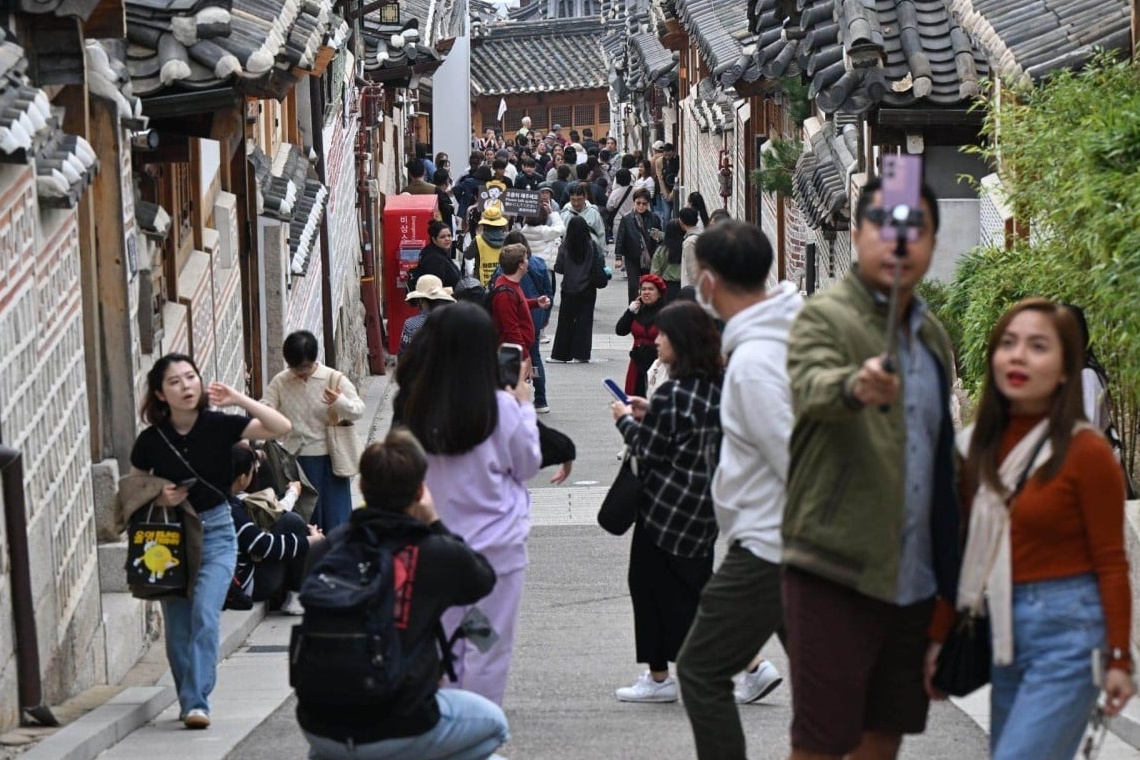 |
An alley crowded with Chinese tourists in Bukchon Hanok Village in central Seoul. Photo: The Korea Times. |
But South Korea isn’t the only destination benefiting. According to Beijing-based travel agencies, many Chinese tourists are switching to destinations with visa-free or relaxed policies, such as Thailand, Malaysia, Singapore, Georgia and Egypt.
“Most group tours to Japan have been canceled. We are now focusing on promoting travel packages to Thailand, Semporna (Malaysia), South Korea and some other destinations,” said a business representative.
Tongcheng Travel data shows that hotel bookings by Chinese tourists in South Korea in the last two weeks of November increased by more than 240% compared to the same period last year. Southeast Asian destinations such as Vietnam and Indonesia also recorded increases of more than 100% year-on-year, while bookings in Germany and Spain increased by more than 300%.
Russia has also quickly become a prominent choice thanks to the visa-free policy of up to 30 days for Chinese citizens applied since the beginning of December. Chinese media reported that the number of searches and bookings for tickets to Russia increased sharply after the visa-free information was announced.
According to Qunar statistics, Thailand is currently the most chosen destination for winter holidays from January 15 to February 10, 2026, while the number of flight bookings to Russia increased 1.5 times compared to the same period last year.
 |
Chinese tourists at Lotte duty-free shopping mall in central Seoul, South Korea, February 2, 2016. Photo: Reuters. |
However, businesses in South Korea admit that the increase in Chinese tourists has not really exploded. A travel agent specializing in serving Chinese tourists in South Korea said that the number of winter tour bookings has increased after the Chinese government advised against traveling to Japan, but competition is fierce.
“There are many options for tourists who want to experience winter, from domestic destinations like Harbin to Russia and many European countries. Therefore, it is not easy for Korea to have absolute advantage,” he said.
Source: https://znews.vn/khach-trung-quoc-dang-do-sang-han-quoc-thai-lan-post1608497.html
![[Photo] 60th Anniversary of the Founding of the Vietnam Association of Photographic Artists](/_next/image?url=https%3A%2F%2Fvphoto.vietnam.vn%2Fthumb%2F1200x675%2Fvietnam%2Fresource%2FIMAGE%2F2025%2F12%2F05%2F1764935864512_a1-bnd-0841-9740-jpg.webp&w=3840&q=75)


![[Photo] National Assembly Chairman Tran Thanh Man attends the VinFuture 2025 Award Ceremony](/_next/image?url=https%3A%2F%2Fvphoto.vietnam.vn%2Fthumb%2F1200x675%2Fvietnam%2Fresource%2FIMAGE%2F2025%2F12%2F05%2F1764951162416_2628509768338816493-6995-jpg.webp&w=3840&q=75)




















































































Comment (0)