

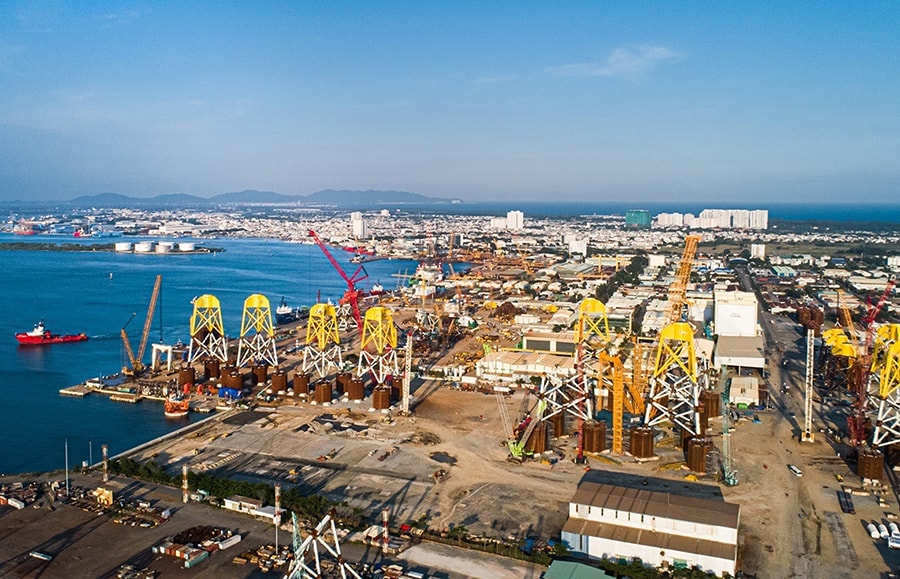
Maximize the mobilization of investment capital.
Previously, state-owned corporations in essential energy sectors such as the Vietnam National Oil and Gas Group (PVN), the Vietnam Electricity Group (EVN), and the Vietnam Coal and Mineral Industry Group were considered the sole "backbone." However, Resolution No. 70-NQ/TƯ now requires the improvement of financial policies aimed at maximizing the mobilization of private and foreign investment capital into energy projects through independent investors or public-private partnerships (PPP).
The resolution also creates a legal framework to improve financial, tax, and preferential credit policies to encourage businesses and individuals to participate in investing in the development of small and medium-sized renewable energy projects, and projects that both produce and consume energy. Private enterprises are encouraged to participate in investment projects in energy storage infrastructure such as battery storage, LNG storage, gasoline and oil storage facilities both onshore and offshore, and to invest in the development of the power transmission grid…
Dr. Ngo Duc Lam, former Deputy Director of the Institute of Energy, believes that Resolution No. 70-NQ/TƯ has provided long-term direction, directly addressing practical and urgent issues facing the energy sector, including the electricity market, helping to resolve major bottlenecks. Specifically, to meet the goal of double-digit economic growth in the next decade, Vietnam will need a massive capital investment of approximately US$200 billion for energy development, meaning an average of US$20 billion must be mobilized annually. Creating conditions for the participation of various economic sectors will help reduce pressure on the state budget while ensuring long-term energy security. The recently revised National Power Development Plan for the period 2021-2030, with a vision to 2050 (Power Plan VIII), is also based on the spirit of promoting and encouraging diversification of investment sectors. The Ministry of Industry and Trade has released a list of energy projects to attract private investment, with the authority to implement them resting with the People's Committees of provinces and cities. Based on this list, the announcement and bidding for these energy projects will be carried out according to regulations on investment and land bidding.
“Investment resources from the state-owned enterprise sector are limited, while the majority of investment needs depend on the private sector. If we don't create the right incentives and mechanisms to encourage private investment, the risk of failing to achieve the goals in implementing the revised Power Development Plan VIII is entirely plausible,” said Ha Dang Son, Director of the Center for Energy and Green Growth Research and Energy Market (Ministry of Industry and Trade).
Transparency and stability in pricing mechanisms.
Following the Politburo's announcement of Resolution No. 70-NQ/TƯ, the Ministry of Industry and Trade demonstrated a "act immediately, act promptly" spirit by organizing an implementation conference. This decisive action shows the high level of determination of the entire sector in putting this important resolution into practice.
According to Deputy Minister of Industry and Trade Nguyen Hoang Long, by 2025, Vietnam's power system will lead ASEAN in total installed capacity, with a projected scale exceeding 90,000 MW, and will also rank among the top 20 countries in the world. However, there are still limitations and shortcomings that need to be addressed. To meet the demands of high growth, the energy sector, especially the electricity sector, needs to take a breakthrough and move ahead, creating a solid foundation for socio-economic development.
From a business perspective, the General Director of Vietnam Electricity Group (EVN), Nguyen Anh Tuan, assessed that Resolution No. 70-NQ/TƯ sets out major, comprehensive directions, creating a basis for units within the Ministry of Industry and Trade, corporations, and energy enterprises to implement specific action plans. EVN has proactively assigned functional departments to develop programs and action plans to concretize the spirit of the resolution.
Meanwhile, expert Phan Duc Hieu, a member of the National Assembly's Economic and Financial Committee, argued that transparency and stability in the electricity pricing mechanism must be ensured. Electricity is an essential input for production and business activities. Therefore, if we create an electricity market that is too attractive and highly profitable, turning electricity into a purely capital-attracting investment channel, it could very well drive up production costs, negatively impacting the economy. Thus, the requirement is to create an electricity market that is attractive enough to attract investment, but at the same time remains reasonable, ensuring a stable and clean electricity supply to serve production and daily life, without putting excessive pressure on input costs.
Furthermore, to attract investment in the electricity sector, regulations need to be systematized and specified, contributing to market stability and transparency. Without a clear legal framework, and without understanding production and business plans, input and output costs, and total investment levels, investors will not feel secure in participating.
Source: https://hanoimoi.vn/buoc-ngoat-lon-bao-dam-canh-tranh-minh-bach-ve-dien-715492.html
































































































Comment (0)