

 |
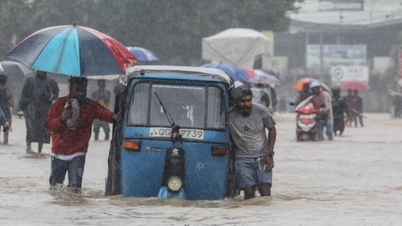
| The continuous spending of huge sums of money by governments has caused the public debt burden to skyrocket. (Source: Reuters) |
This is the conclusion of a study presented at the Jackson Hole Central Bank Conference organized by the US Federal Reserve (Fed) on August 26 in Kansas City, Wyoming, US.
The study states that since 2007, global public debt has increased on average from 40% of GDP to 60%. In advanced countries, this ratio is even higher. Typically, the United States, the world's largest economy, has a government debt higher than GDP. 15 years ago, US public debt was equivalent to about 70% of GDP.
Despite concerns about growth based on high public debt leverage, “debt reduction, although desirable in principle, is difficult to achieve in practice,” pointed out expert Serkan Arslanalp, economist at the International Monetary Fund (IMF), and Professor Barry Eichengreen at the University of California (USA).
This represents a significant change from the past, when countries had successfully reduced their debt-to-GDP ratios.
Many economies will not be able to cope with the debt burden of aging populations, according to the study's two authors, so new public funding will be needed for needs such as health care and pensions.
Meanwhile, rising interest rates from historic lows are also adding to debt servicing costs, and political divisions have made it harder for countries to achieve, or even maintain, current budget surpluses.
Economists Arslanalp and Eichengreen stressed that inflation, unless it unexpectedly increases over a long period, will not reduce debt ratios and debt restructuring for developing countries has become more difficult, as the creditor group has expanded.
The authors note that governments will struggle with high “inherited” debt, passed down from one government to the next. This will require governments to focus more on limiting spending, considering tax increases and improving bank regulation to avoid potential “bankruptcies.”
Source



![[Photo] 60th Anniversary of the Founding of the Vietnam Association of Photographic Artists](/_next/image?url=https%3A%2F%2Fvphoto.vietnam.vn%2Fthumb%2F1200x675%2Fvietnam%2Fresource%2FIMAGE%2F2025%2F12%2F05%2F1764935864512_a1-bnd-0841-9740-jpg.webp&w=3840&q=75)
![[Photo] National Assembly Chairman Tran Thanh Man attends the VinFuture 2025 Award Ceremony](/_next/image?url=https%3A%2F%2Fvphoto.vietnam.vn%2Fthumb%2F1200x675%2Fvietnam%2Fresource%2FIMAGE%2F2025%2F12%2F05%2F1764951162416_2628509768338816493-6995-jpg.webp&w=3840&q=75)






































































































Comment (0)