

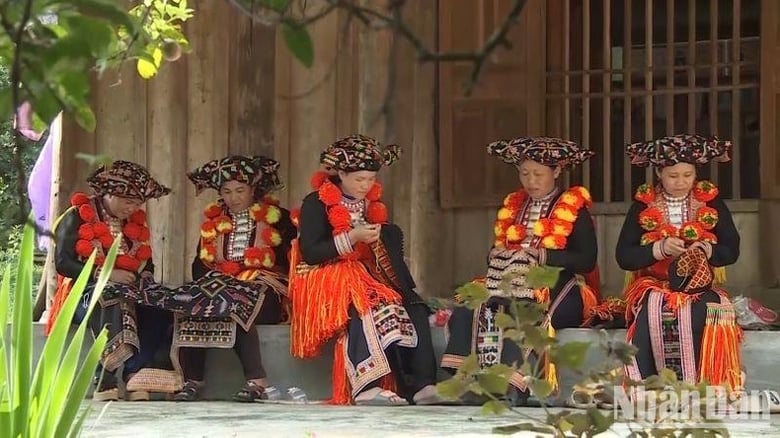
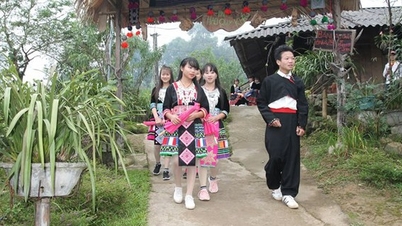
Red Dao ethnic women in Tho Binh (Lam Binh) embroider their traditional costumes.
Culture develops in itself. That is a unique law. However, the mindset of the times and the orientation have a powerful impact. The 13th National Congress of the Party was a convergence of national strength to "awaken the aspiration for national development... striving to make Vietnam a developed country with a socialist orientation by the middle of the 21st century." From here, Vietnamese culture is placed in a new mindset and under new requirements. It is from this goal that the Congress determined the guiding ideas and orientations for cultural development at a new level.
From a historical perspective, this is perhaps entirely new. For the first time, culture has become a crucial element, a central task, within the three strategic breakthroughs: "awakening the aspiration for a prosperous and happy nation, promoting the cultural values and human strength of Vietnam, fostering national unity and pride in the cause of national construction and defense." And perhaps, for the first time, the need to build national value systems, cultural value systems, and standards for Vietnamese people and Vietnamese family values has become urgent, strategically significant, and requires the simultaneous implementation of all three stages: "research, identification, and implementation" in practical life.
Along with these two major and new orientations, the 13th National Congress identified key tasks that need to be implemented in all areas of culture, linked to the needs of culture itself and meeting the requirements of the country's new historical period. This serves as the basis and foundation for understanding and appreciating the achievements and successes that have been achieved, the work that needs to be continued, and also what needs to be overcome or addressed, or what has not yet been implemented after half of the term.
Perhaps, over the past half-term, challenges have outweighed opportunities. The Covid-19 pandemic, raging for nearly two years, has devastated lives and people in an unprecedented way, disrupting economic development plans and forcing a turnaround in a perilous situation. The identification of "internal enemies"—corruption, negativity, degeneration, and moral decay—which have existed and spread for many years, has become a pressing challenge throughout society. However, we have overcome these harsh challenges.
Macroeconomic stability, efforts to find a path to growth, the containment of the Covid-19 pandemic, the resolute and prudent "anti-corruption campaign" by the Party and State, and public peace of mind. Why were these victories achieved? Perhaps, it's not just a victory for the economy, for fighting the pandemic and corruption, but more profoundly, it's a victory for Vietnamese culture, for the Vietnamese people, a victory of resilience, willpower, intelligence, and compassion for the greater good.
And that is culture. Without compassion, brotherhood, and the principle of "loving others as you love yourself," there could be no strength or faith to overcome the pandemic. And these are precisely the traditional cultural values that have been "revived" as an intrinsic strength for each individual and for the entire nation over the past two years.
The practical experience of the past two years has initially answered the question: To awaken the aspiration for national development, we must maximize and most effectively utilize the strength of culture, the intellect, and the will of the people. Over the past two and a half years, we have reaped many valuable cultural, literary, and artistic products and works across various forms and genres, capable of encompassing and "dominating" almost all aspects of life and meeting the increasingly diverse and evolving needs of the public. This is a result and a tremendous effort of those who create and work in the cultural field.
Looking deeper, it's noteworthy that these products are converging on building and nurturing the good in people, spreading deeply into life, while also highlighting the problems of reality, especially the increasingly fierce struggle between good and evil, right and wrong. The cultural products, literary works, and artistic pieces that emerged and reached the public even during the height of the Covid-19 pandemic have become a truly immense source of encouragement for us.
Due to my work and passion, over the past two years, having read, watched, and listened to hundreds of literary works and art forms, I feel that there is a shift towards a multifaceted reflection of life's realities and human destiny, a search for and innovation in creative thinking paradigms to gradually create works that combine tradition with the need for modernity. Although there are not yet truly outstanding works, this is a new sign of creative capacity and the law of development. According to this law, we have the right to hope and expect new achievements in the near future.
We possess a unique spiritual and cultural heritage deeply rooted in national identity. For a long time, the Party and the State have affirmed the task of protecting, preserving, promoting, and developing this invaluable heritage. Continuing in that direction, from the 13th National Congress to the present, in a relatively short period, new qualitative and creative signs have emerged.
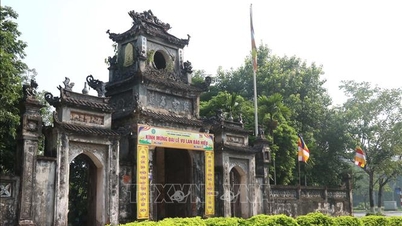
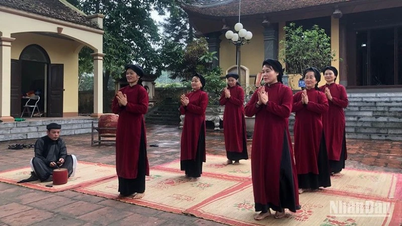
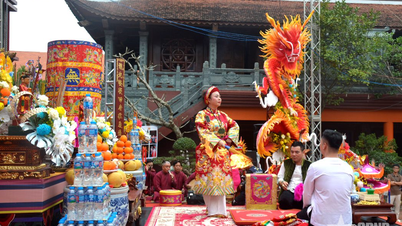
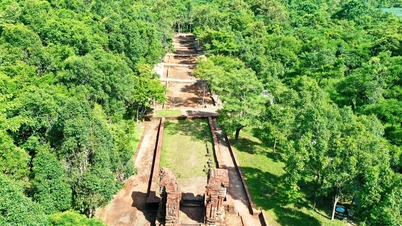
These are the cultural legacies of peoples being revived within their creative spaces, becoming an integral part, an organic entity, in the present life of the communities that created them.
This trend is an effort to effectively promote Vietnamese culture, a special and unique resource for tourism , directly contributing to gradually transforming tourism into a key economic sector as envisioned by the 13th National Congress.
These are efforts to leverage the unique characteristics and strengths of traditional culture in combination with science and technology to build and develop a focused and targeted cultural industry and cultural services sector. Innovative initiatives have begun, achievements are not yet significant, but great prospects are certainly within reach.
And these are the finest aspects of the nation's traditional culture that are being promoted to make Vietnam a destination for international cultural exchange and a soft power in international relations, affirming Vietnam's internal strength.
Overcoming the shortcomings and limitations of journalism, media, and publishing in previous years, after a restructuring and planning process, the press and media have risen to become reliable and discerning companions of contemporary life, making positive contributions to development and directly participating in preventing, detecting, and condemning evil, darkness, corruption, degeneration, and cruelty… These are encouraging signs of a "professional, humane, and modern press and media" as required by the 13th National Congress for this field.
The results achieved are very commendable after half of the Congress's term. However, compared with the requirements and tasks of culture as defined in the Congress, much remains to be done. The cultural sector has a comprehensive program for cultural development in the coming years. I would like to contribute a few suggestions to help complete the tasks of culture as outlined in the documents of the 13th Congress.
The central and core objective of culture is the building of human beings. Currently and in the years to come, this objective has become a severe challenge and a monumental task for culture. The documents of the 13th National Congress of the Communist Party of Vietnam point out the requirement to "Focus on researching, identifying, and implementing the construction of national values, cultural values, and human standards associated with preserving and developing the Vietnamese family values in the new era." This task is assigned to both cultural theory and practical activities in cultural, literary, and artistic creation.
In the diverse and rich development of culture, it is necessary to converge all these developmental currents for the goal of building human potential, and to concentrate human, financial, and material resources on the main current: the ideal of national independence and socialism, all for the sake of humanity. On the other hand, it is urgent to summarize practical experiences to build core value systems that will guide the development of Vietnamese people—national, modern, and integrated into the global community.
These tasks are underway, but have not yet achieved the results required by the Congress. Delays in completion not only lead to missed opportunities but also significantly impact the trends and tendencies in value selection, if we do not consider the potential for confusion, deviations, and even chaos that may occur during the current "long, extremely difficult, and complex" transitional period.
When defining the tasks of culture, Party documents often emphasize building a cultural environment. The documents of the 13th Party Congress specifically outline major tasks that need to be done, namely "having mechanisms, policies, and solutions to build a truly clean and healthy cultural environment," and "implementing breakthrough solutions to effectively prevent the degradation of morality and lifestyle, and to combat social negativity and social evils."
That requires a combination of construction and combating corruption, with very specific content. Over the past two and a half years, we have accomplished much, but perhaps it is still not enough in terms of scope, effectiveness, and efficiency to achieve the requirement of "truly clean and strong" with "breakthrough solutions." The people's hearts remain uneasy; many are frustrated witnessing the evils, cruelty, and the increasingly serious degradation of character, directly threatening the peace of life.
Perhaps the effectiveness of the law in regulating democracy and maintaining order and the rule of law still has many shortcomings. And especially in terms of culture, there has long been insufficient attention paid to harnessing the power of culture's regulatory function in managing human relationships with nature, society, other people, and themselves.
Cadres are the foundation of all work. This is obviously true in all fields, but for culture—a field with many unique characteristics, directly related to people—this foundation becomes even more urgent. Therefore, the documents of the 13th National Congress frankly and objectively point out that "the quality and quantity of cultural cadres have not met the needs of cultural development in the new era," thereby emphasizing a major and difficult task: "training and developing a team of leading, directing, managing, and advisory cadres… especially key cadres who truly understand culture, possess qualities, character, and professional competence to meet the requirements of the task" and "reviewing the entire system of cultural and artistic training schools"… to achieve the goal of "fundamentally overcoming the shortage of cultural cadres within the next 5-10 years."
In recent years, several projects have been developed and implemented, but in practice, their results have been limited. The "mismatch" and incompatibility in arrangement and utilization, the shortage in both quality and quantity, and the signs of a generational gap in the workforce—those with the necessary skills and dedication in this specialized field—are no longer predictions but are gradually becoming a reality. With only a little over seven years remaining, will the goal of "fundamentally addressing the shortage of personnel" be achieved?
Ultimately, addressing the task of building a team of leaders, managers, and advisors, especially key personnel in the cultural field, places a high and essential requirement: "continuing to comprehensively reform the content and methods of the Party's leadership, and improving the effectiveness and efficiency of the State's management of culture."
Investing in culture was emphasized at the 13th National Congress, and we have made remarkable efforts in recent times. However, to achieve new and higher accomplishments, "investing in, exploiting, and maximizing cultural resources" ultimately requires intellectual investment, understanding the role and characteristics of culture, and the vision and capacity of leadership and management.
Perhaps these two investments represent a "dual requirement" to ensure cultural development. Under these crucial conditions, cultural activists and creators believe that the tasks currently underway and those yet to be implemented will yield new results in the remaining half of the term.
Source link























































Comment (0)