

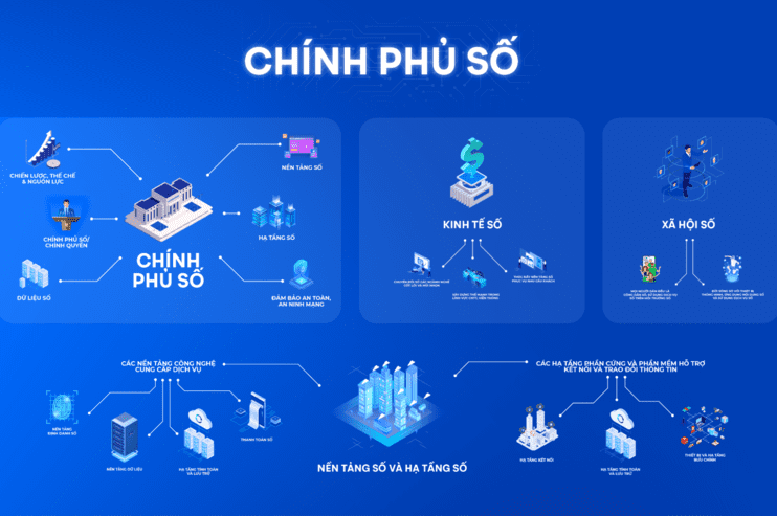
The application of information technology is helping to shorten the time and reduce paperwork in handling administrative procedures, promoting the development of a digital government - Photo: VGP/Thu Giang
Information technology is increasingly asserting its role as a core foundation in the process of transforming the national governance model, becoming an important driving force for building a digital government, aiming towards a modern, transparent, and service-oriented administration for citizens and businesses.
Amidst the strong global digital transformation, Vietnam has been striving to accelerate the application of information technology in state management and public service delivery, gradually changing the operating methods of the administrative apparatus towards a people-centered approach.
Reduce processing time and paperwork.
Over the years, the development of digital government has achieved many positive results, creating a clear transformation in administrative procedure reform. Many public services that previously required citizens to travel multiple times, submit paper documents, and wait for days to weeks are now provided online, significantly shortening processing time.
Allowing citizens and businesses to interact with government agencies "anytime, anywhere" through the digital environment not only improves management efficiency but also contributes to reducing social costs, increasing transparency, and enhancing citizen satisfaction.
Over the past period, ministries, sectors, and localities have focused on investing in the development of information technology infrastructure, building common platforms, and promoting data exploitation to serve management and administration.
One of the significant advancements is the formation and operation of shared data repositories and the National Data Integration and Sharing Platform (NDXP). Through the connection and interoperability of data between systems, the problem of "information fragmentation" is gradually being overcome, facilitating faster and more accurate processing of administrative procedures.
Furthermore, electronic identification and authentication solutions, electronic invoices, and digital signatures have become widely available, significantly reducing the use of traditional paper documents and records in transactions between citizens, businesses, and government agencies.
In practice, thanks to the application of information technology, many administrative procedures that previously took 3-7 days can now be resolved in just a few hours, or even entirely online.
This is clear evidence of the effectiveness of the transition from e-government to digital government, in which technology not only supports but also becomes the "backbone" of state management.
Standardize infrastructure and promote data sharing.
A highlight of this process is the deployment of citizen digital identification through the VNeID application. The digital identification system has created a platform for interconnecting population data with many important sectors such as taxation, insurance, healthcare , transportation, and other essential services.
Systematizing and effectively utilizing population data not only helps reduce information duplication and minimize paperwork for citizens but also supports state management agencies in analyzing data in real time, thereby improving the quality of forecasting and decision-making.
Alongside this, new technologies such as artificial intelligence (AI), blockchain, and cloud computing are gradually being researched and applied in the operations of government agencies.
AI is being used to automate the process of receiving and processing documents, classifying texts, detecting errors in procedural handling, and analyzing citizen satisfaction with public services. This not only reduces the workload for officials and civil servants but also enhances objectivity and efficiency in handling work.
Blockchain technology is also being tested in several areas such as land management, record traceability, and ensuring the transparency and integrity of data.
Meanwhile, cloud computing allows government agencies to optimize infrastructure investment costs, increase system scalability, and enhance data security in the context of ever-increasing volumes of information.
The research, development, and application of information technology not only aim to improve the quality of public services but also play a crucial role in the formation of a national data ecosystem.
Government ministries and agencies are gradually opening up data according to a suitable roadmap, creating conditions for businesses to exploit and develop new products and services, thereby promoting the digital economy and innovation. Open data, if managed and exploited effectively, will become an important resource for socio-economic development in the coming period.
In particular, perfecting institutions and policies is considered a key factor in ensuring the sustainable development of information technology. The enactment of the Law on Personal Data Protection, the amended Law on Electronic Transactions, and the Law on Artificial Intelligence will create a complete and clear legal framework for the application of technology in the public sector, while simultaneously ensuring the legitimate rights and interests of citizens in the digital environment.
Recently, on December 5th, the Prime Minister also issued Decision 2629/QD-TTg approving the Digital Government Development Program until 2030, focusing on building digital infrastructure, digital data, digital platforms, and applying advanced technologies such as AI, blockchain, and cloud computing.
However, the process of building a digital government still faces many challenges. Disparities in implementation capacity between localities, risks to information security, a shortage of high-quality IT personnel, and the need to integrate large-scale systems pose significant problems. If not addressed promptly, these challenges could affect the coherence and effectiveness of the entire system.
To overcome these challenges, Vietnam needs to continue standardizing its information technology infrastructure, further promote data sharing and interoperability among government agencies, and invest in building a modern national data center.
Furthermore, training and developing a team of officials and civil servants with comprehensive digital skills to meet the requirements of the digital administration is a strategic and long-term task.
When implemented in a synchronized, systematic, and people-centered manner, information technology will continue to be a crucial driving force bringing Vietnam closer to a transparent and efficient digital government model, better serving the country's development in the digital age.
Thu Giang
Source: https://baochinhphu.vn/chia-khoa-nang-cao-hieu-qua-giai-quyet-thu-tuc-hanh-chinh-thuc-day-chinh-phu-so-102251214152437178.htm
































































































Comment (0)