

The National Museum of History recently inaugurated a thematic exhibition titled 'Ancient Bat Trang Ceramics' on the occasion of International Museum Day (May 18, 2023).
The exhibition aims to introduce to the public a unique and distinctive collection of ancient Bat Trang ceramics from the 14th to the 20th centuries, giving domestic and international visitors the opportunity to appreciate a rich collection of ancient Bat Trang ceramics with high artistic value, currently preserved at the National Museum of History.
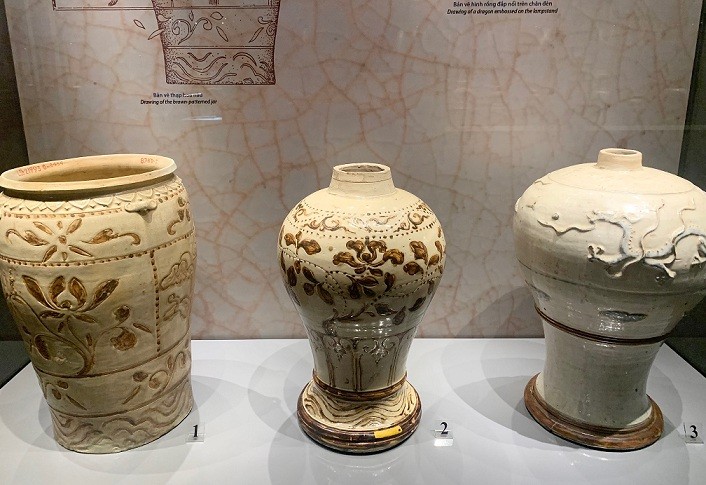 |
| One of the unique and distinctive artifacts of ancient Bat Trang pottery. (Photo: Le An) |
The exhibition is divided into four sections: History of Formation; Bat Trang Pottery in the 14th Century; Bat Trang Pottery in the 15th-18th Centuries; and Bat Trang Pottery in the 19th-20th Centuries.
According to written historical records, the area of Bat Trang was called Bat commune, first recorded in the Dai Viet History Chronicle in 1352. In the 15th century, the name Bat Trang commune appeared and was recognized as a famous pottery village. Nguyen Trai's Geographical Gazetteer (1380-1442) wrote: "Bat Trang village makes bowls and cups."
Around the present-day Bat Trang area, at the Le Xa and Dao Xuyen sites in Da Ton commune, a number of Bat Trang pottery artifacts dating from the late 14th and early 15th centuries have been discovered and collected, such as brown flower pots, blue and white plates, and many other artifacts that are remnants of pottery kilns.
Archaeological excavations conducted between 2001 and 2003 by the Vietnam National Museum of History, the Institute of Archaeology, and other research institutions at the Kim Lan site – a commune adjacent to the south of Bat Trang commune – have uncovered relics and artifacts dating from the 9th to the 19th-20th centuries, particularly cultural layers dating from the 9th-10th and 13th-14th centuries.
Among them, a large number of artifacts are household items such as bowls, plates, basins, spittoons, etc., concentrated in characteristic glazes of the Tran Dynasty, similar to the known glazed ceramic collection at Da Ton.
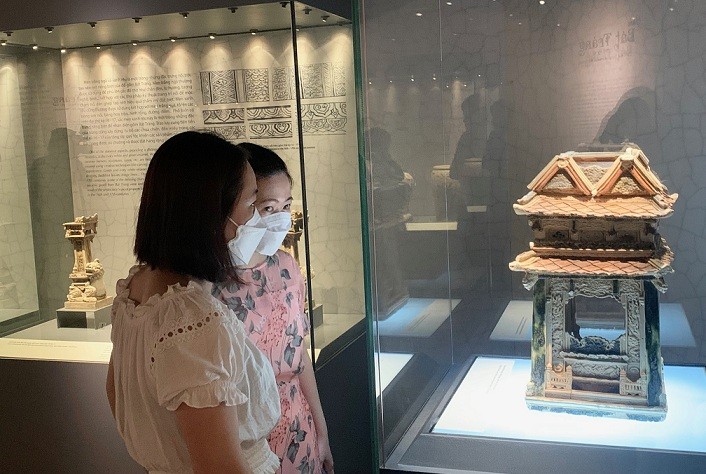 |
| Visitors view the exhibition space showcasing ancient pottery. (Photo: Le An) |
In addition, there are artifacts reflecting local pottery production techniques such as kiln linings, supports, discarded items, glaze blocks, etc., indicating that this was a large-scale ancient pottery production area.
It wasn't until 1958 that this area was divided into two by the Bac Hung Hai irrigation project. Today, Bat Trang commune is located on the left bank of the Red River, bordered to the north by Dong Du commune, to the east by Da Ton commune, to the west by the Red River, and to the south by Kim Lan and Xuan Quan communes.
Sharing his thoughts on the exhibition, Dr. Nguyen Van Doan, Director of the National Museum of History, affirmed that with its long history and the convergence of the finest elements embodying the unique cultural values of the nation, Bat Trang ceramics have become an object of research and collection by the museum over many periods, forming a valuable collection.
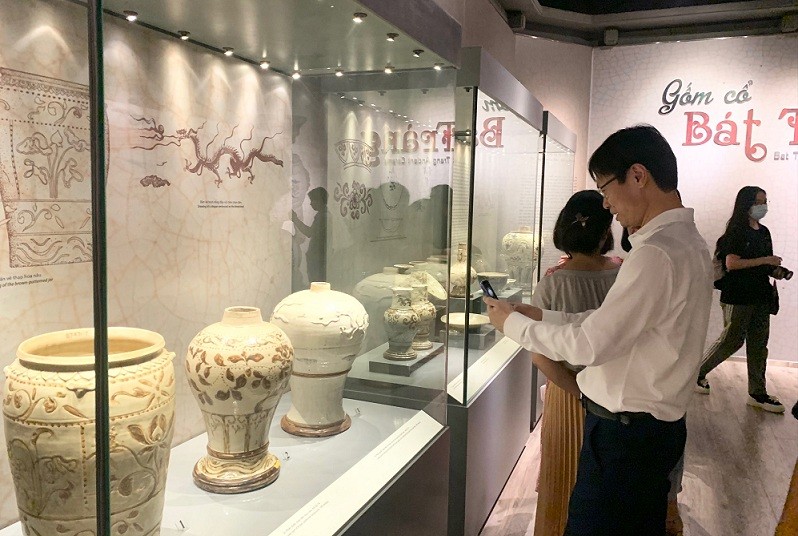 |
| The exhibition runs until September 2023. |
Through the thematic exhibition "Ancient Bat Trang Ceramics," the National Museum of History aims to introduce a rich collection of glazed ceramics with high historical, cultural, and artistic value, thereby helping the public to deeply understand and appreciate traditional cultural values, and raise awareness of preserving and promoting national history.
Source

![[Photo] Prime Minister Pham Minh Chinh holds a phone call with the CEO of Russia's Rosatom Corporation.](/_next/image?url=https%3A%2F%2Fvphoto.vietnam.vn%2Fthumb%2F1200x675%2Fvietnam%2Fresource%2FIMAGE%2F2025%2F12%2F11%2F1765464552365_dsc-5295-jpg.webp&w=3840&q=75)
![[Photo] Closing Ceremony of the 10th Session of the 15th National Assembly](/_next/image?url=https%3A%2F%2Fvphoto.vietnam.vn%2Fthumb%2F1200x675%2Fvietnam%2Fresource%2FIMAGE%2F2025%2F12%2F11%2F1765448959967_image-1437-jpg.webp&w=3840&q=75)


















































![[OFFICIAL] MISA GROUP ANNOUNCES ITS PIONEERING BRAND POSITIONING IN BUILDING AGENTIC AI FOR BUSINESSES, HOUSEHOLDS, AND THE GOVERNMENT](https://vphoto.vietnam.vn/thumb/402x226/vietnam/resource/IMAGE/2025/12/11/1765444754256_agentic-ai_postfb-scaled.png)












































Comment (0)