

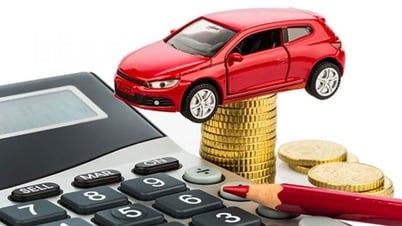
According to the draft revised Law on Special Consumption Tax currently being finalized by the Ministry of Finance , self-charging hybrid electric vehicles (HEVs) with 9 seats or fewer will be subject to an increased tax rate.
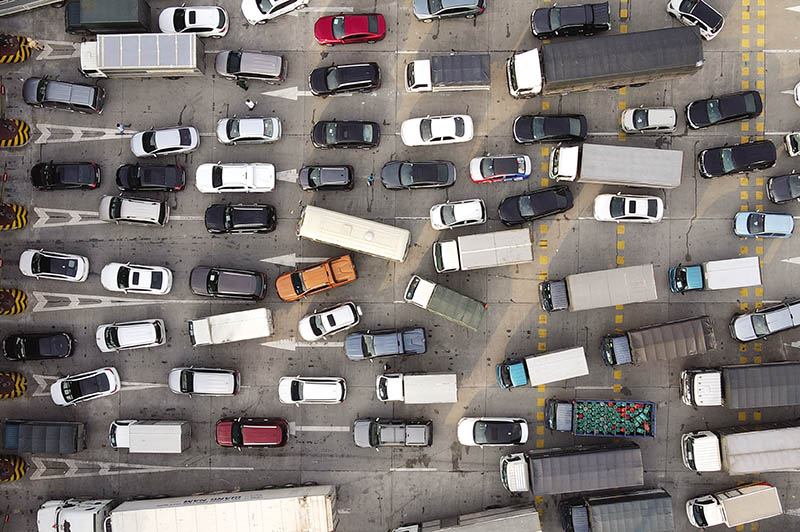 |
| The preferential excise tax treatment for PHEV and HEV vehicles contributes to reducing air pollution in major cities. |
Many countries offer tax incentives for PHEV and HEV vehicles.
According to the current Special Consumption Tax Law, gasoline-powered cars combined with electric vehicles, where the proportion of gasoline used does not exceed 70% of the total energy used, are subject to a special consumption tax rate equal to 70% of the rate applied to similar vehicles using internal combustion engines.
The Ministry of Finance argues that the regulation encourages consumers to use environmentally friendly vehicles, which are vehicles with both gasoline and electric engines. Under normal conditions, the vehicle mainly runs on the electric motor, while the gasoline engine serves as a backup (when the battery used to power the electric motor runs out of power). The amount of emissions released into the environment is much lower than that of other conventional cars.
However, to avoid confusion with hybrid vehicles (HEVs) which have two engines and under normal conditions mainly run on gasoline engines, tax incentives are only granted to plug-in electric vehicles (PHEVs) with a tax rate equal to 70% of the tax rate applied to gasoline-powered vehicles. Thus, HEVs will be subject to the same special consumption tax rate as gasoline-powered vehicles, instead of only 70% as currently.
According to the Vietnam Automobile Manufacturers Association (VAMA), the current rate of HEV and PHEV vehicle usage in Vietnam is not as high as in many other countries, affecting the Vietnamese government's Net Zero commitment by 2050. This is because the current preferential excise tax is not attractive, while the selling price of these two types of vehicles is 10-20% higher than comparable fuel-powered vehicles.
Therefore, VAMA proposes applying the current excise tax rate to HEVs (70% of the rate for gasoline/diesel cars of the same type) and to PHEVs (50% of the rate for gasoline/diesel cars) instead of the current 70%. "HEVs reduce fuel consumption/emissions by 30-40% compared to similar internal combustion engine vehicles, while PHEVs save over 50% compared to internal combustion engine vehicles, so their use should be encouraged," VAMA suggested.
According to Mr. Nguyen Ngoc Thai, Executive Member of Tax Services and Business Support at KPMG Tax & Consulting Company Limited, countries around the world and in the region apply preferential excise tax policies to these two types of vehicles. For example, Thailand applies a lower preferential tax rate of 17% to 27% compared to internal combustion engine vehicles; Indonesia applies a lower rate of 8% to 40%.
As a result, in Thailand, total consumption of PHEV and HEV vehicles increased by 86.58% in 2022; the market share of PHEV and HEV vehicles increased from 2% in 2018 to 15% in 2023. In Indonesia, sales of energy-efficient vehicles increased by 22% annually.
We must nurture sources of revenue.
According to VAMA's calculations, if the special consumption tax rate for PHEVs is set at 50% and for HEVs at 70% compared to internal combustion engine vehicles, the state budget revenue will decrease in the short term, but not significantly. In return, Vietnam will reduce fuel consumption by more than 1 million liters annually, equivalent to 27 trillion VND; and reduce import demand by more than 14 million barrels of crude oil, equivalent to 29 trillion VND, thereby reducing pressure on Vietnam's trade balance.
The preferential excise tax treatment for PHEV and HEV vehicles helps consumers access these models at a more reasonable cost, thereby reducing total CO2 emissions by more than 2.6 million tons. This contributes to achieving the government's carbon reduction targets in the transportation sector; it also helps reduce air pollution and harmful impacts on human health, especially in large cities like Hanoi and Ho Chi Minh City.
Vietnam, like other countries around the world, is developing tax policies that aim to reduce direct taxes and increase indirect taxes. Value-added tax and special consumption tax, which are indirect taxes (levied on consumers through businesses), have been adjusted upwards in this revision. According to Mr. Nguyen Van Phung, former Director of the Department of Large Enterprise Tax Management (General Department of Taxation), this is in line with the global trend to balance revenue sources resulting from reductions in other taxes.
To increase personal allowances and thereby reduce personal income tax; to raise the taxable revenue threshold from 100 million VND to 200 million VND per year for household and individual businesses; and to implement incentives that indirectly reduce corporate income tax, thereby encouraging organizations and individuals to invest capital and increasing competitiveness in attracting foreign investment, it is necessary to increase indirect taxes to ensure that revenue covers expenses.
"However, the decision on which goods to increase taxes on, and by how much, must be calculated based on encouraging investment and nurturing revenue sources, so that the state budget can achieve stable and long-term revenue growth. If the tax increase policy is unreasonable, the state budget will not only fail to increase revenue, but may even experience a decrease," Mr. Phung warned.
Japan also implements tax incentives for HEV and PHEV vehicles. As a result, in 2022, HEV sales accounted for 40% of the market share, surpassing the number of internal combustion engine vehicles sold; PHEV sales in 2022 reached 37,000 units, double the number sold in 2021.
Source: https://baodautu.vn/chua-nen-tang-thue-tieu-thu-dac-biet-voi-xe-hev-d223412.html
![[Photo] Closing Ceremony of the 10th Session of the 15th National Assembly](/_next/image?url=https%3A%2F%2Fvphoto.vietnam.vn%2Fthumb%2F1200x675%2Fvietnam%2Fresource%2FIMAGE%2F2025%2F12%2F11%2F1765448959967_image-1437-jpg.webp&w=3840&q=75)
![[Photo] Prime Minister Pham Minh Chinh holds a phone call with the CEO of Russia's Rosatom Corporation.](/_next/image?url=https%3A%2F%2Fvphoto.vietnam.vn%2Fthumb%2F1200x675%2Fvietnam%2Fresource%2FIMAGE%2F2025%2F12%2F11%2F1765464552365_dsc-5295-jpg.webp&w=3840&q=75)









































![[OFFICIAL] MISA GROUP ANNOUNCES ITS PIONEERING BRAND POSITIONING IN BUILDING AGENTIC AI FOR BUSINESSES, HOUSEHOLDS, AND THE GOVERNMENT](https://vphoto.vietnam.vn/thumb/402x226/vietnam/resource/IMAGE/2025/12/11/1765444754256_agentic-ai_postfb-scaled.png)
















































Comment (0)