

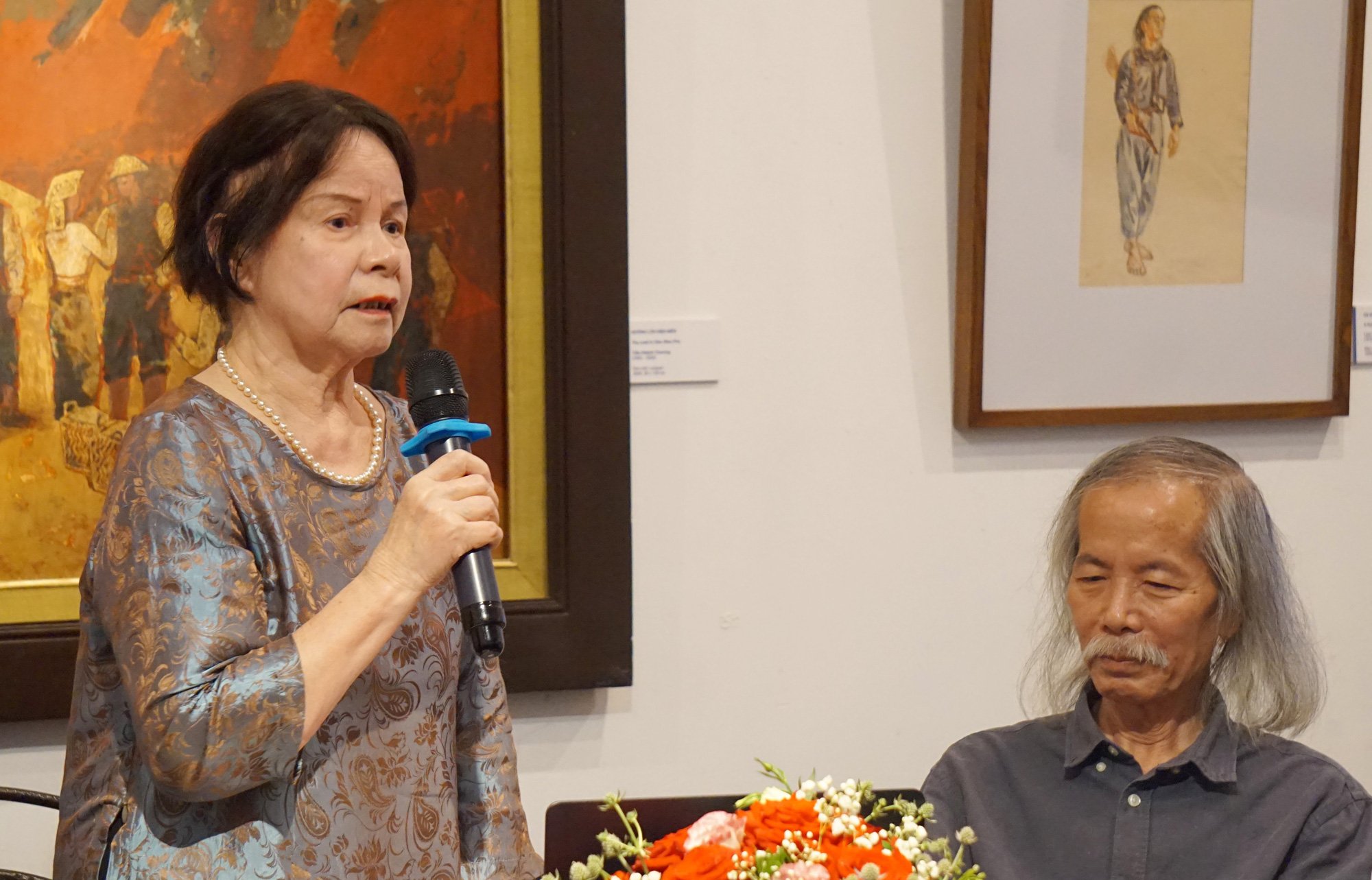
Art critic Nguyen Hai Yen (left) and painter Luong Xuan Doan share about painter To Ngoc Van - Photo: T.DIEU
As part of the "Road to Dien Bien Phu" exhibition currently taking place at the Vietnam Fine Arts Museum, a talk about the painter To Ngoc Van was held on the morning of May 11th. The artist's name attracted a large number of attendees.
Fossils of Vietnamese beauty
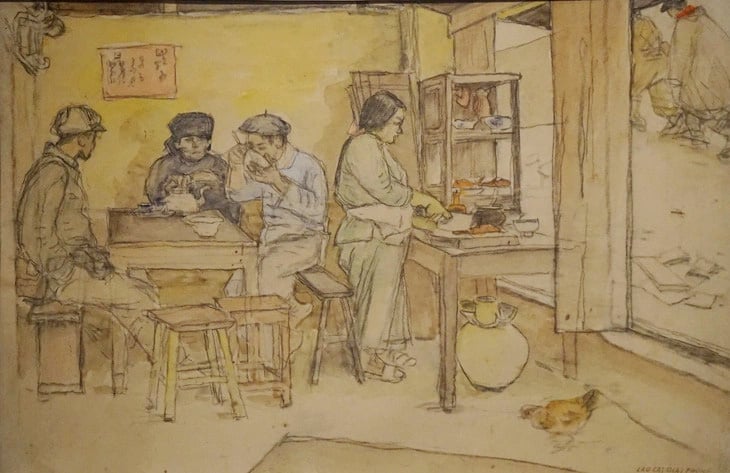
Watercolor sketch Roadside Shop by To Ngoc Van belongs to Vietnam Fine Arts Museum
As one of the first staff members at the Vietnam Fine Arts Museum (established in 1966), art critic Nguyen Hai Yen stated that painter To Ngoc Van studied in the second class of the Indochina College of Fine Arts.
Exposure to Western art movements through French professors led to a significant influence on To Ngoc Van from classical, impressionistic, and post-impressionist artistic trends, particularly in his paintings before 1945.
During this creative period, To Ngoc Van left behind many works filled with light, painting landscapes and very beautiful women.
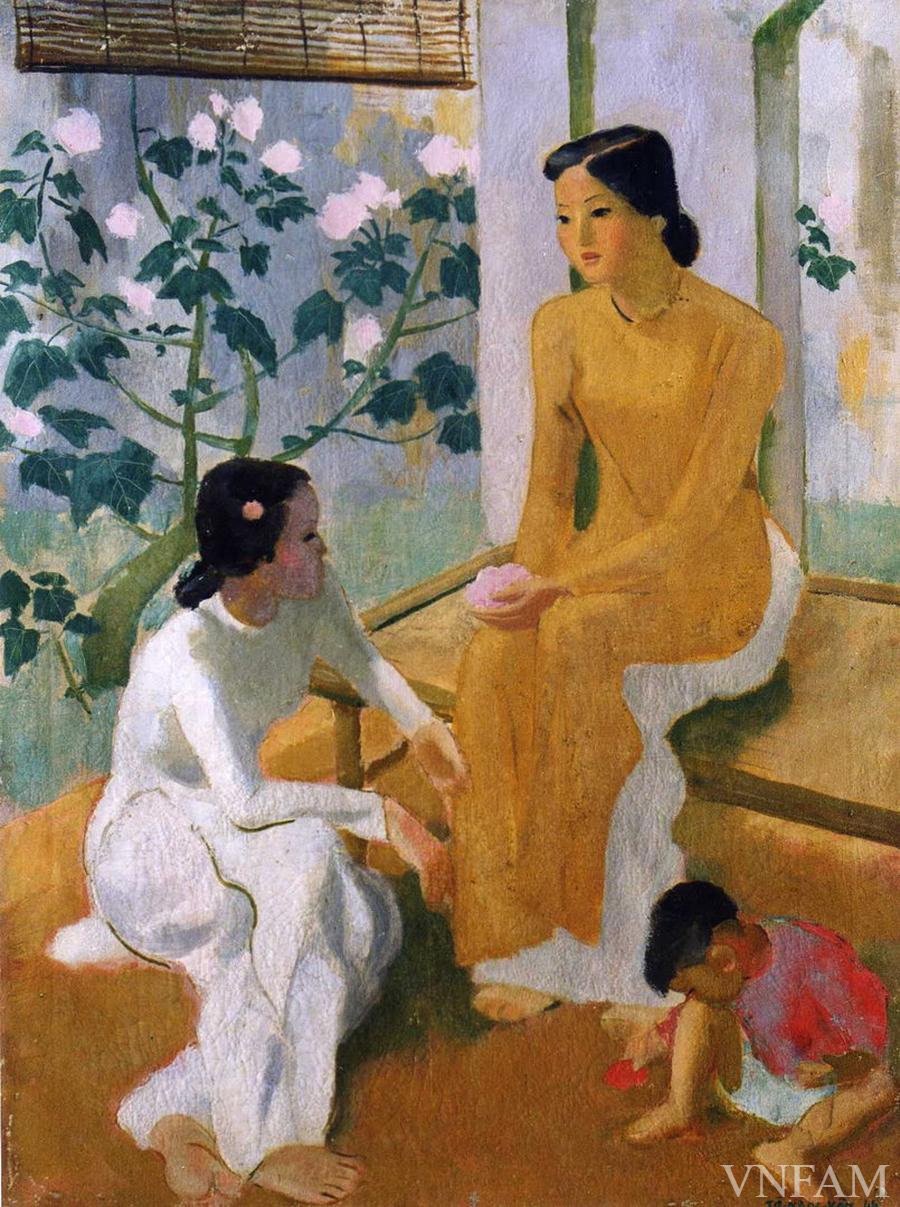
The work Two young women and a baby by artist To Ngoc Van, a national treasure - Photo: Vietnam Fine Arts Museum
Among them is the painting Two young women and a baby, currently in the collection of the Vietnam Fine Arts Museum and recognized as a national treasure.
Speaking about this painting, artist Luong Xuan Doan - president of the Vietnam Fine Arts Association - affirmed that To Ngoc Van had immortalized the beauty of Vietnamese women in a peaceful setting with a trellis of hibiscus flowers on the veranda.
He fossilized the beauty of urban girls of the past, an eternal beauty that never gets old and is very hard to find today.
According to Mr. Doan, To Ngoc Van's oil paintings were greatly influenced by modern European art, but his works are very purely Vietnamese, with soft lines and a skillful handling of color that deeply reflects the Vietnamese spirit.
During the period from 1945 to 1954, a different To Ngoc Van emerged, a courageous soldier on the battlefields.
Ms. Hai Yen recounted that in 1944 the situation was very tense, the Indochina Fine Arts School was temporarily closed, and it was divided into two groups.
A group of sculpture and architecture students followed the headmaster to Da Lat. Another group of painting students followed painters Nam Son, To Ngoc Van, and a French professor to Duong Lam, Son Tay.
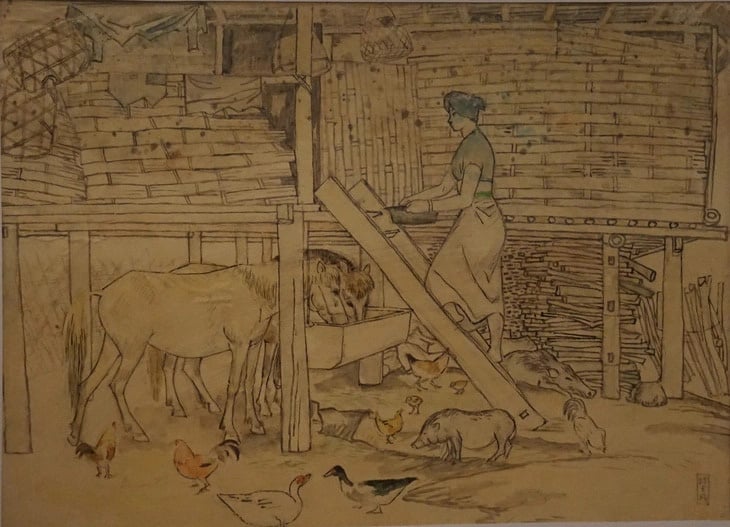
Watercolor sketch Feeding the horse by To Ngoc Van on the way to the Dien Bien Phu front - Photo: T.DIEU
From Son Tay, these artists moved to Viet Bac, forming two organizations: the Vietnam Fine Arts School, headed by artist To Ngoc Van, and the Viet Bac Arts and Literature Association, chaired by artist Tran Van Can.
These two organizations ushered in a new era of Vietnamese art, marking the end of the modern period with the Indochinese artists.
During the resistance war, although very busy teaching students at the Vietnam Fine Arts School (still known as the resistance course), as soon as the school graduated at the end of 1953, painter To Ngoc Van immediately went with his colleagues and students to Dien Bien Phu to sketch battlefield designs.
And it was on this very journey that, in June 1954, To Ngoc Van was killed near Lung Lo Pass, just as the Battle of Dien Bien Phu had ended.
Mr. Doan said that the battlefield sketches left behind by To Ngoc Van show that the artist transitioned from academic painting to the most realistic drawings to depict the faces and personalities of Vietnamese people during the resistance against the French, from elderly women to country girls.
"To Ngoc Van was the soul of the resistance movement. He discovered talented students like Luu Cong Nhan, Tran Luu Hau, Trong Kiem, Le Huy Hoa..., quietly inspiring them without imposing any of his own ideas on them," said Luong Xuan Doan.
Two young girls and a baby from To Ngoc Van's story visit the museum.
According to Ms. Nguyen Hai Yen, the fact that this precious painting by artist To Ngoc Van has arrived at the Vietnam Fine Arts Museum is a great stroke of luck for the museum and also a great stroke of luck for the artwork itself.
After graduating from the University of Culture in 1964, Ms. Yen went to work for the Vietnam Fine Arts Museum, which had been established since 1962.
Before the museum was officially established in 1966, painter Nguyen Do Cung - founder of the Vietnam Fine Arts Museum - sent his students and staff to families in Hanoi to collect modern art works. Fortunately, at that time, photographer Le Vuong was invited by Mr. Nguyen Do Cung to work at the Vietnam Fine Arts Museum.
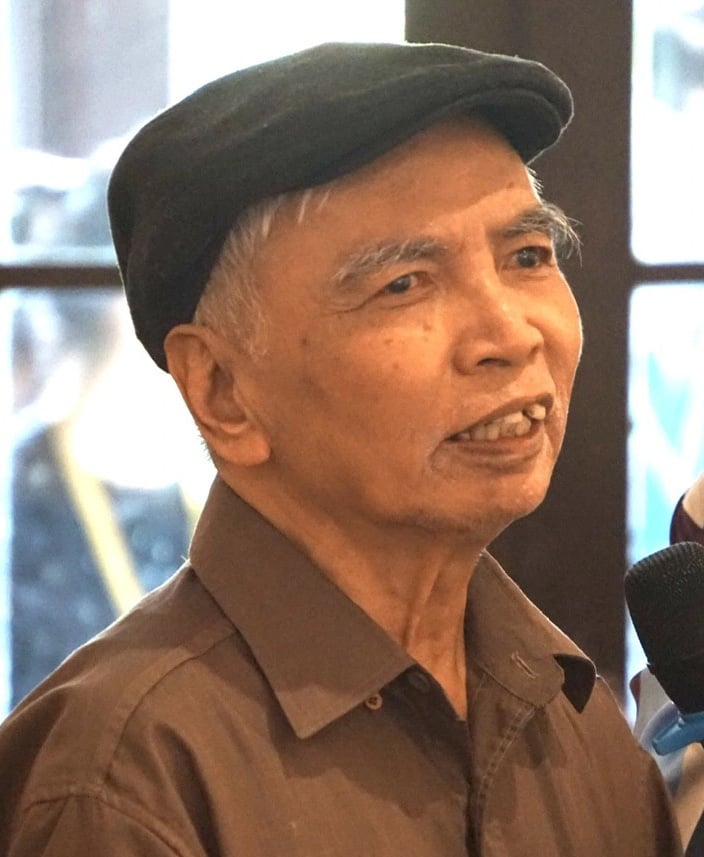
Artist To Ngoc Thanh shares stories about his father - the renowned painter To Ngoc Van - Photo: T. DIEU
Mr. Le Vuong knew many people in the artistic community, and he was particularly close friends with photographer Do Huan at 30 Nguyen Thai Hoc Street, Hanoi.
Seeing that his friend worked at the Vietnam Fine Arts Museum, Mr. Do Huan once told Mr. Le Vuong that his house had a painting by the artist Tran Van Can, which the Vietnam Fine Arts Association often borrowed for exhibitions, so Mr. Huan suggested that Mr. Vuong bring the painting to the museum.
Thanks to that, the painting Em Thuy has appeared in the collection of the Vietnam Fine Arts Museum.
Later, Mr. Huan himself pointed out to Mr. Vuong that there was a family in Hanoi who possessed the painting "Two Young Women and a Baby" by the artist To Ngoc Van.
That was the family of Dr. Nguyen Tan Gi Trong. Mr. Vuong went to persuade this famous doctor, and he agreed to donate the painting to the Vietnam Fine Arts Museum. Now, the painting has become a national treasure.
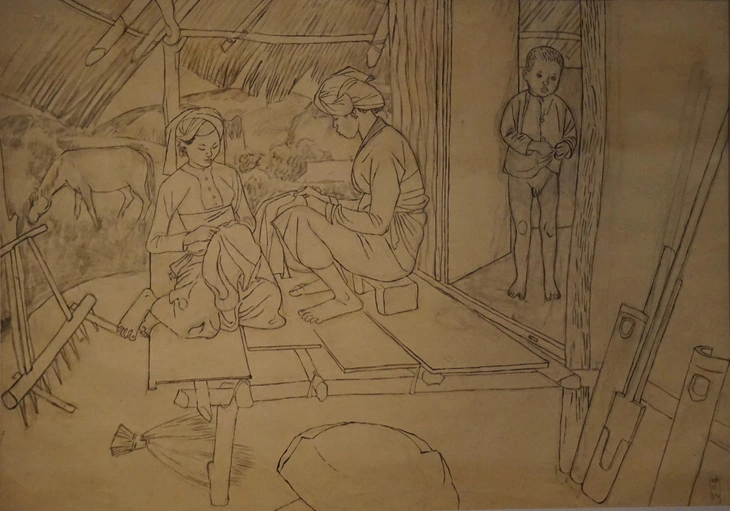
Ink print depicting the scene of sewing a shirt, painted by artist To Ngoc Van on his way to the Dien Bien Phu front - Photo: T. DIEU
To Ngoc Van's sleepless nights
During the conversation, artist To Ngoc Thanh - son of the renowned painter To Ngoc Van - recounted his father's two sleepless nights while painting President Ho Chi Minh at the Presidential Palace in Northern Vietnam.
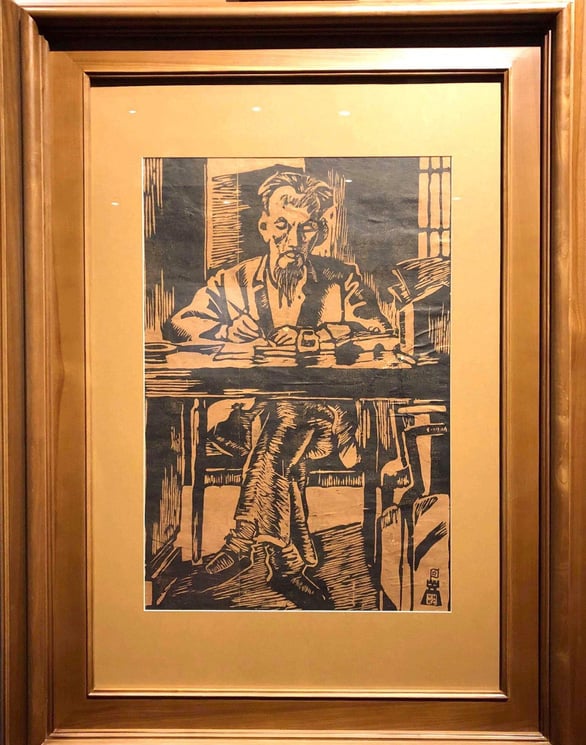
Woodcut painting of Uncle Ho working in the Northern Palace, painted by artist To Ngoc Van in 1946, currently in the collection of the Ho Chi Minh Museum - Photo: T.DIEU
Mr. Thanh recounted that in 1946, his father and several other artists went to the Presidential Palace in Northern Vietnam to paint a portrait of President Ho Chi Minh.
Painter To Ngoc Van asked Uncle Ho for permission to paint in three days and complete it in three weeks. Uncle Ho replied that painting in three months was reasonable, let alone three weeks.
Listening to Uncle Ho's words, painter To Ngoc Van realized that Uncle Ho understood that art requires time to create well.
The artist was deeply moved, and couldn't sleep all night because he saw that the leader could have such a profound understanding of art.
The second sleepless night of painter To Ngoc Van was the day he finished painting Uncle Ho, Uncle Ho asked painter To Ngoc Van how many children he had.
When the artist replied that he had four children, Uncle Ho took four powdered candies wrapped in newspaper from his drawer and gave them to To Ngoc Van to take home for his children, without taking the delicious imported candies on the table.
Once again, the artist received a precious message from the nation's leader: Art must have a national character. To Ngoc Van tossed and turned, unable to sleep for another night because of that lesson.
Source: https://tuoitre.vn/chuyen-chua-biet-ve-nhung-dem-mat-ngu-cua-hoa-si-to-ngoc-van-va-buc-tranh-thanh-bao-vat-20240512085042175.htm







































![[Podcast] National Assembly approves personal allowance deduction of VND 15.5 million/month](https://vphoto.vietnam.vn/thumb/402x226/vietnam/resource/IMAGE/2025/12/10/1765340032834_hnm-1cdn-vn-thumbs-540x360-2025-11-04-_hnm-1cdn-vn-thumbs-540x360-2025-06-27-a7b22b8722-_thu.jpeg)














Comment (0)