


Minister of Public Security Luong Tam Quang presents a report on receiving, explaining and revising the law before the National Assembly passes it - Photo: GIA HAN
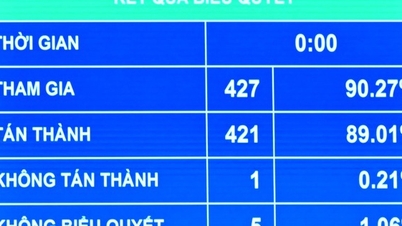
On the morning of December 10th, with 425 out of 433 delegates voting in favor, the National Assembly passed the Law amending and supplementing a number of articles of 10 laws related to security and order. The law will take effect from July 1st, 2026.
This includes the Law on Security Guarding; the Law on Entry, Exit, Transit, and Residence of Foreigners in Vietnam; the Law on Exit and Entry of Vietnamese Citizens; the Law on Residence; the Law on Identity Cards; the Law on Forces Participating in Protecting Security and Order at the Local Level; the Law on Road Traffic Order and Safety; the Law on Roads; the Law on Management and Use of Weapons, Explosives, and Support Tools; and the Law on Fire Prevention, Firefighting, and Rescue.
Passenger transport vehicles are not required to be equipped with child seats.
Notably, the Law on Road Traffic Order and Safety has amended and supplemented regulations on child seats in cars.
Specifically, the newly passed law stipulates that when transporting children under 10 years old and under 1.35m tall in a car, the driver is not allowed to have the child sit in the same row of seats, except in cars with only one row of seats.
Drivers must use and instruct drivers on the use of appropriate child safety equipment, except for vehicles used for commercial passenger transport. This regulation will take effect from January 1, 2026.
Previously, the Law on Road Traffic Safety stipulated that when transporting children under 10 years old and under 1.35m tall in a car, children were not allowed to sit in the same row of seats as the driver, except for cars with only one row of seats.
Drivers must use and instruct in the use of appropriate child restraint devices. This regulation will come into effect from 1-1-2026.
Thus, compared to the old law, the new law has excluded passenger transport business cars.
This includes: fixed-route passenger transport business, public passenger transport business by bus, passenger transport business by taxi, contract-based passenger transport business, and new types of passenger transport business as prescribed by the Government .
At the same time, the implementation time of this regulation is postponed to July 1, 2026 instead of January 1, 2026.
Previously, in the report explaining, receiving feedback, and revising the draft law, the Government stated that there were suggestions that the regulations should only apply to family cars and passenger vehicles traveling on highways... For taxis and service vehicles in the city, exemptions should be considered to better suit practical realities.
The Government has accepted and adjusted as above.
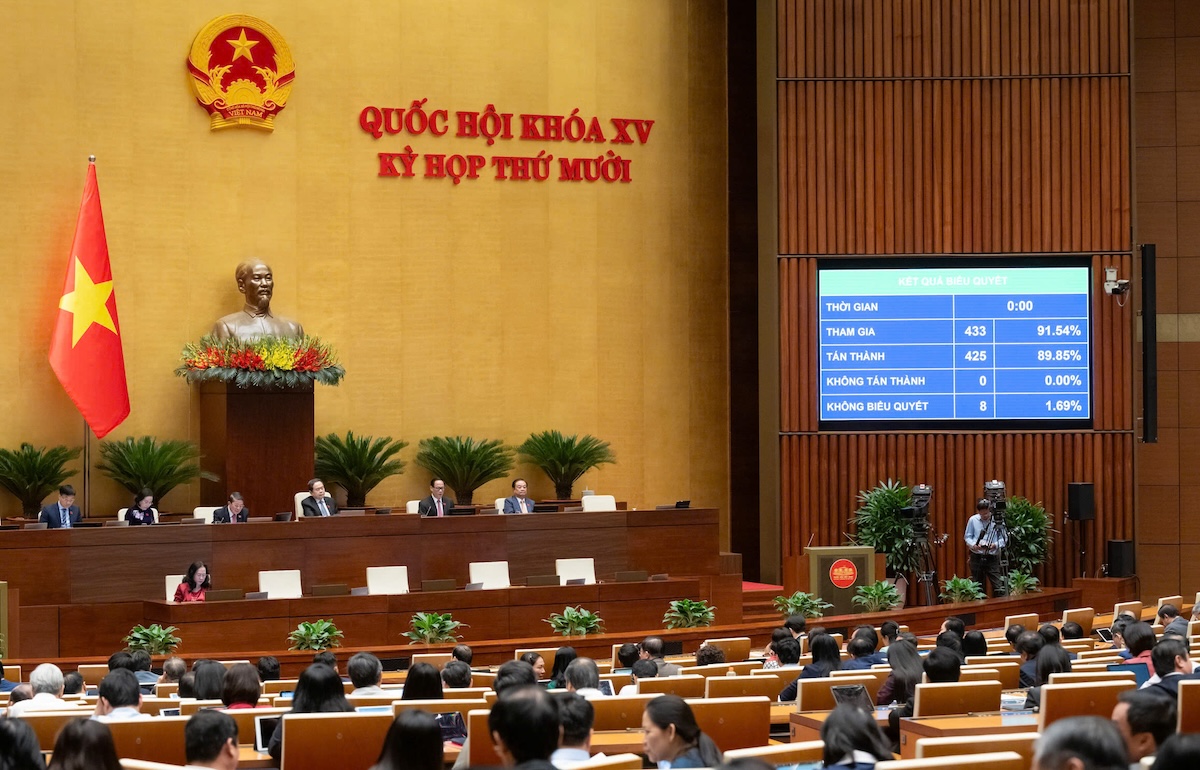
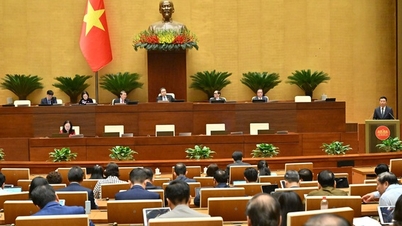
The National Assembly voted to pass the law - Photo: GIA HAN
Regulations on installing cameras in the passenger compartment of cars
Another provision, the newly passed law also stipulates that commercial vehicles for transporting goods, commercial vehicles for transporting passengers with fewer than 8 seats (excluding the driver's seat), tractor-trailers, ambulances, and internal transport vehicles must be equipped with vehicle tracking devices and driver image recording devices.
Passenger transport vehicles with 8 or more seats (excluding the driver's seat) must be equipped with a vehicle tracking device, a device to record images of the driver, and a device to record images of the passenger compartment.
The processing of data obtained from driver image recording devices and passenger compartment recording devices shall be carried out in accordance with the law on personal data protection and other relevant legal regulations.
In the report explaining, receiving feedback, and revising the draft law before its approval by the National Assembly, the Government stated that a review revealed that approximately 121,041 passenger transport vehicles with 8 seats or more are required to install passenger compartment surveillance cameras.
Approximately 300,000 freight transport vehicles and passenger transport vehicles with less than 8 seats must install cameras to record images of the driver.
While this regulation is assessed to incur initial costs, its overall impact is considered positive, with low costs but high efficiency, making it suitable for widespread application and bringing significant benefits to businesses, passengers, and government agencies.
The report also stated that the vehicle tracking device only records data on the vehicle's location, speed, and journey.
The driver image recording device only records, stores, and transmits image data of the driver while participating in traffic, for the purposes of safety monitoring, handling violations, evaluating work performance, and assisting drivers.
These devices do not record images of passengers on board the vehicle and therefore do not violate individual privacy...
Remove the regulation limiting driving hours to no more than 48 hours per week.
The newly passed law stipulates that the continuous driving time of a driver shall not exceed 4 hours, except in cases of force majeure or objective obstacles. The working hours of drivers per day and per week shall be in accordance with the provisions of the Labor Code.
According to current regulations in the Law on Road Traffic Order and Safety, the driving time for car drivers is no more than 10 hours per day and no more than 48 hours per week; continuous driving is no more than 4 hours, and relevant provisions of the Labor Code must be complied with.
Thus, the new law has removed the regulation that car drivers' driving time is no more than 10 hours a day and no more than 48 hours a week.
Regarding this matter, in the report on receiving feedback, explaining, and revising the draft law, the Government clearly stated that the regulation on continuous driving time not exceeding 4 hours inherits the regulation that has been implemented stably for many years.
At the same time, in line with international experience, and based on scientific evidence and the psychological, physiological, and health conditions of drivers, especially those engaged in long-distance freight and passenger transport, this approach is particularly relevant.
Currently, the law only regulates drivers of commercial transport vehicles because they pose a higher risk of traffic accidents than personal vehicles.
For private drivers, the immediate recommendation should be to limit driving to no more than 4 hours; it shouldn't be mandatory yet, as many countries around the world do not have such regulations for private drivers...
Source: https://tuoitre.vn/quoc-hoi-chot-taxi-xe-dich-vu-khong-phai-trang-bi-ghe-ngoi-cho-tre-em-20251210101743158.htm

![[Photo] Explore the US Navy's USS Robert Smalls warship](/_next/image?url=https%3A%2F%2Fvphoto.vietnam.vn%2Fthumb%2F1200x675%2Fvietnam%2Fresource%2FIMAGE%2F2025%2F12%2F10%2F1765341533272_11212121-8303-jpg.webp&w=3840&q=75)


























![[Video] The craft of making Dong Ho folk paintings has been inscribed by UNESCO on the List of Crafts in Need of Urgent Safeguarding.](https://vphoto.vietnam.vn/thumb/402x226/vietnam/resource/IMAGE/2025/12/10/1765350246533_tranh-dong-ho-734-jpg.webp)
































































Comment (0)