

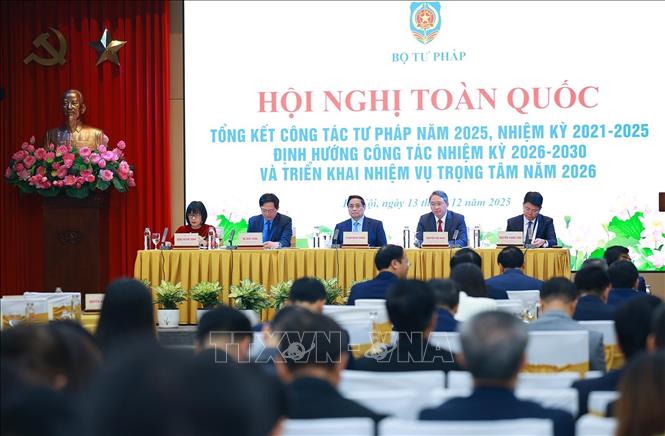
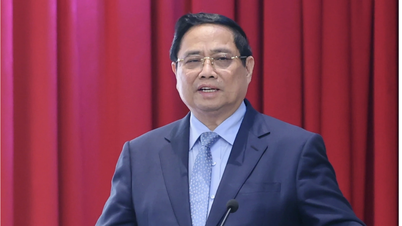
Speaking at the conference, the Prime Minister emphasized the need for continued shift in mindset, defining institutions and laws as resources, driving forces, and goals of development; investing in institution and legal development is investing in development; institution and legal development must be centered around the people and businesses; and institution and legal development must become a national competitive advantage.
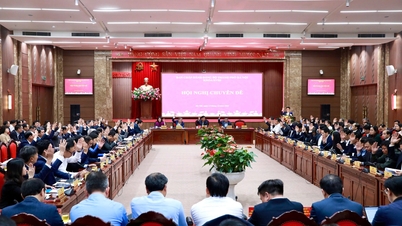
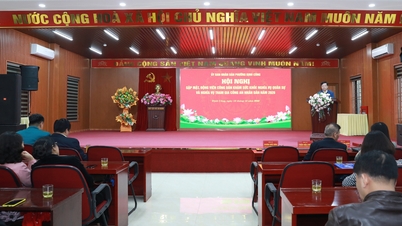
The conference was organized by the Ministry of Justice, held in person in Hanoi and online with participation from 34 provinces and cities. Attending the conference were Politburo member, Secretary of the Central Committee of the Communist Party of Vietnam, and Head of the Central Internal Affairs Commission Phan Dinh Trac; Deputy Prime Ministers Le Thanh Long and Ho Quoc Dung; leaders of central ministries, departments, and agencies; and leaders of provinces and cities.
Advising on the largest legislative task ever.

The conference assessed that, during the 2021-2025 period, despite numerous difficulties and challenges worldwide, Vietnam's socio-economic situation continued to achieve many important and comprehensive results in most areas. In this context, the Ministry and the Justice sector closely followed the resolutions, conclusions, and directives of the Politburo and the Secretariat, as well as the resolutions and directives of the National Assembly, the Government, and the Prime Minister; and adhered to the goals and programs for socio-economic development for the 2021-2025 five-year period and annually as outlined in the resolutions of the National Assembly, the Government, and each locality.
Implementing strategic breakthroughs in building and perfecting institutions and laws to transform them into competitive advantages, along with efforts to effectively carry out regular tasks, the entire Justice sector has focused on promptly resolving newly arising issues; proactively and urgently identifying key tasks, promptly developing, issuing, and adjusting work programs and plans, ensuring priorities, and concentrating resources to comprehensively and effectively implement assigned tasks.
The Ministry of Justice has proactively and actively advised the Government and the National Assembly on proposing major and key policy directions in legal reform, judicial reform, building and perfecting the socialist rule of law in Vietnam, and perfecting the socialist-oriented market economy to effectively implement the Resolution of the 13th National Congress of the Party and the Resolutions of the 13th Central Committee Conferences, most notably advising the Politburo to issue Resolution No. 66-NQ/TW.
The Ministry of Justice has promptly advised on the promulgation of the Law on the Promulgation of Legal Normative Documents in 2025, and resolutions of the National Assembly to concretize the guiding principles on reforming the law-making work of the Party and State leaders; responsibly participated in resolving difficult and complex issues that arose, contributing to removing obstacles hindering development, ensuring the legitimate rights and interests of the people, and creating favorable conditions for investment, production, and business; and advised on the effective implementation of the activities of the Central Steering Committee on institutional and legal improvement and the Steering Committee for reviewing and organizing the implementation of handling obstacles in the legal system.
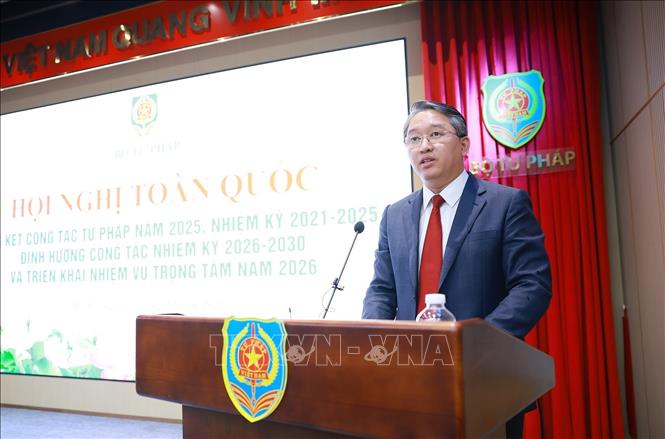
During the term, ministries and agencies advised the Government to submit to the National Assembly the largest volume of legislative tasks ever, with nearly 180 draft laws and resolutions; ministries and agencies drafted, submitted for promulgation, or promulgated under their authority 4,974 legal documents; localities promulgated 51,799 legal documents. The entire sector reviewed more than 52,000 draft legal documents…
The dissemination of legal education continues to be emphasized with many new and effective models and approaches. In particular, the development and operation of the National Legal Portal is a significant step forward, effectively meeting the needs of citizens and businesses in accessing policies and laws in the digital environment.
Civil enforcement work and monitoring of administrative enforcement continue to make significant progress, with fundamental changes in organizational models. The rate of enforcement of judgments, both in terms of cases and monetary value, has increased over the years, contributing to ensuring security, order, and social safety, upholding justice, and improving the investment and business environment.
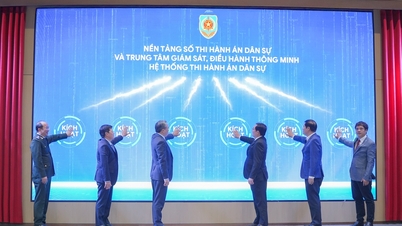
Judicial administration focuses on reforming administrative procedures and strongly applying information technology. The national electronic civil registry database has been put into operation, connecting with the national population database, contributing to the digitization of population management, facilitating the issuance of civil registration documents conveniently and quickly, saving costs for citizens, and playing an important role in the process of administrative reform, building an e-government, and moving towards a digital government.
The work of supporting the judicial system has undergone many innovations and continues to be socialized in accordance with the spirit of the Judicial Reform Strategy. Fields such as lawyers, notaries, legal consulting, asset auctions, and arbitration have developed both in scale and quality, contributing to ensuring justice, improving the efficiency of judicial activities, and serving citizens and businesses.
Legal aid work has made many notable achievements, being implemented synchronously across all national target programs, expanding the scope of policy beneficiaries; hundreds of thousands of cases have been handled and resolved, protecting the legitimate rights and interests of people, especially vulnerable groups, contributing to promoting social justice and ensuring human rights and civil rights.
International legal work and international cooperation in law and justice continue to deepen, become more substantive and effective, further affirming the position of the Ministry of Justice in its leading role as the legal representative of the Government in resolving international investment disputes and handling legal issues related to international integration.
Legal research continues to make many practical contributions, providing numerous scientific arguments for strengthening the effectiveness and efficiency of the Ministry and the Justice sector in performing their functions and tasks. The application of information technology and digital transformation has been implemented vigorously, fulfilling the plan of the Task Force for Project 06 and the plan and directives of the Central Steering Committee for the implementation of Resolution No. 57-NQ/TW, as well as the plans and resolutions of the Government.
At the conference, delegates discussed and clarified the limitations, difficulties, and obstacles in the work of drafting and organizing the implementation of laws; judicial administration, judicial support, and civil enforcement; and proposed feasible and practical solutions to further improve the effectiveness of legal and judicial work in the future.
The Ministry of Justice has responded to 118 proposals from ministries, sectors, and localities regarding the direction, management, and professional guidance of the Ministry of Justice in 2025; and simultaneously launched the emulation movement of the Justice sector in 2026.
Implementing the “3 strategic directions” and “6 key tasks”

Speaking at the conference, on behalf of General Secretary To Lam, Head of the Central Steering Committee on Institutional and Legal Improvement, and the Party and State leadership, Prime Minister Pham Minh Chinh extended his respectful greetings, warm regards, and best wishes to the conference and all delegates.
According to the Prime Minister, the 2021-2025 term was a very special one, marked by many changes, complexities, and unprecedented issues that exceeded predictions, such as the COVID-19 pandemic, war, strategic competition, and natural disasters. However, with the spirit of "the Party's guidance, the Government's consensus, the National Assembly's agreement, the people's support, and international friends' assistance," the entire country overcame these "headwinds" and achieved comprehensive achievements in almost all fields.
In this context, the Ministry of Justice has made many practical and comprehensive contributions, clearly demonstrating its role as the government's "legal gatekeeper," leading the "revolution" in building and perfecting institutions and laws with the perspective that: "institutions are both a goal and a driving force and resource," "a breakthrough of breakthroughs," "a competitive advantage for the nation," and "investing in institutions is investing in development."
Highlighting six outstanding achievements in the work of the Ministry and the Justice sector with results that are "synchronous - comprehensive - effective - rigorous - thorough," especially the specific mechanisms and policies that remove obstacles and difficulties and promote development; on behalf of the Government, Prime Minister Pham Minh Chinh acknowledged, commended, and highly appreciated the efforts and important achievements that the Ministry of Justice, the Justice sector, and the legal organizations of ministries, sectors, and local governments have achieved, making an important contribution to the socio-economic development, national defense, security, and social order and safety of the country and localities.

Frankly pointing out existing shortcomings, limitations, causes, and lessons learned, Prime Minister Pham Minh Chinh stated that 2026 is a year of special significance, as it marks the 14th National Congress of the Party; the first year of the 2026-2030 term; and the implementation of the Resolution of the 14th National Congress of the Party and Party congresses at all levels. Therefore, it is necessary to continue changing mindsets, recognizing that institutions and laws are resources, driving forces, and goals of development; investing in institutions and laws is investing in development; building institutions and laws must prioritize the people and businesses as the central subjects; and building institutions and laws into a national competitiveness factor.
Considering that the mission and responsibilities placed on the judicial sector in building and perfecting the institution will become increasingly heavy, the Prime Minister emphasized "3 major directions" and "6 key tasks" that need to be implemented in the coming period.
In the "three major orientations," the Prime Minister requested that the core role in strategic planning for building and perfecting institutions be promoted; while also focusing on improving the quality of law enforcement; ensuring close coordination between lawmaking and law enforcement, especially in building and perfecting the socialist rule of law state of the people, by the people, and for the people, under the leadership of the Party.
This includes prioritizing the comprehensive development of institutions, with a focus on the legal system; reforming the mindset of lawmaking, shifting from "management by law" to "creating development institutions"; eliminating the mindset of "managing without knowing" or "prohibiting if you can't manage"; and promoting decentralization and delegation of power coupled with resource allocation and improved implementation capacity at lower levels.
Promote comprehensive digital transformation and the widespread application of information technology, artificial intelligence, and big data in the field of justice, especially in the drafting and promulgation of legal documents and the organization of law enforcement; build a system for measuring the quality of law enforcement based on the level of satisfaction of citizens and businesses.
Priority should be given to developing high-quality human resources in the judicial sector who possess strong ethics, political integrity, in-depth expertise, a thorough understanding of international law, and technological proficiency; while proactively integrating and enhancing international cooperation in legal work and judicial reform; improving the capacity to prevent and resolve international disputes; and maximizing the utilization of all available resources.
In the "Six Key Tasks," the Prime Minister requested continued adherence to and effective implementation of the tasks and solutions clearly outlined in Resolution No. 66-NQ/TW of the Politburo; and a push to review and address institutional obstacles. In particular, he urged a prompt focus on researching and finalizing important projects on improving the structure of the legal system in the new era; establishing public lawyers in a socialist rule of law state; establishing a specialized agency for resolving international investment disputes; and refining criteria and solutions to improve the quality of personnel working in institutional and legal development.
The Ministry of Justice continues to closely coordinate with relevant ministries and agencies to advise the Government and the Prime Minister on legislative orientations and tasks during the 16th National Assembly term, based on the principle of "three guarantees": comprehensive coverage of all areas of socio-economic life; full and timely institutionalization of the Party's guidelines and policies, especially the documents of the 14th National Congress and the strategic resolutions of the Politburo; and meeting the requirements of building and perfecting the socialist rule of law state.
The Prime Minister directed that research and refinement of the law-making process be focused on, in line with the innovative approach to lawmaking and the orientation towards perfecting the structure of Vietnam's legal system; strictly implement the provisions of the Law on the Promulgation of Legal Normative Documents, ensuring the Government's "full and proper fulfillment of its role and responsibility" for draft laws, ordinances, and resolutions; develop breakthrough solutions to thoroughly address the delay and backlog in promulgating detailed regulations for laws, ordinances, and resolutions; and improve the quality of policy appraisal, impact assessment, and law enforcement monitoring.
The Ministry of Justice continues to research and improve the institutional framework and effectively implement legal regulations on civil and administrative enforcement; striving to complete and exceed assigned targets; ensuring that 100% of legally effective judgments and decisions of the Courts in administrative cases are monitored for enforcement; and at the same time, effectively promoting the role of the Government's legal representative agency in advising, preventing, and resolving international investment disputes, and maximally protecting the legitimate rights and interests of the State, the Government, the business community, and the people.
In addition, accelerate the progress and completion of the construction and connection of specialized databases of the Ministry of Justice with the National Population Database and other databases; effectively implement the provision of full-process online public services in key areas, shortening time and reducing compliance costs for citizens and businesses; strictly implement the streamlining of the organizational structure to be efficient and effective, coupled with building a team of Justice officials with the qualities, capabilities, and qualifications to meet the requirements of the new phase.
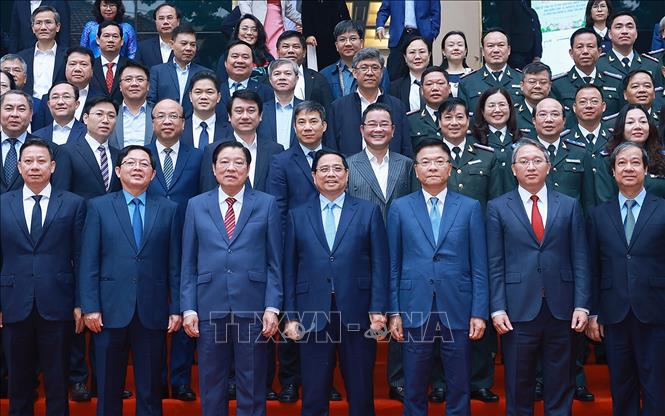
To ensure the Justice sector fulfills its mission effectively in the new era, the Prime Minister requests that Ministers, heads of agencies, and leaders of Party committees and governments at all levels continue their decisive leadership and direction, dedicating time, intellect, and maximizing resources to the work of drafting and implementing laws; proactively and actively advising, coordinating closely, synchronously, and effectively with relevant agencies in the process of building and perfecting institutions and organizing the implementation of laws. The Prime Minister urges each agency, unit, official, and civil servant to uphold the spirit of the rule of law, and to set an example in complying with and implementing legal regulations.
With the motto that lawmaking must be "impartial and transparent - dedicated and responsible - courageous and intelligent - effective for the people," Prime Minister Pham Minh Chinh hopes and believes that all officials, civil servants, and employees of the Ministry and the Justice sector will continue to excellently fulfill all tasks, making worthy contributions to the cause of building a socialist rule of law state, leading the country to steadily advance into a new era, an era of prosperity, civilization, happiness, and progress towards socialism.
Source: https://baotintuc.vn/thoi-su/chuyen-tu-quan-ly-bang-phap-luat-sang-kien-tao-the-che-phat-trien-20251213114826511.htm


![[Photo] Prime Minister Pham Minh Chinh attends the Conference summarizing and implementing tasks of the judicial sector.](/_next/image?url=https%3A%2F%2Fvphoto.vietnam.vn%2Fthumb%2F1200x675%2Fvietnam%2Fresource%2FIMAGE%2F2025%2F12%2F13%2F1765616082148_dsc-5565-jpg.webp&w=3840&q=75)




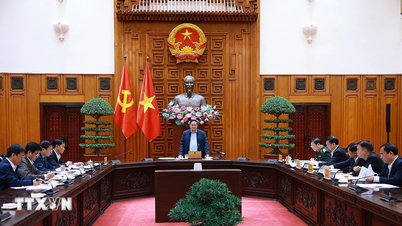

![[Photo] Prime Minister Pham Minh Chinh attends the Conference summarizing and implementing tasks of the judicial sector.](https://vphoto.vietnam.vn/thumb/402x226/vietnam/resource/IMAGE/2025/12/13/1765616082148_dsc-5565-jpg.webp)





















































































Comment (0)