

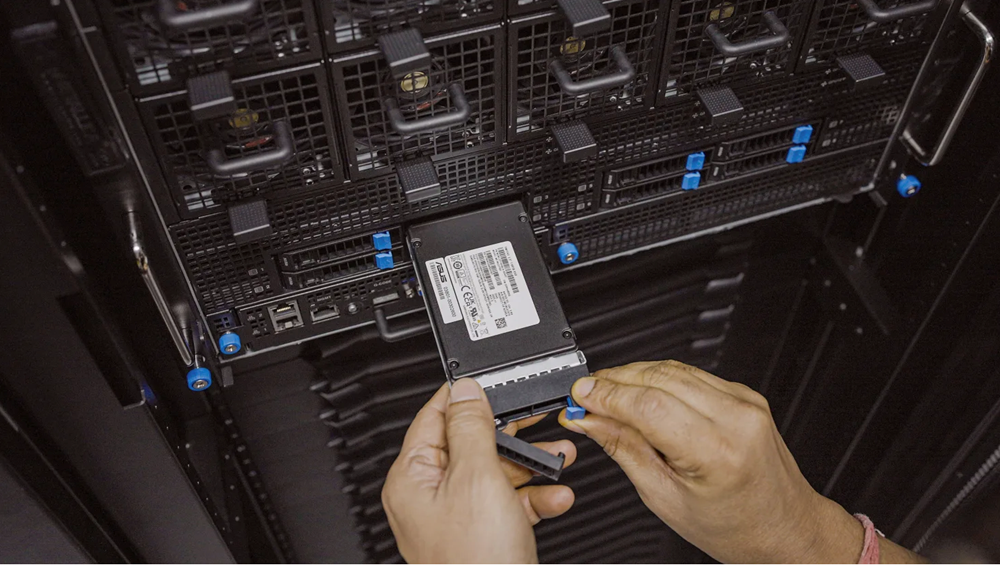
According to a May report by real estate investment and services firm Collier, India's current data center capacity is around 1.2 gigawatts – a fraction of global capacity – but this potential market is expected to more than double, surpassing 3 gigawatts within the next five years.
That growth is attracting global data center companies, Indian billionaires, and even high-end real estate developers. They are all betting on this sector, seen as the backbone of the country's digital future.
In July, Google began negotiations with the Andhra Pradesh state government to establish a 1-gigawatt database. A month later, OpenAI announced its interest in exploring plans to build a 1-gigawatt data center in India.
These moves demonstrate the scale of ambition: databases once measured in tens of megawatts are now being planned in gigawatts, often by "super-scale" companies, or those consuming enormous amounts of computing power.
Unsurprisingly, competition is becoming increasingly fierce. More than 15 companies are vying for market share — from global giants like Japan's NTT, Singapore's Temasek-managed STT GDC, and US operator Equinix, to Indian conglomerates including Adani Group and Reliance Industries.
Real estate developers are also shifting their focus. Yotta Infrastructure of Hiranandani Group, a high-end property developer; Delhi-based Anant Raj Developers; and Pune-based Panchshil Realty are also moving away from residential properties to mega-projects, betting billions of dollars to reposition their strategies.
The AI boom
At the heart of this surge is a shift in demand structure. According to data from real estate consultancy Anarock Capital, approximately 60% of data center customers are enterprises, 30% are mega-corporations, and around 10% are AI users.
"As AI workloads increase, we anticipate enterprise usage will remain stable, but usage by mega-sized companies could increase by around 35%. Specific user demand for AI is likely to increase by 20% to 25%," said Shobhit Agarwal, CEO of Anarock Capital.
Mega-sized companies include large-scale data center operators such as Microsoft, Amazon Web Services, and Google.
“The digitalization of banking in India and regulations on data localization, requiring Indian financial data to be stored domestically, have fueled the demand for enterprise data,” Alok Bajpai, Managing Director of NTT Data Systems in India, told CNBC.
Alok Bajpai added that the rise of e-commerce services, followed by cloud infrastructure companies, has brought about a second wave of data center demand. Now, a third wave is expected to come from AI workloads.
Last week, Equinix expanded into its second state in India, with its first AI database located in Chennai.
"60% of Equinix's revenue comes from customers across all three regions: the Americas, Europe, and Asia, and 'they are very keen to expand into India,'" said Manoj Paul, Equinix's country CEO, on CNBC's "Inside India" program.
Enterprise customers currently have a need for data centers in India, but their demand is relatively modest. As customer needs change, the infrastructure will be designed to handle much larger workloads.
"Previously, enterprise capacity requirements rarely exceeded 10 megawatts. For hyperscale providers, the requirement was up to 25 megawatts, or even 50 megawatts. With AI workloads, this number could increase to 75–100 megawatts," said Bajpai of NTT Data Systems.
Why India?
In theory, India has several natural advantages. Markets like Japan, Australia, China, and Singapore in the Asia- Pacific region have already developed strongly.
Singapore, one of the oldest data center hubs in the region, has limited space for deploying large-scale data centers due to land scarcity issues.
India has ample space for developing large-scale data centers. Compared to data centers in Europe, electricity costs in India are relatively low.
Coupled with India's growing renewable energy capacity – a crucial factor for data centers struggling with power shortages – the economy is starting to become attractive.
Domestic demand, driven by the growth of e-commerce—a major driver of data center growth in recent years—and potential new regulations on social media data storage, further strengthens this argument.
India is entering a golden age, where global cloud providers, AI companies, and domestic digitalization firms are converging to create one of the world's most vibrant data center markets.
Source: https://baovanhoa.vn/nhip-song-so/con-sot-trung-tam-du-lieu-tai-an-do-chua-tung-co-trong-lich-su-172116.html




























![[Video] The craft of making Dong Ho folk paintings has been inscribed by UNESCO on the List of Crafts in Need of Urgent Safeguarding.](https://vphoto.vietnam.vn/thumb/402x226/vietnam/resource/IMAGE/2025/12/10/1765350246533_tranh-dong-ho-734-jpg.webp)

























































Comment (0)