

Luis Chonillo, the newly elected mayor of Duran, Ecuador, was on his way to his inauguration ceremony when assassins ambushed him, opening fire on his convoy.
"I only had two minutes to survive," the 39-year-old politician recalled as he rushed into a nearby house, took refuge in the bathroom, and escaped the attack.
Two police officers and a bystander were killed in a failed assassination attempt on May 15, 2023. Chonillo's family had to leave the country and have been unable to return because police have not apprehended the group of assassins, amidst Ecuador's struggle with one of the worst outbreaks of gang violence in its history.
"I call myself a 'nomadic mayor,' moving from place to place, unable to stay in one place for more than two nights," Chonillo told the Guardian from a safe house deep in the mountains of Ecuador. He is escorted by police and works mostly online. Since taking office, he has never sat in the mayor's chair at town hall.
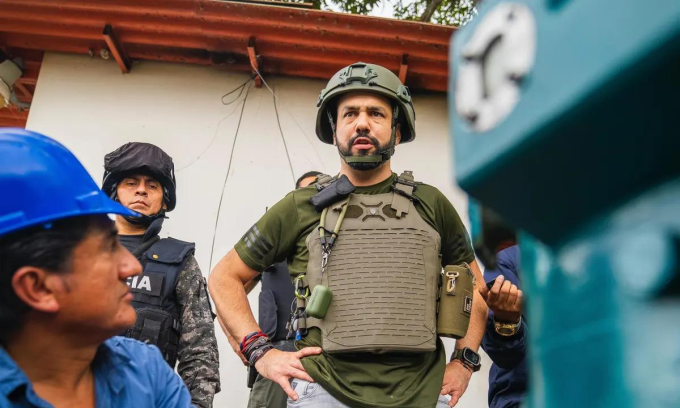
Luis Chonillo, the mayor of Duran, wore a bulletproof vest while interacting with the public. Photo: Guardian
On January 10, President Daniel Noboa declared Ecuador a war against drug cartels, two days after drug kingpin Adolfo Macias escaped from prison, sparking riots and further fueling the violence of criminal organizations.
Located opposite Guayaquil, Ecuador's most important port city, across the Guayas River, Duran became a strategic hub for drug shipments from Colombia and Peru, the world's two leading cocaine-producing countries. From here, the drugs were transported to the United States and Europe in containers of fruit and food.
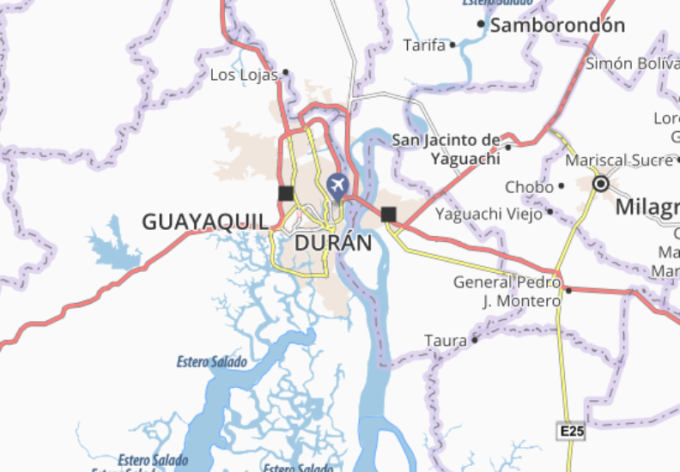
Location of Guayaquil and Duran. Graphic: Michelin
Between 2007 and 2017, Ecuador was a "peaceful oasis" in South America, when former President Rafael Correa agreed to negotiate with gangs. He opened a path to rehabilitation, providing subsidies to gangs on the condition that they register as local cultural organizations and cease all violent activities.
The homicide rate in Ecuador decreased by nearly 70% during this period. However, the security situation deteriorated after Correa's term, particularly since the neighboring Colombian government signed a peace agreement in 2016 with the Revolutionary Armed Forces of Colombia (Farc).
Much of the drug trafficking route from southern Colombia to Ecuadorian ports was once controlled by the Farc. After this separatist movement agreed to dissolve under a peace agreement, powerful Mexican drug cartels sought to take its place. They poured money and weapons into the operation to entice local criminal groups to create new smuggling corridors.
As a result, Guayaquil and Duran became crime hotspots. Ecuador's military intelligence warned that the country had become a transit point for 40% of the drugs produced in Colombia.
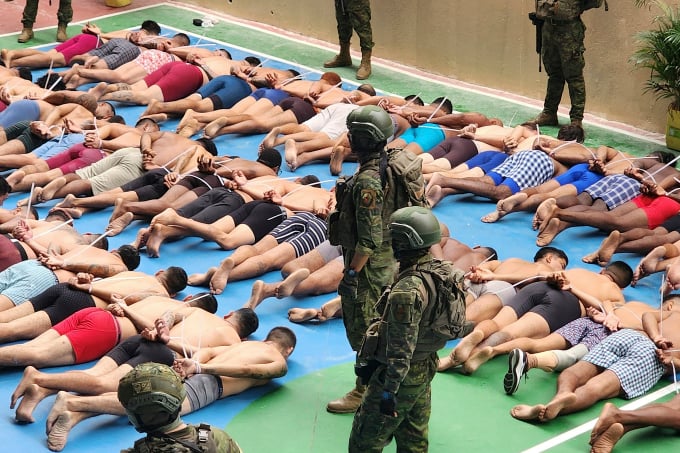
Ecuadorian police crack down on prisoners in Guayaquil on January 18. Photo: AFP
A day before declaring war on drug cartels, President Noboa listed 22 gangs with approximately 20,000 members as terrorist organizations, making these groups legitimate military targets for the army.
Since declaring war on the gangs, Ecuadorian police have conducted 15,000 operations to crack down on crime, arresting thousands. Mayor Chonillo affirmed that Ecuador will overcome the drug scourge. "The country will sooner or later escape this nightmare, and remember it as a dark past," he said.
But for now, he has no choice but to continue working remotely, holding online meetings to run the city amidst gang violence.
Duc Trung (According to The Guardian )
Source link


![[Photo] Closing Ceremony of the 10th Session of the 15th National Assembly](/_next/image?url=https%3A%2F%2Fvphoto.vietnam.vn%2Fthumb%2F1200x675%2Fvietnam%2Fresource%2FIMAGE%2F2025%2F12%2F11%2F1765448959967_image-1437-jpg.webp&w=3840&q=75)







































![[OFFICIAL] MISA GROUP ANNOUNCES ITS PIONEERING BRAND POSITIONING IN BUILDING AGENTIC AI FOR BUSINESSES, HOUSEHOLDS, AND THE GOVERNMENT](https://vphoto.vietnam.vn/thumb/402x226/vietnam/resource/IMAGE/2025/12/11/1765444754256_agentic-ai_postfb-scaled.png)



































Comment (0)