

Using 27 liters of blood to complete its 605 pages, the blood-written Quran of former Iraqi leader Saddam Hussein has been a subject of much controversy in the Muslim world .
Hidden in a secret cellar deep beneath the Umm al-Qura mosque in Baghdad, the blood Quran is a copy of the holy book of Islam, written in the blood of former Iraqi president Saddam Hussein, who ruled from 1979 to 2003.
Hussein is believed to have commissioned calligrapher Abbas Shakir Joody al-Baghdadi to transcribe the blood scripture on April 28, 1998, on his 61st birthday. However, others say the date was 1997, on his 60th birthday.
One event that prompted the former Iraqi president to do this was his son, Uday Hussein, narrowly escaping an assassination attempt on December 12, 1996. In a letter published in 2000, Hussein explained that the blood manuscript was written to thank the Almighty for helping him safely overcome "many conspiracies and dangers" throughout his political career.
"My life has been full of dangers that should have cost me a lot of blood. But since I only lost a little, I asked someone to write the words of the Almighty in my own blood to express my gratitude," he said.
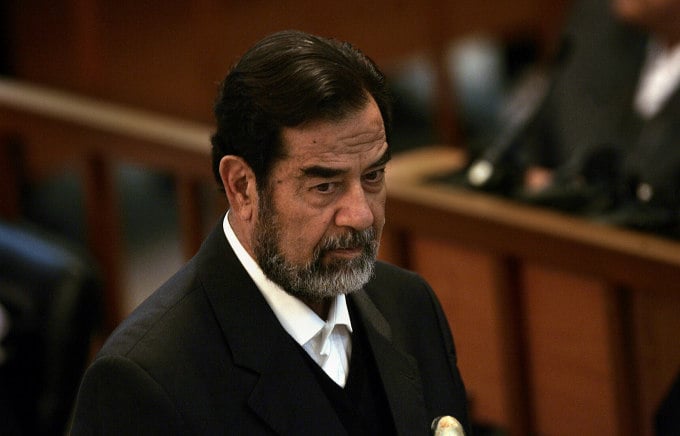
Former Iraqi President Saddam Hussein during his trial in Baghdad in December 2006. Photo: AFP
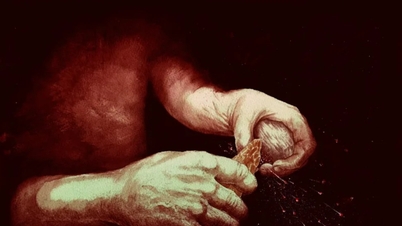
In the two years since commissioning the transcription of the Quran, the nurse collected 27 liters of Hussein's blood and transferred it to al-Baghdadi. After treating the blood with chemicals, the calligrapher used this liquid to transcribe all 114 chapters, comprising approximately 6,000 verses and 336,000 words of the Quran.
Completed in 2000, the blood Quran is 605 pages thick and written in 2cm high font, with intricate red, black, and blue decorative borders. The book is framed in gold and displayed at the Umm al-Ma'arik Mosque in Baghdad. Hussein built this mosque to commemorate what he called his "victory" in the 1990-1991 Gulf War and completed it in 2001. Only a small group of special guests of Hussein are allowed to admire the book.
From the outset, Hussein's blood Quran was highly controversial among Muslim clerics. According to Sharia Islamic law, human blood is considered unclean, and so is anything that comes into contact with it. Therefore, writing the Quran in blood was forbidden. Religious authorities in the UAE and Saudi Arabia issued statements condemning this practice in 2000.
Calligrapher al-Baghdadi said he was well aware of this but could not disobey Hussein's orders. In a 2003 interview, al-Baghdadi, who later moved to the United States, said, "I don't like to talk about this. It's a painful part of my life that I want to forget."
The controversy also revolves around the total amount of blood Hussein donated to the blood donation book. Typically, the maximum amount of blood a person can donate is about 3 liters per year. Based on this rate, it would have taken Hussein nearly 9 years to donate the full 27 liters of blood.
This led some to speculate that the blood used to copy the scriptures was not entirely Hussein's. However, these questions remain unanswered to this day.
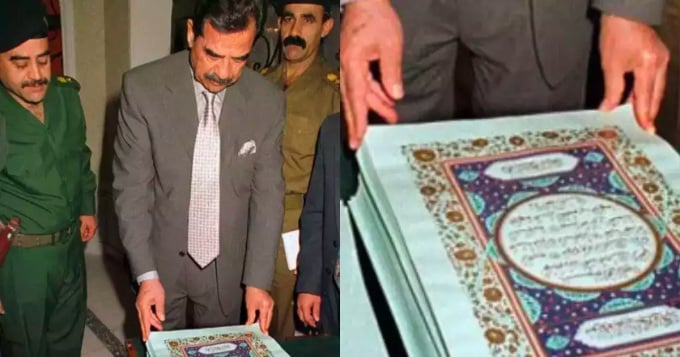
Hussein examines what is believed to be the blood Quran. Photo: PressWire18
The blood Quran was on display until April 2003, when US forces invaded Baghdad. As fighting engulfed the Iraqi capital, the mosque's caretakers took the book and hid it. Cleric Ahmed al-Samarrai had kept the book hidden in his home. "We knew the blood Quran would be sought after, so we decided to protect it," he said.
In 2010, al-Samarrai stated that after Hussein was overthrown, the sacred text was stored in a secret basement beneath the mosque, now renamed Umm al-Qura, with three layers of tightly locked doors.
"The three keys are kept in three different places. I have one, the regional police chief has one, and one is hidden elsewhere in Baghdad. It requires the approval of a committee to enter that bunker," al-Samarrai said.
Beyond its religious controversies, the blood manuscript also ignited political debate. Many members of the Iraqi government later feared that the legacy of Hussein's era could fuel efforts to revive the late leader's Ba'ath Party and suggested destroying it.
But many others disagreed with this idea, arguing that Hussein and the Bible are part of Iraq's history. "He made a huge difference to Iraq, whether we like it or not. We don't necessarily have to bury the legacy of that era; instead, we should remember it and learn from it," said Mowaffak al-Rubaie, Iraq's former national security adviser.
Thanh Tam (According to TIFO, Guardian, NBC News )
Source link
![[Photo] Prime Minister Pham Minh Chinh attends the Conference summarizing and implementing tasks of the judicial sector.](/_next/image?url=https%3A%2F%2Fvphoto.vietnam.vn%2Fthumb%2F1200x675%2Fvietnam%2Fresource%2FIMAGE%2F2025%2F12%2F13%2F1765616082148_dsc-5565-jpg.webp&w=3840&q=75)































































Comment (0)