

In Quang Nam province , 83-year-old Mrs. Le Thi Ke, residing on Cu Lao Cham island, meticulously weaves hammocks from paulownia tree bark over two months, selling them for 12-15 million VND.
Late November is the low season for tourism on Cu Lao Cham Island, Tan Hiep commune, Hoi An city, so there are few visitors. Ms. Le Thi Ke, with a bundle of ivory-white corn fiber and a knife, sits weaving hammocks on her porch. Her hands nimbly twist each strand of fiber tightly together, forming a series of interconnected shuttle-like shapes.
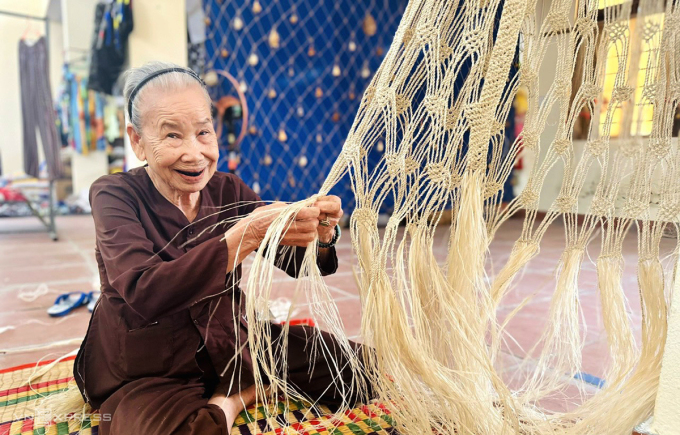
Ms. Le Thi Ke has been weaving hammocks from paulownia tree bark for over 50 years. Photo: Son Thuy
With over 50 years of experience, the old man measured the spacing between the squares by hand, yet they were perfectly even, as if woven by machine. After nearly a month, the hammock was completed, over a meter long, without any knots or joints, and the ropes were tightly wound without fraying. This is what distinguishes paulownia hammocks from other types of hammocks.
Ms. Kề was originally from Hội An on the mainland. In 1962, she married a man from the remote island of Cù Lao Chàm, about 15 km from the mainland. She learned the craft of weaving hammocks from paulownia wood through her mother-in-law's instruction.
Only those in the trade truly understand the meticulous process of making a hammock. "To weave a beautiful hammock, you can't rush it. This craft is more suitable for older people because it requires strict technical skills in the stitches and twists, demanding patience and meticulousness," the elderly woman shared.
Having worked as a hammock maker for 10 years on Cu Lao Cham island, Ms. Huynh Thi Ut said that there are two types of paulownia wood hammocks: those with 4 strands and those with 6 strands (the distance between two sections is 4-6 strands). The weaver must both twist and smooth the strands to ensure they are tightly bound together smoothly, without any lumps or rough joints. When weaving, the weaver carefully adjusts the spacing so that the sections are even, and each knot is tightly secured to prevent sagging.
The 56-year-old woman said that hammocks are handmade, so you have to "learn by watching, learning by yourself, and it depends on each person's skill; you can't hold their hand and show them every stitch and weave."
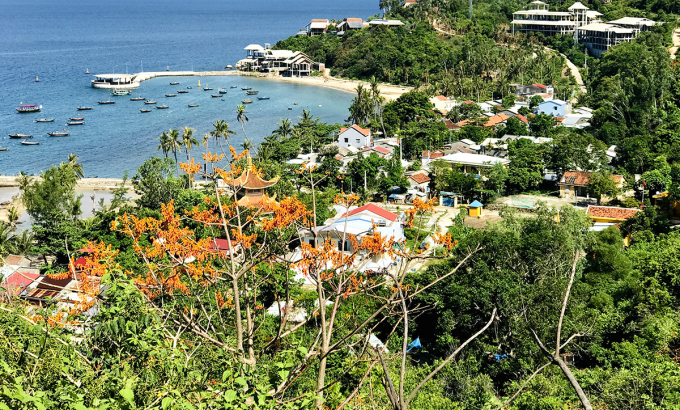
Every year in July, the paulownia flowers on Cu Lao Cham Island bloom in a vibrant orange-red color. Photo: Son Thuy
On the island, many paulownia trees grow on rocky mountains. From April to July is the peak flowering season for paulownia trees. Locals go into the forest to find paulownia trees and branches as thick as a wrist, then cut off the leaves and take the straight trunk section.
The tree trunks are crushed, the bark is peeled off, and they are soaked in spring water. In summer, they are soaked for half a month, and in winter for more than 20 days, then they are taken out and washed clean. The craftsmen select the inner layer of bark, which is opaque white, called "manh dong." The "manh dong" is stripped into small strands and dried until it turns white to weave hammocks.
Grandpa Kề explained that cutting down the paulownia trees doesn't harm the forest. In the summer, the trees shed their leaves, bloom, and then bear fruit. When the fruit falls, saplings sprout everywhere, and after about three years, people cut them down for their bark. "From the stump of the cut tree, 3-4 new shoots will grow, developing into saplings when the rainy season comes," he said.
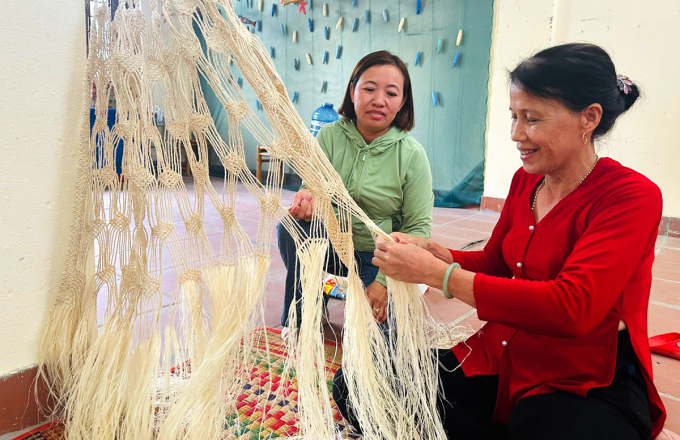
It took Ms. Huynh Thi Ut nearly half a month to knit half a hammock. Photo: Son Thuy
To complete a 2.6-meter-long hammock, not including the time to prepare the materials, it takes two months. The hammock can be used for 20 years; when it gets dirty, it can be washed and dried.
Previously, finished hammocks made from paulownia wood were usually sold to locals. Since the island developed tourism, hammocks have been purchased by many domestic and foreign tourists for 10-15 million VND each. "Each hammock doesn't bring in a high income compared to the effort put in. But once you've started this profession, you can't give it up; if you don't weave for a day, you miss it and can't sit still," said Ms. Huynh Thi Ut.
Those who weave hammocks from paulownia wood don't know when the craft originated, only that it has been passed down through many generations. Many have switched to other, higher-paying jobs as Cu Lao Cham Island has attracted more tourists. Currently, only five elderly people on the island still make hammocks and pass the craft on to a few younger people.
Mr. Nguyen Minh Duc, Vice Chairman of Tan Hiep commune, said that the hammock-making craft is gradually dying out, so the government has opened classes to teach the younger generation, while also encouraging product diversification and creating spaces for tourists to experience the traditional craft when visiting the island.
Source link
![[Photo] Prime Minister Pham Minh Chinh holds a phone call with the CEO of Russia's Rosatom Corporation.](/_next/image?url=https%3A%2F%2Fvphoto.vietnam.vn%2Fthumb%2F1200x675%2Fvietnam%2Fresource%2FIMAGE%2F2025%2F12%2F11%2F1765464552365_dsc-5295-jpg.webp&w=3840&q=75)

![[Photo] Closing Ceremony of the 10th Session of the 15th National Assembly](/_next/image?url=https%3A%2F%2Fvphoto.vietnam.vn%2Fthumb%2F1200x675%2Fvietnam%2Fresource%2FIMAGE%2F2025%2F12%2F11%2F1765448959967_image-1437-jpg.webp&w=3840&q=75)




















































![[OFFICIAL] MISA GROUP ANNOUNCES ITS PIONEERING BRAND POSITIONING IN BUILDING AGENTIC AI FOR BUSINESSES, HOUSEHOLDS, AND THE GOVERNMENT](https://vphoto.vietnam.vn/thumb/402x226/vietnam/resource/IMAGE/2025/12/11/1765444754256_agentic-ai_postfb-scaled.png)
















































Comment (0)