

No 
The name Ta Suoi Cau, translated from the Dao language into standard Vietnamese, means "village with a large stream." Ta Suoi Cau is located on a mountainside, in a precarious area with many cliffs, belonging to the former A Lu commune, bordering A Mu Sung commune. This is also where the Dao ethnic people have lived for many generations.
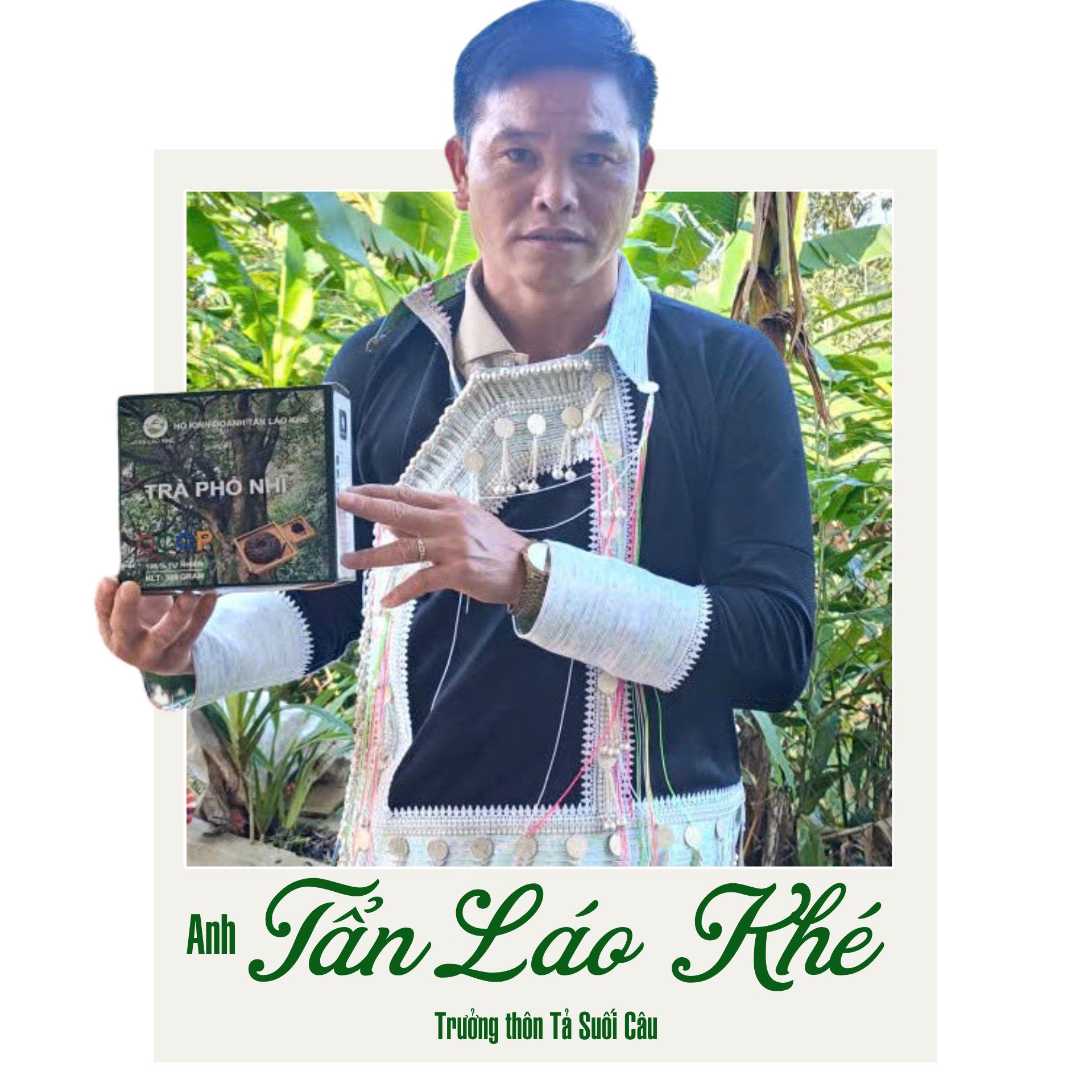
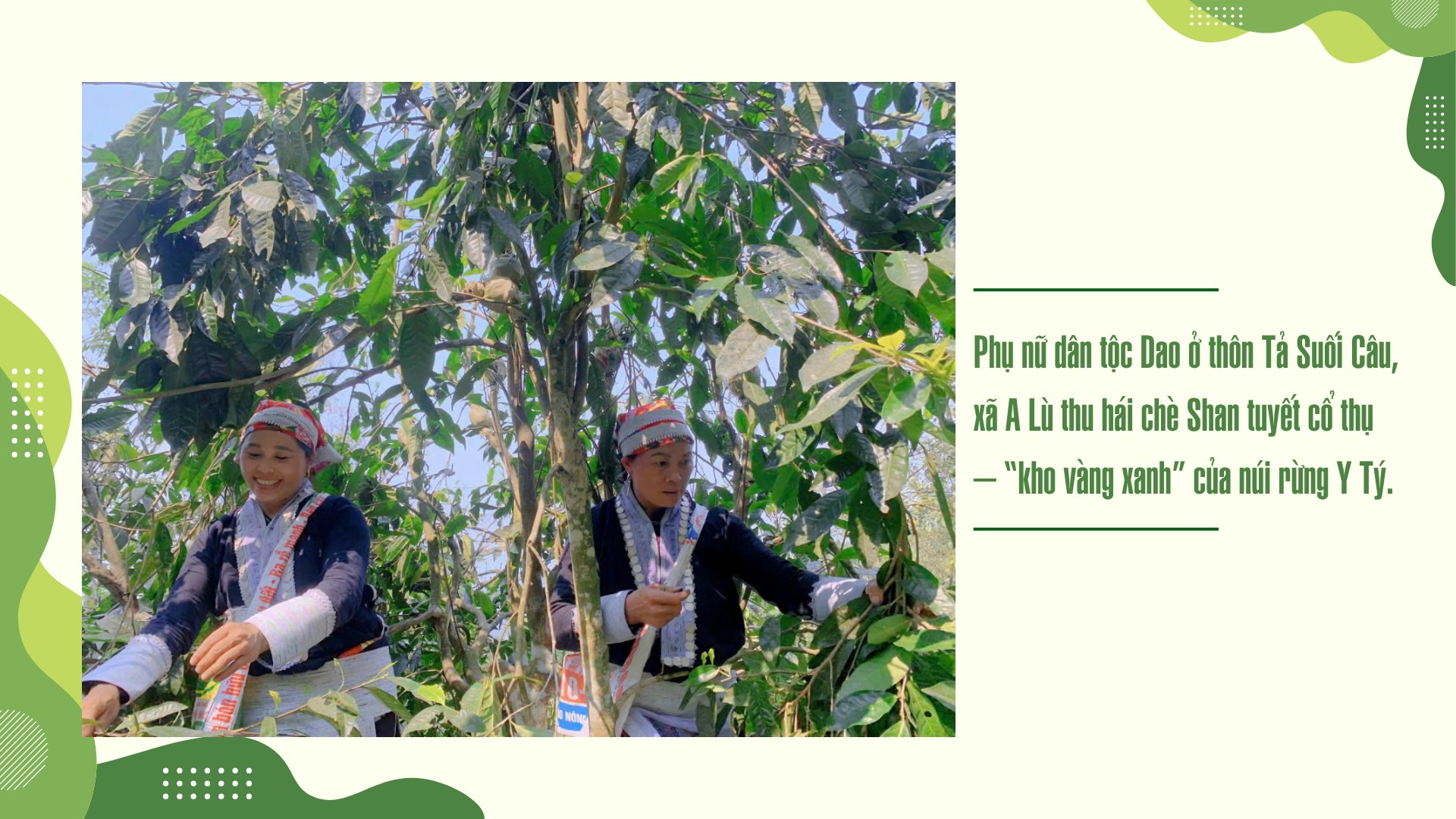
Pointing to the lush green forest at the foot of the towering rocky mountains, Mr. Tan Lao Khe, head of Ta Suoi Cau village, said that it is precisely in this remote mountainous area that lies the "green gold mine" of the Dao people. It is the forest of ancient Shan Tuyet tea trees, hundreds of years old. It's unknown when the Dao ancestors here first brought the seeds of these ancient Shan Tuyet tea trees from the rocky mountains to plant around the village, so now some households have moss-covered, ancient tea trees in their gardens. Mr. Khe's family alone owns a patch of forest with over 200 ancient tea trees.
Taking us to visit his family's ancient tea plantation, Mr. Khé explained that in the past, people only harvested tea leaves to boil for drinking. Later, some households started harvesting tea buds to dry and preserve the tea for longer periods, so they could serve tea to guests when they visited. There are many ancient tea trees, but no one buys or processes them.
That's why these old tea trees don't bring any economic value to the people. At one point, people cut down ancient tea trees so large that one person couldn't wrap their arms around them to make room for corn. Enormous tea plantations were gradually destroyed, a heartbreaking sight.
As the head of Ta Suoi Cau village, Tan Lao Khe was always concerned about how to help his fellow villagers escape poverty. Since 2018, seeing that people in A Mu Sung commune were harvesting ancient tea leaves to sell to traders who exported them to China, he researched and connected with several traders to sell his family's tea. Depending on the time of year, each kilogram of fresh tea sells for 15-25 thousand dong. For tea buds (one bud per kg), the price ranges from 230-250 thousand dong.
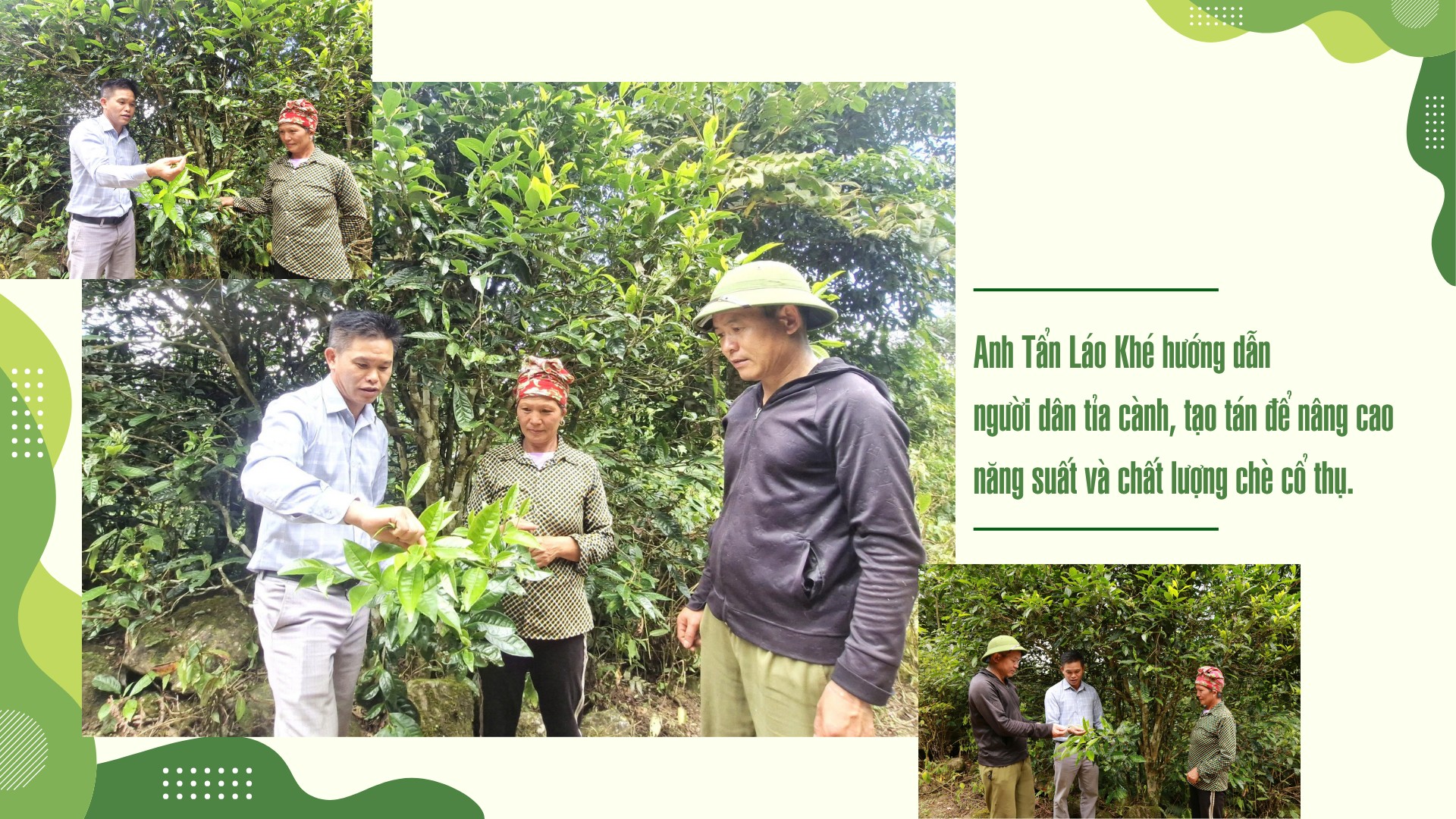
Notably, village head Tan Lao Khe not only sells tea to increase his family's income, but he also acts as a middleman, purchasing about 10 tons of tea annually from villagers at stable prices. He also encourages villagers to actively protect, care for, prune, and shape the ancient tea gardens. Although there are no specific statistics, Ta Suoi Cau village has about 20 hectares of ancient Shan Tuyet tea trees. From these ancient tea trees, families like Tan U May, Tan Lao Sinh, Vang Thong Thien, and Phan Lao Lu earn between 20 and 40 million VND annually.
Ms. Tan U May smiled brightly: “Before, I never thought that the tea plants in our forest could yield so much money from selling the buds. Ta Suoi Cau village has nearly 90 Dao households, and every house has ancient tea trees. Now, with Mr. Khe buying the tea, the villagers have a regular income, and their lives are more prosperous. Along with tea, the villagers also grow purple cardamom, cinnamon, corn, and rice. In 2024, 18 households in the village escaped poverty, journalist! ”

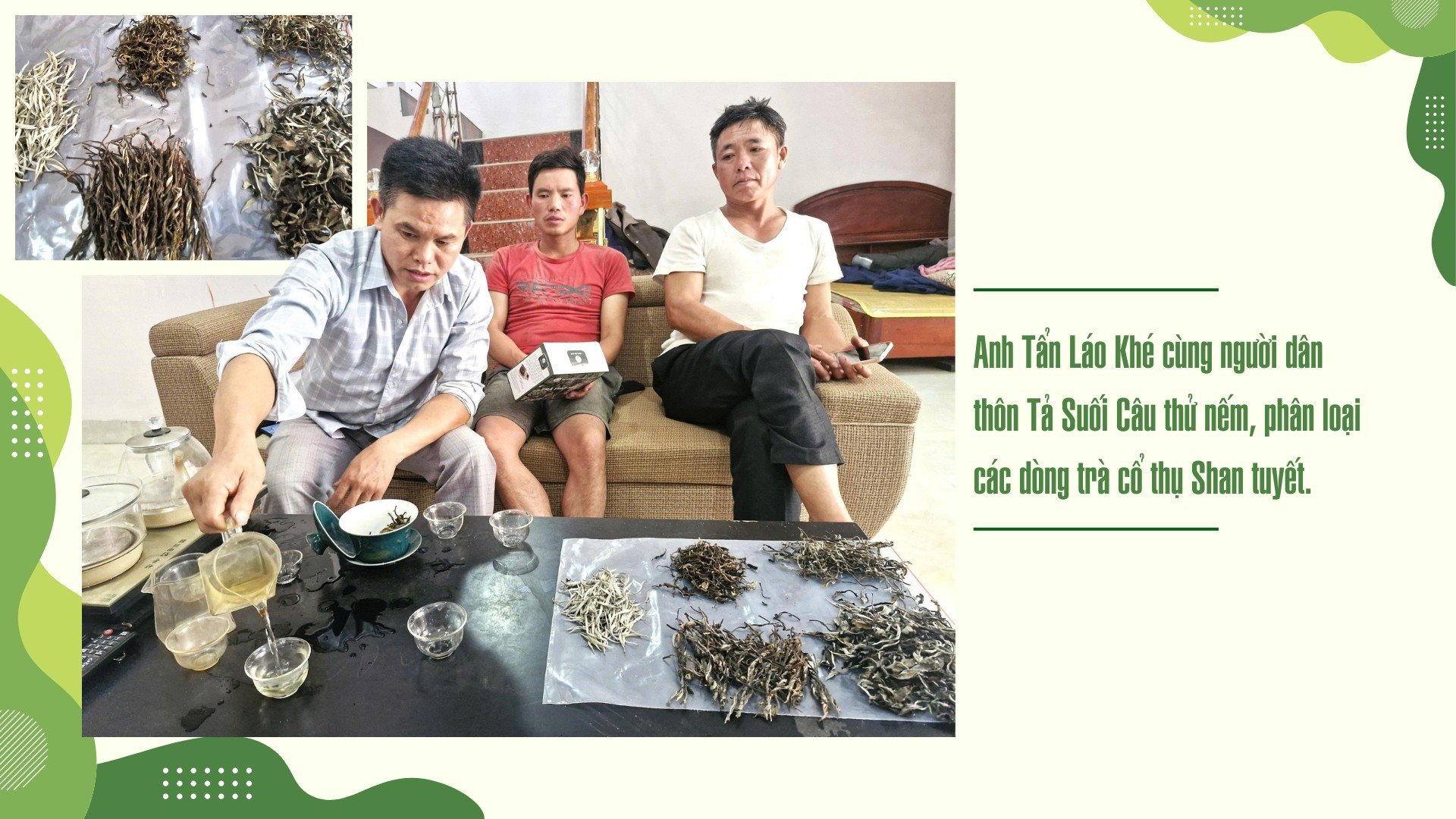
In his well-built house in Ta Suoi Cau village, Mr. Tan Lao Khe brewed a pot of ancient tea and invited us to enjoy it. I was surprised to see Mr. Khe displaying many types of tea made from ancient tea trees on Ta Suoi Cau mountain.
Mr. Khé introduced Bạch tea as the most precious type, containing only one bud, harvested from tea plants hundreds of years old at an altitude of over 1,000 meters above sea level, so each kilogram costs from 1.5 to 2 million VND. In addition, there are other teas such as Tiên tea, Pu-erh tea, and Black tea…
Holding a cup of white tea in my hand, I immediately sensed the honey-like aroma of the mountain forest, a strangely gentle and pure taste. The first infusion of this tea is light in color, but with the second and third infusions, the color deepens, and the aroma intensifies, filling the entire room. Shan Snow ancient white tea has a distinctive flavor, unlike any other tea; once you taste it, you'll never forget it.
In a conversation with us, Mr. Tan Lao Khe explained that the ancient Shan Tuyet tea from Ta Suoi Cau is more special than ancient teas from many other places because the tea trees are hundreds of years old, grow on rocky mountains exposed to wind and rain year-round, and are at an altitude of 1,000 to 1,500 meters above sea level, giving it a very distinctive flavor.
With such a precious type of tea, simply harvesting the fresh leaves and selling them to China would be a waste of resources. Therefore, he was determined to learn how to process it to enhance the value of the ancient tea, helping local people earn a higher income.
Thanks to his connections with some Chinese traders, in 2021, Tan Lao Khe proactively went to China to learn tea-making techniques from famous artisans there. As a reputable supplier of raw tea materials, he was taught by several tea masters how to select and harvest the best white tea leaves, and how to process them so that each type of tea has its own unique appearance and flavor.
In addition to two trips to China to learn how to process ancient tea leaves, Village Head Tan Lao Khe also spent his own money to visit tea-growing regions in Ha Giang and Thai Nguyen provinces to see how people and businesses process tea, thereby learning more from their experience.
“Our village has a lot of valuable tea, but the villagers are wasting it or selling green tea at very low prices. No one knows how to make tea. As the village head, if I don't learn how to process tea, things will remain the same in 5 or 10 years. Who knows when I'll be able to help the villagers escape poverty?” shared Village Head Tan Lao Khe.

Indeed, with a thirst for knowledge and determination, coupled with the motivation from the desire to help his fellow villagers have a better life through the ancient tea trees, Village Head Tan Lao Khe has once again "awakened" the ancient tea forest.
Holding the new tea product in his hand, which resembles dried cordyceps mushrooms, Mr. Khé explained that each type of tea has its own secret recipe. Processing this "immortal tea" is very difficult, requiring entirely manual labor, thus taking a lot of time. In return, each kilogram of this "immortal tea" fetches a price many times higher than regular green tea. Tea makers must also constantly learn and improve to create new types of tea to meet market demands.
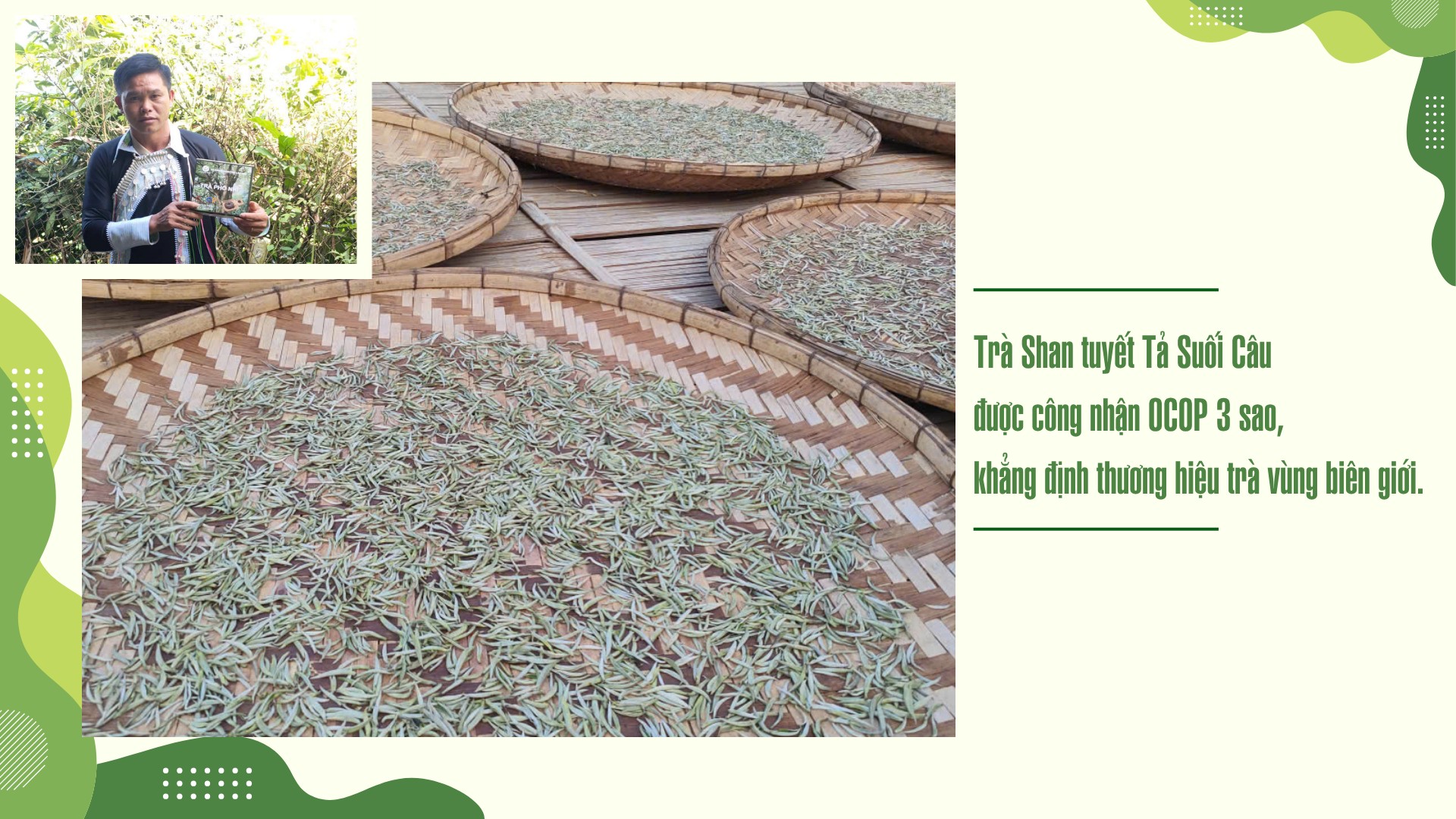
Driven by his passion and dedication to ancient tea trees, village head Tan Lao Khe has turned his dream into reality. To date, the Ta Suoi Cau Shan Tuyet ancient tea product he produces has been recognized as a 3-star OCOP product of the locality.
From the ancient tea trees, Mr. Khé's family earns approximately 200 million VND per year. Not stopping there, Mr. Khé is continuing to learn how to process other products and enhance promotion to increase the value of Tả Suối Câu ancient tea.

In Ta Suoi Cau, Mr. Tan Lao Khe is an exemplary Party member, a respected figure trusted and loved by the villagers. With nearly 15 years as village head, Mr. Khe has not only pioneered the development of his family's economy but also served as a leading figure in opening up economic development opportunities for the villagers. Thanks to Mr. Khe, the ancient Shan Tuyet tea forests have been "awakened," providing the people in this border region with stable incomes, regular employment, and a more prosperous life.
- Mr. Phan Lao Lu -
Secretary of the Party Branch of Ta Suoi Cau village.
Source: https://baolaocai.vn/danh-thuc-rung-che-co-thu-ta-suoi-cau-post885978.html
![[Photo] Prime Minister Pham Minh Chinh receives the Chinese Ambassador to Vietnam](https://vphoto.vietnam.vn/thumb/1200x675/vietnam/resource/IMAGE/2026/04/05/1775397481797_ndo_br_dsc-5512-jpg.webp)



























































![[INFOGRAPHICS] Exploiting children's personal images for profit can result in fines of up to 50 million VND.](https://vphoto.vietnam.vn/thumb/402x226/vietnam/resource/IMAGE/2026/04/06/1775442200854_1775442148.webp)
















Comment (0)