

Vinh Xuong is located at the headwaters of the Tien River, while Khanh Binh is situated along the Hau River, flowing downstream towards the Southwestern region of Vietnam. These two communes, located on different branches of the river, share a common upstream lifestyle, where the water opens the way for livelihoods, from fishing along the riverbanks to expanding trade through border crossings.
Livelihood by the river
On a misty morning during the flood season, Mr. Nguyen Van Thanh (58 years old), residing in Hamlet 2, Vinh Xuong Commune, sits in his small, faded motorboat, slowly casting his nets into the murky, silt-laden water. The boat gently sways with the waves, and in the distance, the sound of barge engines echoes from the direction of the Vinh Xuong International Border Gate. On one side, the rhythm of livelihood depends on the water; on the other, the bustling trade flows – these two contrasting colors create a distinctive picture of this upstream commune on the Tien River.
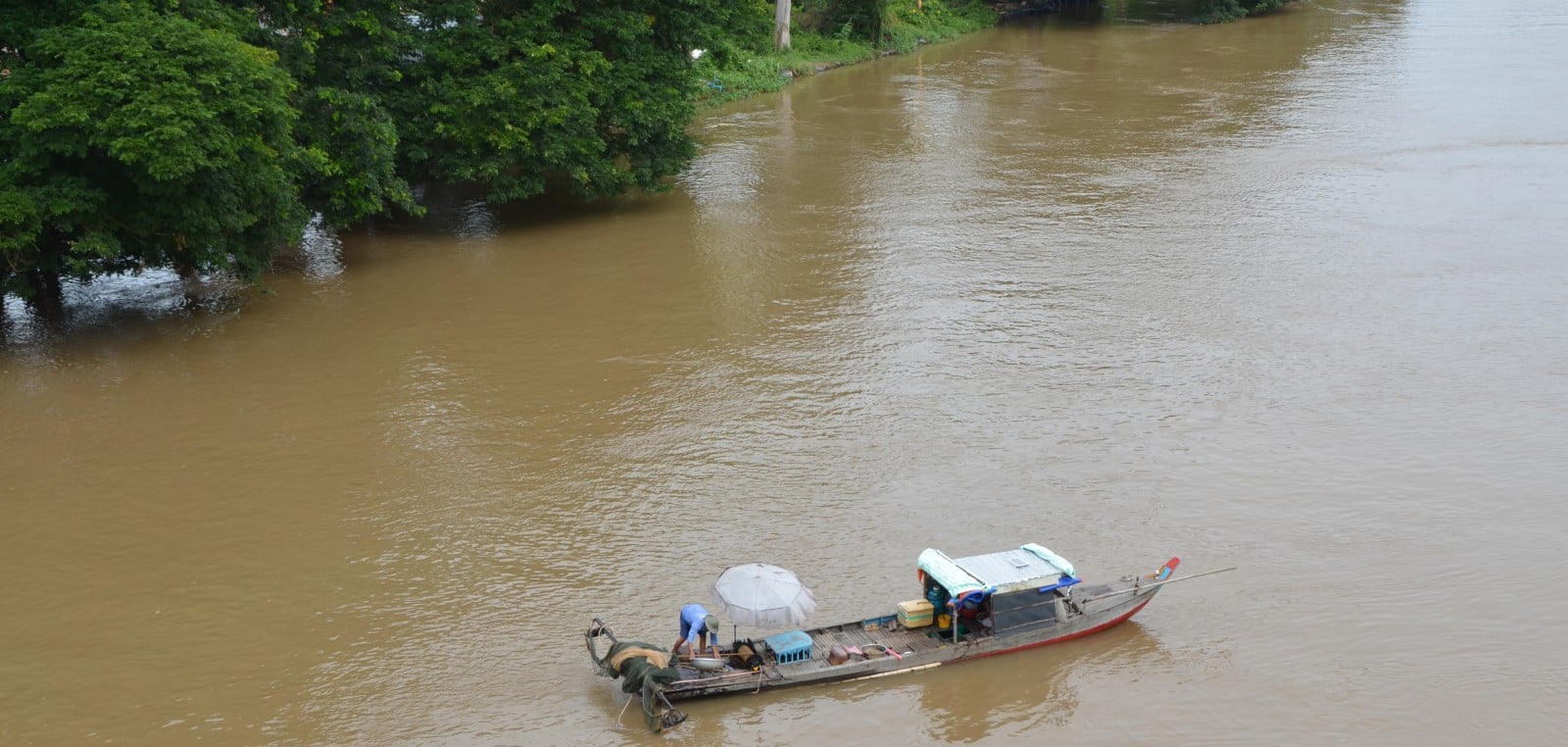
People in Khanh Binh commune make their living on the Binh Di River. Photo: Trong Tin
Having been involved in the fishing trade for nearly 40 years, Mr. Thanh understands that the rising and falling water levels each season are not only a natural law but also determine the family's livelihood. His eyes never leave the river, and occasionally he wipes away the salty sweat from the corner of his mouth: "If the flood comes late, I worry a lot! If the water doesn't rise, there will be fewer fish, and the rice crop could easily fail." Before he finished speaking, Mr. Thanh suddenly leaned forward and pulled hard on his net. About 10 catfish were caught in the net, splashing in the water under the early morning sun. "Every day, I travel more than 30km along the river to cast my nets. I'm used to the sun and rain! The river trade doesn't make you rich, but it's enough to feed my family of five, give my children a proper education, and prevent them from having to leave home to work far away," he smiled, his calloused hands nimbly untangling each mesh of the net. Mr. Thanh's small motorboat gradually disappeared into the deep river, blending into the rhythm of the water flowing downstream.
Not far away, boats carrying tourists on the Tien River docked one after another. Mr. Tran Van Tuan, residing in Vinh Thanh B hamlet, busily wiped down the seats, his sleeves still smelling of sunshine. “I operate a boat independently; I take whoever hires me. On average, I earn 400,000 to 500,000 dong a day, and on busy days, I can earn over 1 million dong,” Mr. Tuan said cheerfully. These small boats and people like Mr. Tuan are contributing to the bustling new life along the Tien River, where traditional livelihoods and service industries intertwine, opening up new avenues for earning a living in this border region.
According to the authorities and people of Vinh Xuong, its upstream location gives the commune a special advantage. Agriculture , fisheries, border trade, and even community tourism all thrive in the ebb and flow of the river. For generations, the people here have built houses, cultivated crops, fished, and engaged in small-scale trading based on the river, carrying with them memories, beliefs, and aspirations for progress. In their stories of making a living, they still proudly recall the prosperous times of the river, as described in ancient texts: "Fish and shrimp teemed in the river, all you needed to do was bring a net. Flowers and fruits hung everywhere in the gardens, all you had to do was reach out and pick them."
Today, Vinh Xuong boasts both land and river border crossings. Hundreds of cargo ships pass through daily, fostering bustling trade between Vietnam and the Kingdom of Cambodia. Export turnover through the Vinh Xuong International Border Gate reaches approximately US$1 billion per year. The commune has over 300 fish cages for raising catfish and basa fish, supplying processing plants for export in Chau Doc and Tan Chau. Mr. Bui Thai Hoang, Chairman of the People's Committee of Vinh Xuong commune, stated: “Vinh Xuong plays a crucial role in developing border trade and ensuring national border security. We are exploiting the strengths of the upstream region to connect the Mekong Delta with the Greater Mekong Subregion.”
Khanh Binh - where four cultural streams blend into the rhythm of the river.
Leaving Vinh Xuong, we headed south to Khanh Binh. During the flood season, the Hau River rises, filling every canal and ditch. The water carries silt, shrimp, fish, and the characteristic rhythm of life in the delta region. On their small boat, Mr. Lam Van Hung and his wife, Ms. Pham Thi Bich, were untangling their nets. The couple makes a living by fishing in the Hau River and nearby canals and ditches. "The fish in this river have firm, delicious meat. Besides selling at the market, I also buy fish from other fishermen and transport them to sell in Can Tho and Ca Mau cities to increase my income," Mr. Hung said, nimbly removing fish from the nets. For them, living by the river is not only a means of livelihood but also a way to preserve the traditional occupation of their ancestors.
Further downstream, Binh Thien Lake appears like a large mirror reflecting the clouds and sky. Locals call it the "heavenly lake"—a natural treasure of Khanh Binh. Surrounding the lake are fish farms, rice paddies, and Cham villages along the river. Today, Binh Thien Lake has become a famous ecotourism destination, attracting visitors to experience river life and local culture. Mr. Ly Van Nhan, a resident of Binh Di hamlet, proudly said: "The lake's water is green all year round, and during the flood season, there are plenty of shrimp and fish. Every visitor wants to take a boat ride around."
But what defines Khanh Binh's identity is not just its scenery, but also the community life of the four ethnic groups: Kinh, Cham, Khmer, and Hoa. The Kinh and Khmer people engage in agriculture and trade. The Cham people live along the river, fishing and weaving brocade. The Hoa people run shops and work in handicrafts. Despite their differing beliefs and customs, they still live together in harmony, working together, overcoming difficulties, and uniting. The people here often say: "The river has two banks, but the hearts of the four ethnic groups are one."
Amidst the houses along the Binh Di River, where the gentle sound of evening prayers echoed in the wind, Mr. Kaly, the Deputy High Priest of the Al-Mukarramah mosque, slowly shared: “The people here live in great unity! The Kinh, Cham, Khmer, and Chinese treat each other like brothers and sisters. Thanks to the attention of the Party and the State, the lives of the people are becoming increasingly stable.”
From agriculture to border trade economy
Along the roads bordering the Hau River, lush green mango orchards stretch as far as the eye can see. Thanks to the alluvial soil and freshwater sources, Khanh Binh mangoes have a distinctive crisp and sweet taste. We visited the Long Binh Agricultural Cooperative, the largest mango production model in the commune, with products achieving OCOP 3-star certification. Mr. Huynh Thanh Minh, Director of the Long Binh Agricultural Cooperative, said: “Farmers no longer work individually but cooperate to ensure stable output. This is a sustainable direction for the border region.”
The orchards laden with mangoes are clear evidence of Khanh Binh commune's orientation towards developing clean agriculture linked to the border gate economy. The total cultivated area of the commune is currently about 1,088 hectares, of which more than 1,000 hectares are fruit trees, mainly Keo mangoes. By 2025, Khanh Binh Keo mangoes will be exported to Thailand and Malaysia, gradually building a brand for this key agricultural product.
Similar to Vinh Xuong, Khanh Binh not only relies on agriculture but also leverages its border gate advantage to develop border trade. The Khanh Binh national border gate directly connects to Kandal province (Kingdom of Cambodia), with hundreds of vehicles crossing daily, creating a vibrant border region. The border economic zone has 7 enterprises with a total import and export turnover of over 150 million USD per year. Mr. Ta Van Khuong, Chairman of the People's Committee of Khanh Binh commune, said that the locality is focusing on developing its agricultural strengths in conjunction with the border gate, expanding market linkages, and aiming for sustainable development.
As evening falls, the sunlight fades on the Tien and Hau rivers. Fishing boats haul in their nets, the sound of barge engines receding into the distance towards the border crossing. Life in the upstream area slows down in the peaceful atmosphere of the border region. Where the Mekong River enters Vietnamese territory, the people of Vinh Xuong and Khanh Binh continue to cling to the river and the land, cultivating their livelihoods and safeguarding the border, as steadfast as the river itself, flowing downstream without ceasing.
MINH HIEN - TU LY - TRONG TIN
(To be continued)
Source: https://baoangiang.com.vn/dau-nguon-song-mekong-chay-vao-dat-viet-dau-an-mot-vung-dat-bai-1-hai-xa-bien-gioi-mot-dong-ch-a470396.html
![[Live] 2025 Community Action Awards Gala](/_next/image?url=https%3A%2F%2Fvphoto.vietnam.vn%2Fthumb%2F1200x675%2Fvietnam%2Fresource%2FIMAGE%2F2025%2F12%2F16%2F1765899631650_ndo_tr_z7334013144784-9f9fe10a6d63584c85aff40f2957c250-jpg.webp&w=3840&q=75)
![[Photo] Prime Minister Pham Minh Chinh receives the Governor of Tochigi Province (Japan)](/_next/image?url=https%3A%2F%2Fvphoto.vietnam.vn%2Fthumb%2F1200x675%2Fvietnam%2Fresource%2FIMAGE%2F2025%2F12%2F16%2F1765892133176_dsc-8082-6425-jpg.webp&w=3840&q=75)
![[Image] Leaked images ahead of the 2025 Community Action Awards gala.](/_next/image?url=https%3A%2F%2Fvphoto.vietnam.vn%2Fthumb%2F1200x675%2Fvietnam%2Fresource%2FIMAGE%2F2025%2F12%2F16%2F1765882828720_ndo_br_thiet-ke-chua-co-ten-45-png.webp&w=3840&q=75)
![[Photo] Prime Minister Pham Minh Chinh receives Lao Minister of Education and Sports Thongsalith Mangnormek](/_next/image?url=https%3A%2F%2Fvphoto.vietnam.vn%2Fthumb%2F1200x675%2Fvietnam%2Fresource%2FIMAGE%2F2025%2F12%2F16%2F1765876834721_dsc-7519-jpg.webp&w=3840&q=75)





























































Comment (0)