

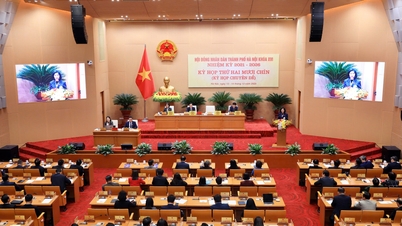
On the afternoon of November 23rd, at the National Assembly building, continuing the program of the 8th Session, under the chairmanship of National Assembly Chairman Tran Thanh Man , the National Assembly discussed in the plenary hall the draft Law on Chemicals (amended).

Participating in the discussion, National Assembly Deputy Vo Manh Son (National Assembly Delegation of Thanh Hoa province), Provincial Party Committee member, Chairman of the Provincial Federation of Labor, basically agreed with the verification report of the Committee on Science , Technology and Environment.
Commenting on the obligations of the investor in a chemical project, National Assembly Deputy Vo Manh Son suggested reconsidering point d, clause 2, Article 11 of the draft law, which stipulates the investor's obligation to: "Apply green chemistry principles in the design and selection of technology and equipment as prescribed by law," because:
According to Clause 12, Article 4, the principle of green chemistry is issued by the Ministry of Industry and Trade to be applied in the design, production process, use, and disposal of chemicals in order to minimize or eliminate the use and creation of hazardous chemicals. This means the Ministry of Industry and Trade has the authority to issue regulations that constitute investment and business conditions for chemical projects. This regulation needs further consideration to align with the principle that ministries cannot issue regulations on investment and business conditions as stipulated in Clause 3, Article 7 of Law No. 61/2020/QH14 on Investment. Furthermore, this regulation on investment and business conditions applies to all chemical projects, not just those producing and trading chemicals under specific conditions. Therefore, it is suggested that the application of this principle be reconsidered to ensure consistency with other legal regulations.
Regarding the Chemical Incident Prevention and Response Plan (point c, clause 2, Article 11 of the draft), National Assembly Deputy Vo Manh Son suggested that, to reduce administrative procedures and difficulties for businesses, a provision should be added to the Chemical Law allowing businesses to integrate their chemical incident prevention and response plans into other documents such as fire safety designs, fire fighting plans, or into the environmental incident prevention and response section of environmental impact assessment reports. Along with this, it should allow the integration of chemical safety training into other safety training activities.
Because there are currently many legal regulations related to the obligation to plan for incident prevention and response and train workers in each field in which businesses invest and operate, such as: The Law on Occupational Safety and Health requires businesses to have an occupational safety and health plan (Article 75), an emergency response plan (Article 77), and to provide occupational safety and health training (Article 14); The Law on Fire Prevention and Fighting stipulates that businesses must have fire prevention and fighting designs and design approvals (Article 15), a fire fighting plan approved by a state agency (Article 31), and that workers must be trained in fire prevention and fighting (Articles 22, 46)...
Meanwhile, in the Draft Law on Chemicals, point c, clause 2, Article 11 requires the investor of a chemical project to develop a Chemical Incident Prevention and Response Plan (according to Article 64) or measures for preventing and responding to chemical incidents (according to Article 66). Article 60 stipulates that workers must receive chemical safety training. Furthermore, the preparation of chemical incident prevention and response plans and measures will be carried out by a licensed consulting firm (Articles 13 and 14). Thus, the provisions of the draft will make it difficult for businesses to integrate overlapping content on chemicals with content in the fields of environment, labor, and fire prevention and control, compared to current regulations.
Regarding the validity period of certificates and licenses (Clause 4, Article 24; Clause 4, Article 25). In practice, chemicals subject to specific conditions are always subject to very strict inspection and control before being licensed for production and are frequently inspected and monitored. Therefore, the 5-year validity period for certificates of eligibility to produce and trade in chemicals is too short, potentially creating an administrative burden and affecting the production and business plans of enterprises.
Therefore, it is suggested that a 10-year term be applied to both types of licenses: the Certificate of Eligibility for Conditional Chemical Production and the Certificate of Eligibility for Conditional Chemical Business, to align with operational practices and facilitate business operations.
Regarding safe distances (Article 62), National Assembly Deputy Vo Manh Son strongly agreed with the regulation on safe distances for chemical facilities. This regulation will contribute to ensuring the safety of chemical facilities, residential areas, and other structures as prescribed, preventing violations of safe distances. However, to ensure the feasibility of the law after its promulgation and its suitability to practice, consideration should be given to existing chemical facilities located near residential areas that do not meet the safe distance requirements as stipulated in the new regulation.
Regarding hazardous chemicals in products, National Assembly Deputy Vo Manh Son argued that the regulation stipulating that "Ministries and ministerial-level agencies shall publish lists of hazardous chemicals in products and goods that do not yet have technical standards within their respective areas of state management" (Clause 2, Article 56) may lead to a waste of resources and is impractical due to the specific characteristics of different sectors. He suggested researching a mechanism for coordination and information sharing between the Ministry of Industry and Trade and other ministries and ministerial-level agencies in publishing lists of hazardous chemicals in products and goods that do not yet have technical standards. He also proposed clearly defining the functions of the Ministries of Industry and Trade, Health, and Agriculture and Rural Development in managing chemicals in products containing such chemicals.
Quoc Huong
Source: https://baothanhhoa.vn/dbqh-vo-manh-son-tham-gia-gop-y-ve-du-an-luat-hoa-chat-sua-doi-231211.htm


![[Image] Vietnam's colorful journey of innovation](/_next/image?url=https%3A%2F%2Fvphoto.vietnam.vn%2Fthumb%2F1200x675%2Fvietnam%2Fresource%2FIMAGE%2F2025%2F12%2F14%2F1765703036409_image-1.jpeg&w=3840&q=75)





























































![[Image] Vietnam's colorful journey of innovation](https://vphoto.vietnam.vn/thumb/402x226/vietnam/resource/IMAGE/2025/12/14/1765703036409_image-1.jpeg)





























Comment (0)