


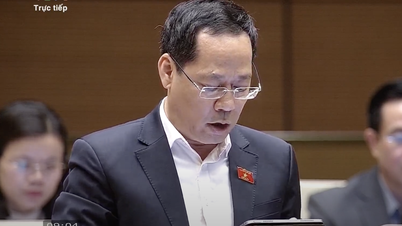
Delegate Nguyen Hoang Bao Tran proposed to clearly identify workers' children as a priority group. Photo: Quochoi.vn
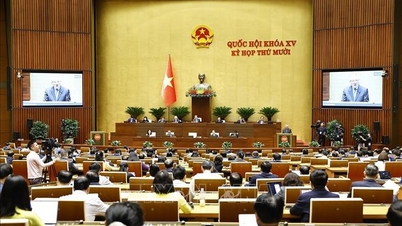
On the afternoon of December 2, the National Assembly discussed in the hall the Investment Policy of the National Target Program on Modernizing and Improving the Quality of Education and Training for the 2026-2035 period.
Speaking at the meeting, delegate Nguyen Hoang Bao Tran (HCM City National Assembly delegation) said that this is a key program to improve the quality of human resources, narrow the educational gap and ensure fairness for all Vietnamese children.
This delegate analyzed a number of limited issues that require innovation, thereby proposing feasible solutions to ensure that the national target program is substantive, practical and effective.
Delegate Nguyen Hoang Bao Tran said that for many years, when talking about educational difficulties, we often mentioned remote areas and islands. In these areas, students have to go to school far away, facilities are lacking, and access to education is still limited.
However, there is another group of people that is less mentioned but in reality is no less difficult, which is the children of workers in industrial parks and export processing zones.
According to the delegate, on the surface, the children living in urban areas, near the center, seem to have more favorable conditions. But in reality, the workers' lives are still difficult: cramped boarding houses, unsafe living environments, parents working overtime continuously, unstable income, not enough time to care for and support their children's studies.
Delegate Tran emphasized that most of the children's families only live in 10-12 m² rented rooms, the children do not have space to study, lack social connections, and do not have access to extracurricular activities.
“Compared to children in mountainous areas, the difficulties of the two groups are different in form, but they have in common that they are disadvantaged: lack of quality learning environment, lack of support from family and lack of opportunities for comprehensive development” - said the delegate of Ho Chi Minh City delegation.
This person added that in some places, more than 70% of children in industrial zones do not have the opportunity to learn special subjects, foreign languages or extracurricular activities because their family's economic conditions do not allow it.
From the above analysis, this delegate suggested that the National Target Program must clearly identify children of workers as a group of subjects needing priority support, not in a general group.
Accordingly, priority is not only given to scholarship policies, but also to contents such as: Support for building public schools near industrial parks.
Many industrial zones have tens of thousands of workers but there is a serious shortage of schools. Children have to go to school far away, and class sizes are overloaded.
Or the flexible boarding school model for workers' children. This is to ensure lunch, afternoon study, participation in skill activities, safe play, helping parents feel secure going to work.
Along with that, there must be a community learning space in the boarding house; a program to support psychological and skills for migrant children.
“We cannot let a large portion of the children of the core workforce of the economy suffer from educational disadvantages. Educational equity is not only a matter between mountainous and lowland areas, but also within industrial cities,” said delegate Nguyen Hoang Bao Tran.
Source: https://laodong.vn/thoi-su/de-nghi-xac-dinh-ro-con-em-cong-nhan-lao-dong-la-nhom-doi-tuong-can-uu-tien-1619102.ldo



![[Photo] Parade to celebrate the 50th anniversary of Laos' National Day](/_next/image?url=https%3A%2F%2Fvphoto.vietnam.vn%2Fthumb%2F1200x675%2Fvietnam%2Fresource%2FIMAGE%2F2025%2F12%2F02%2F1764691918289_ndo_br_0-jpg.webp&w=3840&q=75)
![[Photo] Worshiping the Tuyet Son statue - a nearly 400-year-old treasure at Keo Pagoda](/_next/image?url=https%3A%2F%2Fvphoto.vietnam.vn%2Fthumb%2F1200x675%2Fvietnam%2Fresource%2FIMAGE%2F2025%2F12%2F02%2F1764679323086_ndo_br_tempimageomw0hi-4884-jpg.webp&w=3840&q=75)







































































Comment (0)