

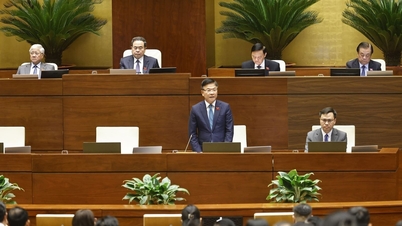
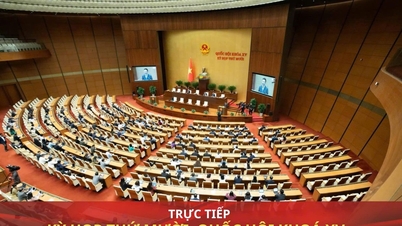
On the afternoon of December 2, the National Assembly discussed in the hall the national target program on modernizing and improving the quality of education and training for the 2026-2035 period.
Stronger incentives needed for "digital school" model
Delegate Nguyen Thi Ngoc Xuan (HCMC) proposed that in the specific goals, it is necessary to add the digitization rate of data in the entire education system linked with population data, employment, labor in enterprises, and training linkage between professions...
This, according to the female delegate, is to provide accurate information and data for the investment process, program implementation and State management process.

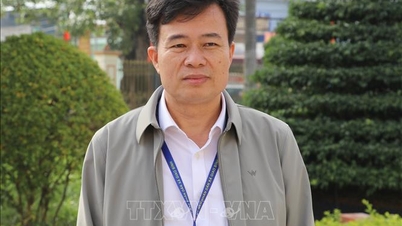
Delegate Nguyen Thi Ngoc Xuan (Photo: Hong Phong).
Ms. Xuan also cited information that as of July, Vietnam had the 3rd largest number of online learners in Southeast Asia, had online learning platforms, and Vietnamese learners ranked 2nd in the world .
Therefore, she recommended that the Government complete the legal framework for the online teaching model combined with direct teaching.
In addition, the female delegate proposed creating a mechanism to allow students with outstanding abilities and talents to shorten their study time, in order to optimize the process of human capacity development.
“There needs to be a stronger and more preferential system for schools and businesses regarding digital school models, digital majors, and digital-based vocational certificate accumulation, and a program to equip and sponsor computers for 100% of students, bringing equal learning opportunities to everyone,” Ms. Xuan suggested.
According to the female delegate, as the Government, educational institutions and communities continue to promote technological innovation, Vietnam will certainly become one of the pioneering countries in digital education, opening up more equal and effective learning opportunities for current and future generations.
Enough equipment, are there enough qualified teachers to teach in English?
Meanwhile, delegate Tran Khanh Thu (Hung Yen) wondered about the feasibility of the goal of making English the second language in the national education system.
The program sets a target that by 2030, 30% of preschool and general education institutions will have equipment to implement teaching and learning in English; by 2035, 100% of preschool and general education institutions will meet standards in terms of facilities; preschool and general education institutions will have teaching equipment to implement teaching and learning in English, gradually making English the second language in schools.

National Assembly Delegate Tran Khanh Thu (Photo: Hong Phong).
Pointing out the challenges in realizing this goal, Ms. Thu cited a report on English teaching in disadvantaged areas by the Ministry of Education and Training, saying that we are lacking about 4,000 English teachers at all levels of general education.
The capacity of the team is also a problem. Currently, the average age of English teachers in the district is quite high (44.2 years old), some older teachers are less interested or have difficulty in finding modern teaching methods suitable for each group of students, so the quality and effectiveness of teaching the subject have not been as expected.
In reality, infrastructure conditions, schools being far apart, dual classrooms, and electronic teaching equipment are limited. In addition, student learning outcomes also have a clear difference between the national average and the provinces in particularly difficult areas.
Another fact pointed out by Ms. Thu is that the difference in investment in infrastructure between regions is still large. Many general schools have not met the standards of technological equipment for foreign language learning, and many remote schools in ethnic minority areas do not have solid classrooms.
Therefore, she believes that the proposed goal may be feasible in large provinces and cities, but is very challenging in mountainous areas where infrastructure conditions are not uniform, not to mention the serious shortage of qualified English teachers.

Delegates attending the discussion session on the afternoon of December 2 (Photo: Hong Phong).
“When there is equipment to deploy teaching and learning in English, are there enough qualified teachers to be able to use this equipment?”, Ms. Thu questioned.
The female delegate suggested that it is necessary to increase investment in infrastructure for provinces, especially mountainous provinces; have strong enough policies to attract high-quality English teachers...
In addition, according to Ms. Thu, there should be policies to promote technology application, connect online classrooms, use artificial intelligence (AI) to support to compensate for the lack of teachers; build English centers in difficult areas according to the inter-commune model.
Source: https://dantri.com.vn/thoi-su/de-xuat-co-che-cho-sinh-vien-tai-nang-vuot-troi-duoc-rut-ngan-thoi-gian-hoc-20251202162422669.htm

![[Photo] Parade to celebrate the 50th anniversary of Laos' National Day](/_next/image?url=https%3A%2F%2Fvphoto.vietnam.vn%2Fthumb%2F1200x675%2Fvietnam%2Fresource%2FIMAGE%2F2025%2F12%2F02%2F1764691918289_ndo_br_0-jpg.webp&w=3840&q=75)

![[Photo] Worshiping the Tuyet Son statue - a nearly 400-year-old treasure at Keo Pagoda](/_next/image?url=https%3A%2F%2Fvphoto.vietnam.vn%2Fthumb%2F1200x675%2Fvietnam%2Fresource%2FIMAGE%2F2025%2F12%2F02%2F1764679323086_ndo_br_tempimageomw0hi-4884-jpg.webp&w=3840&q=75)














![[Video] Continuing the 34th working day, 10th Session, 15th National Assembly](https://vphoto.vietnam.vn/thumb/402x226/vietnam/resource/IMAGE/2025/12/03/1764720131270_dung00-53-48-32301still010-jpg.webp)










![[Video] Protecting World Heritage from Extreme Climate Change](https://vphoto.vietnam.vn/thumb/402x226/vietnam/resource/IMAGE/2025/12/03/1764721929017_dung00-57-35-42982still012-jpg.webp)





























































Comment (0)