

According to the National Tourism Administration, the fourth experiential route extends through Cao Bang city, Thach An district, and Quang Hoa district. This area is home to many geological heritage sites reflecting a long evolutionary process with complex geological changes that occurred hundreds of millions of years ago.
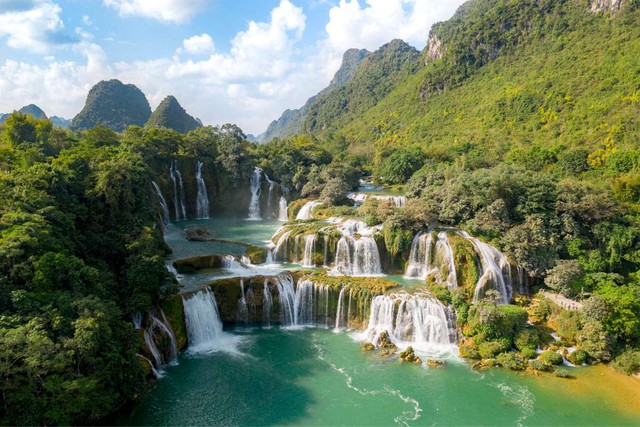
Ban Gioc Waterfall is one of the "specialties" of Cao Bang tourism.
Specifically, it involves faulting activity, the transformation of the Earth's crust from oceanic to continental; and karstification, which creates impressive karst landscapes, primarily mature karst landscapes (such as valley peaks, misty karst valleys, saddles, etc.) with "old" characteristics and a full range of different landforms, offering visitors surprises when exploring geological heritage sites.
In the Cao Bang city area, archaeologists have found traces of a river-lake-swamp environment that existed approximately 28-38 million years ago, with diverse and abundant flora and fauna.
Typical fossils such as coral fossils (Thuy Hung commune, Thach An district) and stratigraphic depressions (Le Lai, Thach An district) have been discovered, providing evidence of the long-term geological process of an area that was formerly seawater and then uplifted. At Khau Khoang pass (Thai Cuong commune, Thach An district), volcanic eruption products from the ocean floor have appeared in the form of cushion-shaped basalt rock outcrops.
The "A Time of Fiery Flowers" experiential tour is linked to the legendary fiery Highway 4; the heroism of our army and people that led to the 1950 Border Victory. Visitors will tour the 1950 Border Victory historical site – a testament to the brilliant leadership of President Ho Chi Minh and General Vo Nguyen Giap in the resistance war against French colonial aggression. In particular, Bao Dong mountain peak marks the first and only time President Ho Chi Minh personally went to the front lines. The route also includes a heritage site honoring the steadfast communist soldier and outstanding son of Cao Bang, Hoang Dinh Giong.
In addition, the tour route also takes visitors to the traditional sugarcane making village of Bo To (Quang Hoa district); along with rich biodiversity typical of the Van Trinh heritage forest (Thach An) and many rare native plants such as black jelly plant, Dong Khe pear, mandarin orange, fragrant pumpkin...
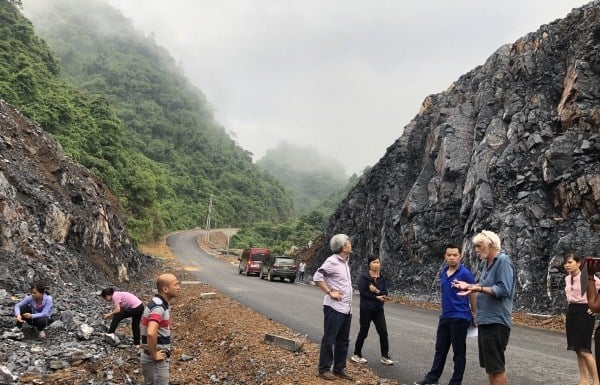
Experts from UNESCO Global Geoparks and the Vietnam Institute of Geological Sciences and Minerals surveyed the ancient underwater volcanic geological landscape heritage site at Khau Khoang Pass, Thai Cuong commune (Thach An district, Cao Bang province).
Mr. Truong The Vinh, Deputy Director of the Department of Culture, Sports and Tourism of Cao Bang province, said that the fourth experiential route has integrated heritage sites; connecting Cao Bang city with tourist routes inside and outside the province. This tourism product also helps to effectively utilize National Highway 4A, a vital transportation route connecting Cao Bang with Lang Son and the provinces of Quang Ninh, Hai Phong, etc.; connecting visitors with the National Special Monument of the 1950 Border Victory, cultural and geological heritage values. Especially the most typical manifestations of the Cao Bang - Tien Yen deep fault zone...
Previously, the UNESCO Global Geopark Cao Bang had developed three exploration routes: the Northern Route - A Journey to the Origins; the Western Route - Exploring Phia Oac - A Mountainous Region of Change; and the Eastern Route - Experiencing Indigenous Culture in a Land of Fairytales.
Source link


![[Image] Close-up of the newly discovered "sacred road" at My Son Sanctuary](/_next/image?url=https%3A%2F%2Fvphoto.vietnam.vn%2Fthumb%2F1200x675%2Fvietnam%2Fresource%2FIMAGE%2F2025%2F12%2F13%2F1765587881240_ndo_br_ms5-jpg.webp&w=3840&q=75)







































































Comment (0)