

Amidst the many lively activities celebrating Vietnamese Teachers' Day, I took some time to reread some books about the teaching profession. I revisited "Questions and Answers on Vietnamese Education ," a two-volume set compiled by author, journalist, and poet Le Minh Quoc, previously published by Nha Xuat Ban Tre (Youth Publishing House).
Some contents of the booklet
In the Preface to Volume 1, the publisher stated: "In any era, if you want to select talented people to serve the country, there is no better method than to take care of the education of the entire population and organize fair examinations."
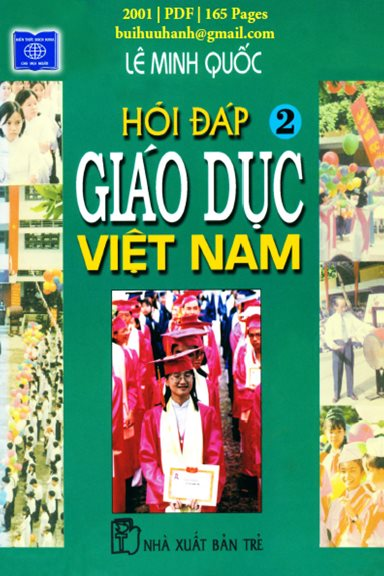
"Questions and Answers on Vietnamese Education" is organized according to the development of Vietnam's education system from the period of Chinese rule to the early years of the 21st century. Volume 1 concludes with the year 1919, the year the Nguyen dynasty held its last doctoral examination, ending the examination system of feudal Vietnamese education. Volume 2 begins from the time the French colonialists, after invading Vietnam, established the Franco-Vietnamese education system until after the August Revolution, marking the beginning of a new education system.
With the content arranged in these two volumes, readers can easily visualize the two educational systems, distinguished by the use of Chinese characters and the Vietnamese Quốc ngữ script as the official writing system in the imperial examinations.
The two books contain 182 questions and answers covering various topics related to Vietnamese education. Volume 1: 90 questions, Volume 2: 92 questions.
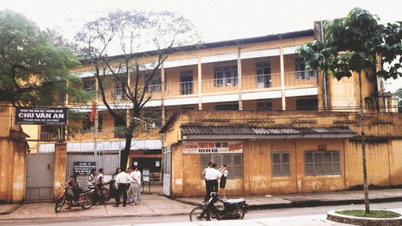
The author of this book has meticulously reviewed numerous old documents related to Vietnamese education compiled by many people from previous generations. Along with this, they have collected old photographs, illustrations depicting educational activities from the past, examination halls, covers of old textbooks, a photograph of President Ho Chi Minh visiting and speaking with teachers and students at Chu Van An School in 1958, photographs of prominent educators and cultural figures, and photographs of the activities of Vietnamese students at various schools throughout different periods.
The author would like to briefly summarize some of the content covered in the two books:
1. The examination system marked the beginning of the Vietnamese education system during the feudal era: In 1075, King Ly Nhan Tong held the first Confucian examination (Tam Truong) to select intelligent and well-educated individuals to serve as officials. The examination system became more organized and structured in 1232 when King Tran Thai Tong organized the Thai Hoc Sinh examination, awarding the title of Tam Giap (third class). From 1239, the king stipulated that the Hoi examination (national examination) would be held every seven years.
2. Regarding the reason why students in the past were called Confucian scholars, the book contains the following passage: “The cultural scholar Pham Quynh explained as follows: “The name Confucian scholar not only refers to those who are literate and study the teachings of the sages in Confucianism; it also refers to a social class, that is, the intellectual elite in the country…”.
3. Regarding the examination rules during the feudal era, the book mentions: “In the past, scholars entering the examination hall were bound by the strict and harsh rules of the ‘examination regulations’ – the rules governing the examination process. Some of these rules include: ‘Taboo names’ – meaning no words related to the king's name were allowed; ‘Minor taboo names’ – meaning the names of the king's grandmother, mother, or ancestors were forbidden. If a candidate violated a ‘minor taboo,’ they would be shackled and exposed to the sun for several days and banned from taking exams for life; if they violated a ‘major taboo,’ not only would the candidate be imprisoned, but even their teachers and instructors would be reprimanded and demoted.”
4. In 1070, King Ly Thanh Tong ordered the construction of the Temple of Literature in Thang Long. In 1076, King Ly Nhan Tong ordered the expansion of the Temple of Literature into the National Academy, allowing princes and high-ranking officials to attend. This can be considered the first university in our country.
5. Regarding the title of Trạng Nguyên (First-ranked Scholar): In 1232, King Trần Thái Tông held the Thái Học Sinh (Imperial Academy) examination, dividing the successful candidates into three classes: First, Second, and Third. In 1246, the Trần dynasty held the Đại Tỷ (Grand Examination) and redefined the ranking within the three classes: The First class had three top scholars: Trạng Nguyên, Bảng Nhãn, and Thám Hoa. In the 1246 examination, the first Trạng Nguyên of our country was Nguyễn Quan Quang, from Tam Sơn commune, Đông Ngàn district (now Tam Sơn village, Tiên Sơn district, Bắc Ninh province ).
6. The first Confucian examination in our country was the Ất Mão examination (1075) under King Lý Nhân Tông and the last examination was the Kỷ Mùi examination (1919) under King Khải Định. Thus, the examination system of the feudal education system of Vietnam lasted 844 years, with a total of 185 examinations and 2,898 successful candidates, including 46 Trạng nguyên (First-place winners), 48 Bảng nhãn (Second-place winners), 76 Thám hoa (Third-place winners), 2,462 Tiến sĩ (Doctors) and 266 Phó bảng (Associate Scholars).
7. The famous Vietnamese language textbook series used uniformly in Vietnamese schools during the French colonial period and throughout the first half of the 20th century was the "National Language Textbook," compiled by educators Tran Trong Kim, Nguyen Van Ngoc, Dang Dinh Phuc, and Do Than under the direction of the French Indochina Education Department.
8. One of the important and noteworthy events in Vietnamese education during the French colonial period was the establishment and operation of the Society for the Promotion of the National Language, initially in Hanoi in 1938. The Society's purpose was to teach people to read and write the national language. Initially, the provisional governing board consisted of Mr. Nguyen Van To (Chairman), Mr. Bui Ky (Vice Chairman), Mr. Phan Thanh (Secretary), and several other members. The influence of the Society for the Promotion of the National Language spread to many provinces in the North and even to Central and Southern Vietnam.
9. President Ho Chi Minh, the infinitely beloved leader of our nation, paid great attention to the cause of education. On the first day of school in the Democratic Republic of Vietnam in the 1945-1946 school year, he wrote a letter to students nationwide. And on October 15, 1968, in his last letter to cadres, teachers, staff, and students at all levels on the occasion of the opening of the 1968-1969 school year, he affirmed: “Education aims to train successors to the great revolutionary cause of our Party and people; therefore, all sectors and levels of the Party and local governments must pay even more attention to this cause, must take care of schools in all aspects, and push our education cause to new levels of development.”
10. On April 26, 1986, the Government issued Decree No. 52/HĐBT on the awarding of the titles of People's Teacher and Excellent Teacher. This prestigious title is considered and announced every two years on November 20th.
On May 19, 1995, the Minister of Education and Training issued Decision No. 1707/GD-ĐT on the promulgation of the "For the Cause of Education" medal, which is awarded annually to recognize the contributions of those who have made significant contributions to the cause of education and training.
11. Regarding the organization of November 20th in Vietnam, the book provides the following information: On November 20, 1958, the International Charter Day for Teachers was first celebrated in North Vietnam; subsequently, it was celebrated in the liberated areas of South Vietnam. Since the reunification of the country, November 20th has been widely celebrated and gradually become a valuable tradition to honor teachers. On September 28, 1982, the Council of Ministers issued Decision No. 167/HĐBT, designating November 20th annually as Vietnamese Teachers' Day.
Along with a wealth of other information about education and training contained in this book.
Some lasting impressions
Reading "Questions and Answers on Vietnamese Education" compiled by journalist and poet Le Minh Quoc, readers gain a comprehensive overview of the Vietnamese education system, from the feudal era to the years after the August Revolution, and then after the country's reunification to the beginning of the 21st century. From this, readers can see some of the achievements of the Vietnamese education system throughout history.
Above all, it is the vast majority of learners, of all ages, who value learning combined with practical application, so that they can work for many years, provide for themselves, and contribute to society.
Education has always been a crucial undertaking for the nation. Therefore, every Vietnamese family hopes that those responsible for this cause, in various positions—from managers at all levels to teachers directly instructing students—will put their hearts into their work and perform effectively so that future generations of students can enjoy the best possible education, acquire the most scientific knowledge, and apply what they have learned from school to life in a useful way, in line with the development of society.
Source



![[Image] National Assembly discusses the implementation of the socio-economic development plan.](https://vphoto.vietnam.vn/thumb/1200x675/vietnam/resource/IMAGE/2026/04/20/1776696707422_ndo_br_img-20260420-185419-jpg.webp)

![[Photo] General Secretary and President To Lam meets with National Assembly delegates from ethnic minorities.](https://vphoto.vietnam.vn/thumb/1200x675/vietnam/resource/IMAGE/2026/04/20/1776696701056_a1-bnd-8331-3342-jpg.webp)

































































Comment (0)