

Despite escalating tensions in Ukraine and the Middle East, since the end of July, US Secretary of State Antony Blinken has made his 18th and longest overseas trip to the Asia -Pacific region since taking office.
Reasons and purposes
The packed schedule also includes 2+2 meetings and dialogues between Secretary of State Antony Blinken and Secretary of Defence Lloyd Austin with their counterparts from Japan and the Philippines. Also in Tokyo, the US Secretary of State met with his counterparts from Australia, India, and Japan – members of the Quad.
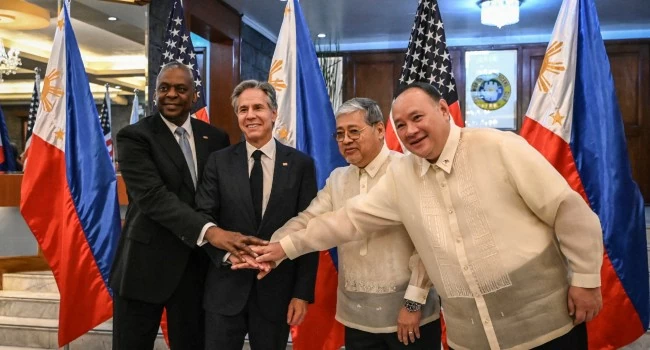 |
| US Secretary of State Antony Blinken, Secretary of Defense Lloyd Austin, and their Philippine counterparts at the 2+2 dialogue in Manila on July 30. (Source: AFP) |
That move was "not sudden," as the U.S. has repeatedly affirmed its determination to promote a "free and open" Indo- Pacific strategy. The recent surge in activity is a highlight in the implementation of the U.S.'s fundamental, long-term strategy in the region, stemming from a variety of reasons and aiming at multiple objectives.
The Asia-Pacific region is of immense importance to global security. It is also a region fraught with challenges, ranging from nuclear threats, terrorism, climate change, and epidemics, to instability, confrontation, and fierce competition among major powers. In particular, the growing role and influence of China, a long-term systemic rival, threatens the United States' position as the world's leading superpower.
The joint statement of the Quad Foreign Ministers' Meeting on July 29 emphasized “deep concern about the situation in the South China Sea and East China Sea”; “the militarization of disputed entities and coercive and threatening actions in the South China Sea”; and reaffirmed its position of “strong opposition to any unilateral actions seeking to change the status quo by force”.
Previously, at the 21st Shangri-La Dialogue (June 2024), Secretary of Defense Lloyd Austin affirmed, “The United States is only secure if Asia is secure. That is why the United States always maintains a presence in this region” and “protecting the security and prosperity of the region is a core principle of U.S. national security policy.” Thus, promoting the Indo-Pacific strategy aims at fundamentally and primarily strengthening the political, security, and military role, as well as the leading and dominant role of the United States in many aspects.
Notably, the US emphasizes this challenge as a shared threat to countries in the region. A new aspect of US policy is the shift from a "one-axis, many-spoke" strategy to a "new convergence" strategy. At its core, this involves strengthening and expanding relationships and cooperation with allies and partners; bringing them together around shared values and principles to address common threats and challenges. The US is not bearing this burden alone, yet it can still achieve its objectives.
The hurried arrival of the "commander" of diplomacy at this time carries a message about America's long-term commitment; it alleviates the concerns of allies and partners about Washington's focus on the Ukraine crisis and the Middle East while neglecting and distancing itself from the region. At the same time, it aims to create a fait accompli ahead of the presidential election. It must be affirmed that, regardless of who occupies the next White House, the fundamental US security strategy and policy towards the region cannot be reversed. Perhaps only the approach and specific implementation measures will be adjusted or changed.
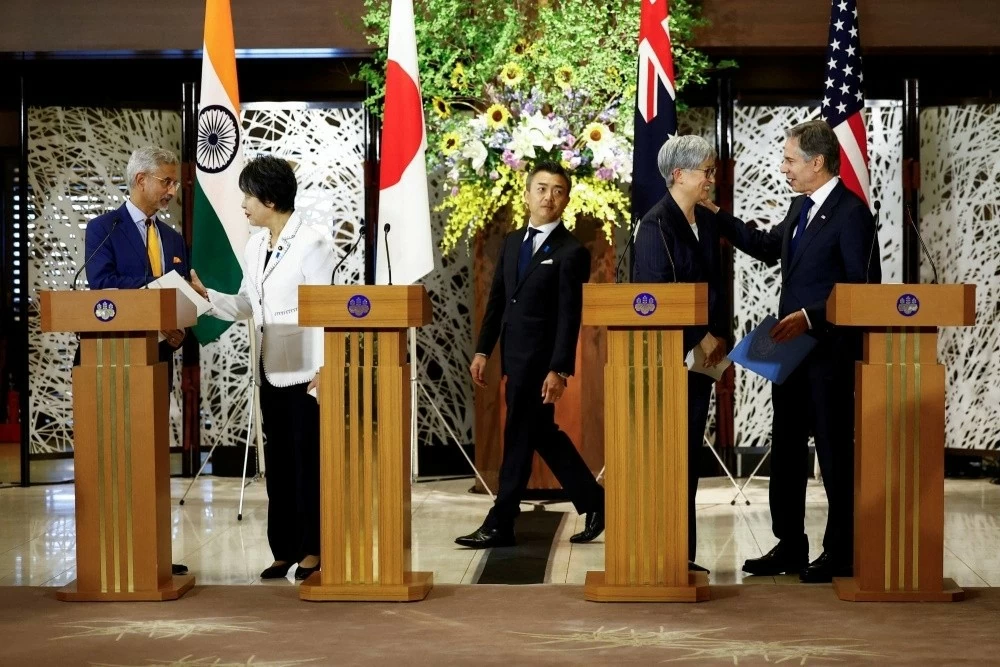 |
| Foreign Minister Antony Blinken and his counterparts in the Quad: Subrahmanyam Jaishankar (India), Kamikawa Yoko (Japan), and Penny Wong (Australia) in Tokyo on July 29. (Source: Reuters) |
Strategy implementation and current situation
The US continues to strengthen its security structure and multifaceted cooperation institutions (political, security, military, economic, and technological) to link and connect allies and partners, complementing and supporting each other.
First, Washington coordinates and enhances bilateral relations and multifaceted cooperation with strategic allies and key partners, as well as among allies and partners themselves, through agreements, treaties, and accords. The US strengthens and expands the scope of cooperation with strategic allies and traditional partners, while simultaneously promoting relations with new partners such as India and ASEAN.
Secondly, consolidate and expand the system of over 200 military bases and nearly 70,000 soldiers in Japan, South Korea, the Philippines, etc., into land fortresses, anchorages, and unsinkable warships at sea; serving as a deterrent foothold and a springboard for deploying forces and handling situations in the region.
Third, strengthen and expand multilateral strategic cooperation, promoting the role of trilateral and quadrilateral cooperation organizations (AUKUS, the Quad, the Five Eyes, etc.). It is anticipated that the US and its allies may develop new security mechanisms and structures in the region in the near future.
These "mobile structures" combine with "fixed structures" to form triangular, quadrilateral, arc, crisscrossing, multi-layered systems on land and at sea. In this way, the U.S. and its allies maintain a powerful presence, conduct exercises, and carry out many regular activities in the region.
But China and other major powers are not sitting idly by. They are also forging alliances and partnerships, gathering forces, and deploying their strategies (in some aspects even proactively), using a "soft approach" to bind effectively, linking cooperation, economic, financial, and investment interests with security, forming belts and axes across a wide area, both on land and at sea, creating a counterweight to the US and its allies.
ASEAN continues to strengthen internal solidarity, linkages, and connectivity, and expand multifaceted cooperation with other partners, especially major powers, in order to consolidate its central role and maintain peace and stability in the region. Mechanisms and forums within the framework of ASEAN-centric cooperation, such as ARF, EAS, ADMM+, etc., are increasingly attractive. This situation makes major powers respect ASEAN and seek to cooperate with it, trying to draw ASEAN and its member states closer to them.
Given this situation, one side or the other may have a dominant advantage or lead in certain aspects at specific times, but overall, the balance of power in the region has not shifted decisively in favor of either side.
 |
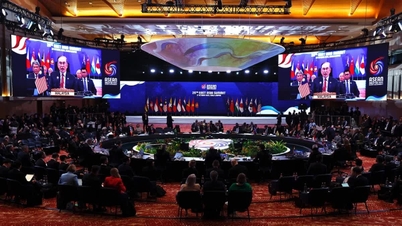
| ASEAN needs to strengthen solidarity and cooperation for common interests; promote a regional structure based on existing and developing mechanisms, with ASEAN playing a leading role. (Source: Getty) |
Impact and some of the issues raised
The presence, involvement, confrontation, and competition of structures and institutions led by major powers create both advantages and disadvantages.
Firstly, it provides conditions for maintaining a secure environment and space for cooperation and development for ASEAN and many countries, including Vietnam. Secondly, it creates opportunities for ASEAN and Vietnam, along with other countries, to address common issues. Thirdly, it creates opportunities for ASEAN and Vietnam, as well as other middle- and developing countries, to enhance their role, position, and prestige in the region and the world.
Fourth, ASEAN and its member states have become more aware of the necessity and urgency of building strategic trust; implementing security mechanisms, managing disagreements, and resolving disputes through peaceful means and dialogue, based on international law, including UNCLOS and the DOC; and building a substantive and truly effective COC.
The involvement, confrontation, and strategic competition of major powers also pose challenges and difficulties. Firstly, it complicates and makes the regional situation unpredictable; it harbors factors of instability, tense confrontation, and the risk of conflict. Secondly, it creates complex and sensitive situations that force ASEAN and other countries to weigh their options between different sides. Thirdly, it causes internal divisions and disparities, differences in cooperation and integration with partners, and in addressing common issues; it diminishes ASEAN's central role and standing.
In this context, ASEAN needs to strengthen solidarity and cooperation for common interests; promote a regional structure based on existing and developing mechanisms, with ASEAN playing a leading role. This will enhance its attractiveness and draw more countries, especially major powers, to participate.
Vietnam needs to maintain its independence, self-reliance, political stability, and security; promote rapid and sustainable economic development; appropriately handle situations; and balance relations with major powers. It must vigorously implement the strategic direction outlined in the Party's 13th National Congress document, which states: "Continue to promote the pioneering role of foreign affairs in creating and maintaining a peaceful and stable environment, mobilizing external resources for national development, and enhancing the country's position and prestige."
Source: https://baoquocte.vn/dong-thai-moi-cua-my-o-chau-a-thai-binh-duong-va-nhung-van-de-dat-ra-281004.html

















































































Comment (0)