

| It is expected that by the end of August 2023, Vietnam may have exported all of its 2023 pepper production. In the first seven months of 2023, pepper exports to China increased by 665% compared to the same period in 2022. |
According to data from the General Department of Customs, cited by the Import-Export Department ( Ministry of Industry and Trade ), Vietnam's pepper exports in August 2023 were estimated at 16,000 tons, worth 60 million USD, an increase of 4.9% in volume and 5.4% in value compared to July 2023, but a decrease of 13.4% in volume and 20.2% in value compared to August 2022.
 |
| Forecasts indicate that Vietnam's pepper exports will remain at a low level. |
In the first eight months of 2023, Vietnam exported approximately 184,000 tons of pepper, worth $600 million, an increase of 14.5% in volume but a decrease of 15.9% in value compared to the same period last year.
In August 2023, the average export price of Vietnamese pepper was estimated at US$3,748 per ton, an increase of 0.5% compared to July 2023, but a decrease of 7.9% compared to August 2022. For the first eight months of 2023, the average export price of Vietnamese pepper was estimated at US$3,263 per ton, a decrease of 26.5% compared to the same period last year.
In terms of product structure, in July 2023, Vietnam's exports of black pepper and ground black pepper decreased in both volume and value compared to July 2022, while exports of white pepper and ground white pepper decreased in volume but increased in value.
In the first seven months of 2023, exports of black pepper increased in volume but decreased in value compared to the same period last year; exports of ground black pepper, white pepper, and ground white pepper decreased in both volume and value.
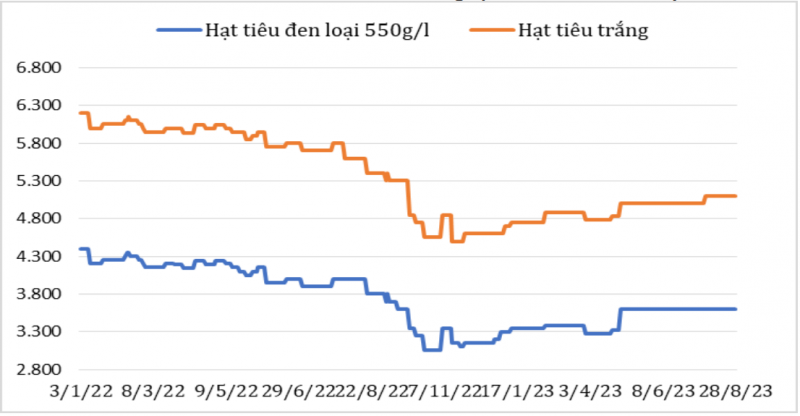 |
Trends in the export prices of Vietnamese black and white pepper from the beginning of 2023 to the present (Unit: USD/ton) (Source: International Pepper Association (IPC)) |
In the short term, the global pepper market is expected to face pressure from weak demand from the United States, Europe, and China. However, limited supply from Vietnam will have a positive impact on global pepper prices.
According to the International Pepper Association (IPC), total global pepper production in 2023 is estimated at 526,000 tons, lower than the 537,600 tons of 2022. Of this, Vietnam's pepper production is estimated at 200,000 tons, an increase of 9.3%; production in Brazil, Indonesia, and India is forecast to decrease compared to 2022.
Currently, the amount of pepper from the 2023 harvest held by farmers and businesses is not large. From now until the end of the year, pepper exports will mainly come from inventories carried over from previous years. This is believed to be the reason for the increase in domestic pepper prices in August 2023.
Specifically, on August 28, 2023, the price of black pepper increased by 1,500 – 2,000 VND/kg compared to the end of July 2023, reaching 68,500 – 72,000 VND/kg (depending on the surveyed area). The price of white pepper was 102,000 VND/kg, an increase of 1,000 VND/kg compared to the end of July 2023, but still lower than the 105,000 VND/kg recorded during the same period last year.
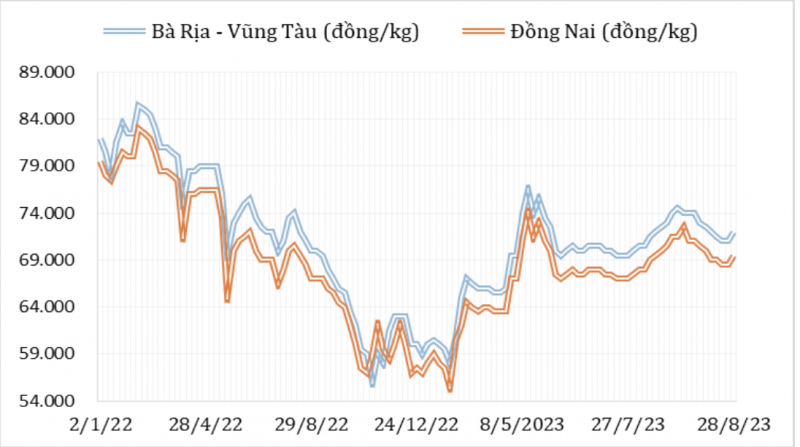 |
Trends in black pepper prices in the domestic market from the beginning of 2022 to the present (Source: Vietnam Pepper Association) |
As of September 7th, pepper is being purchased by provinces at prices ranging from 70,500 to 73,000 VND/kg. Gia Lai province has the lowest purchase price at 70,500 VND/kg, while Ba Ria - Vung Tau province maintains its purchase price at 73,500 VND/kg.
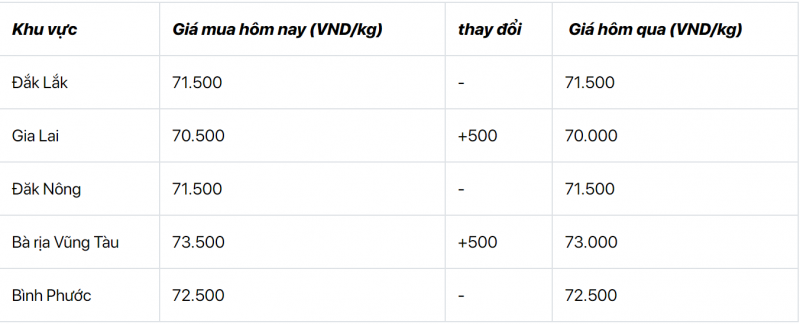 |
| Domestic pepper prices on September 7, 2023 |
Forecasts indicate that Vietnam's pepper exports will remain low in the coming period. Domestic supply is no longer abundant, and demand from the US, EU, and Chinese markets has not yet truly picked up.
From a business perspective, in an interview with a reporter from the Industry and Trade Newspaper, Ms. Nguyen Thi Huyen – General Director of Vinasamex Joint Stock Company for the Production and Export of Cinnamon and Anise – stated that due to the impact of the pandemic and inflation, consumer demand for many types of agricultural, forestry, and aquatic products in markets such as the EU and the United States has decreased.
However, although the demand for Vietnamese spice products in general, and pepper in particular, has decreased slightly, businesses have not been significantly affected.
The reason is that Vietnamese product lines typically serve not only the spice industry but also have many other uses.
For example, cinnamon, star anise, pepper, and ginger and turmeric are used by customers in the food and beverage industries, such as in the production of alcoholic beverages, teas, and herbal products.
In addition, these products are also sold to companies specializing in manufacturing medicines, dietary supplements, and beauty products for women. These two product categories are considered to have strong growth potential in the post-Covid-19 pandemic period.
Vietnam has strengths in agriculture , and particularly in spices. The climate and soil conditions have created unique aromas and flavors in pepper, cinnamon, and star anise that are distinct from those found in other markets around the world.
“Cinnamon contains procyanidins and cinnamic acid , two components used in anti-stroke and anti-inflammatory drugs. Star anise also contains a certain amount of shikimic acid, which gives it strong antiviral properties. Shikimic acid is also known as the main ingredient in Tamiflu – a medication commonly used to treat colds and flu. As for black pepper, a jar of black pepper is indispensable on dining tables worldwide,” shared Ms. Nguyen Thi Huyen.
Regarding the EU market specifically, according to Ms. Nguyen Thi Huyen, Vietnam currently has the EVFTA agreement, and pepper and spice exporting businesses are benefiting greatly from this agreement.
"Many EU customers have switched from purchasing from Indonesia, China, etc., to purchasing from Vietnam to benefit from the 0% import tax," said Ms. Nguyen Thi Huyen.
Source link


![[Photo] Prime Minister Pham Minh Chinh holds a phone call with the CEO of Russia's Rosatom Corporation.](/_next/image?url=https%3A%2F%2Fvphoto.vietnam.vn%2Fthumb%2F1200x675%2Fvietnam%2Fresource%2FIMAGE%2F2025%2F12%2F11%2F1765464552365_dsc-5295-jpg.webp&w=3840&q=75)
































































Comment (0)