


1. On a warm spring day, a large crowd of young men and women gathered on the sandy riverbank to play swings. Flags fluttered, and drums sounded joyfully. Suddenly, from the hillside, the bandits rushed out. Those who were not quick enough to escape, especially the women and girls, were captured by the bandits and taken to the southern bank of the Thu Bon River…
That scene was something I… imagined, after reading the lines in Professor Phan Khoang's "Vietnamese History: The Southern Region 1558-1777": "At that time in Hoa Chau, there was a custom that every year, in the spring, boys and girls would gather to play swings at Ba Duong (?), so every December, the Cham people would hide at the headwaters of this province, waiting until January to ambush and abduct people."
There is a question mark after the place name Bà-dương, indicating that Professor Phan Khoang still has some doubts about the place name. But the time frame is clear. "At that time," meaning the years after Chế Bồng Nga ascended the throne as King of Champa (1360).
This "robbery and kidnapping" incident is specifically mentioned in 1361 and 1366. The geographical area (of Hoa Chau) extends from Phu Loc and Phu Vang (Thua Thien Hue ) to present-day Dai Loc and Dien Ban (Quang Nam).
At this time, the two provinces of Ô Lý had "returned" to Đại Việt more than half a century earlier and been renamed Thuận and Hóa provinces, but historical records show that the region never had a day of peace. Chế Bồng Nga constantly sent troops to raid and plunder, and several times even reached the capital Thăng Long, causing trouble until the Trần dynasty lost power…
The traditional swinging dances of the past evoke memories of the folk songs and rituals performed along the Vu Gia - Thu Bon river. As described by researcher Pham Huu Dang Dat, Chan Son village (Dai Loc district) is one of the localities with a long-standing tradition of folk song and ritual singing.
“ The folk songs are like the traditional New Year's songs / Wishing for a year of sticky rice and sweet soup / The folk songs are like the traditional New Year's songs / Wishing for a year of sticky rice and sweet soup ,” the chants of the folk song troupe still echo as they go to wish people a happy new year. There are even folk songs wishing good fortune in farming, weaving, carpentry, blacksmithing, and trading… very old songs.
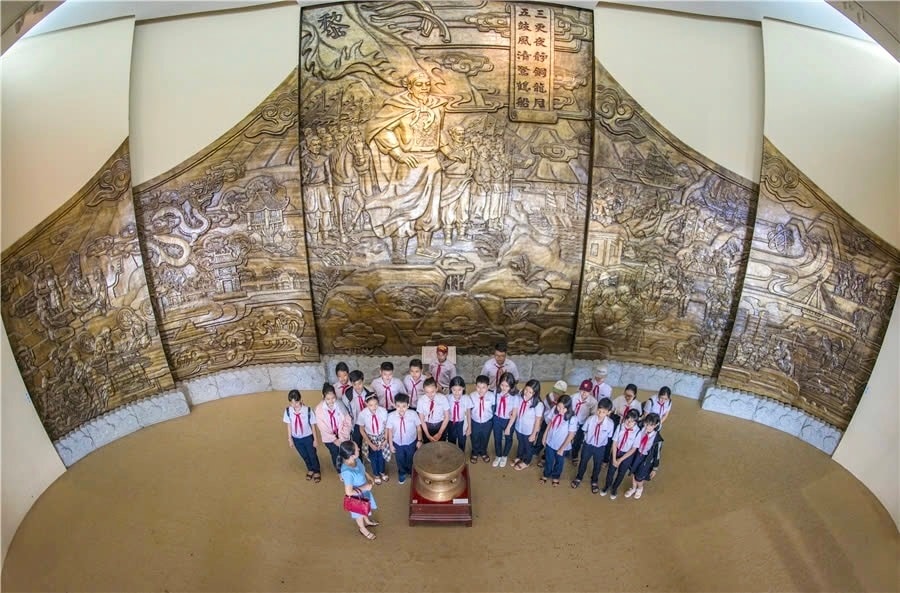
2. It was not until King Le Thanh Tong's campaign against Champa (1471) that Dien Ban - the land of Hoa Chau bordering Champa - was truly liberated. For 160 years, from 1306 to 1471, the land from south of Hai Van to north of Thu Bon River was a period when "records were merely empty names," according to researcher Vu Hung.
"Hoang Viet Nhat Thong Du Dia Chi" records that, during the Tran dynasty, although two more provinces, O Ly and others, were added, "they were merely symbolic territories." "Lich Trieu Hien Chuong Loai Chi" similarly records: "During the Ly and Tran dynasties, although Hoa Chau was captured, the area south of Hai Van remained the old territory of the Champa people."
Then, more than 80 years after the Champa conquest, the flourishing landscape of Dien Ban was described in "O Chau Can Luc": "The people get rich from rice, farmers use buffaloes to thresh the rice... Mac Xuyen gardens grow many roses, Lang Chau people weave much white silk... Women wear Champa cloth trousers, men hold Chinese fans" (translation by Tran Dai Vinh). Just imagine how vibrant and colorful the spring days were in this region expanding southward...
"When spring arrives, the swimming races begin, and people in silk clothes crowd together," another sentence in the summary of customs in the land from Quang Binh to northern Quang Nam opens up a scene of peaceful yet bustling activity.
Dr. Dương Văn An, who revised "Ô Châu Cận Lục" in 1555, would spend his days reviewing maps, village names, and commune names after court sessions, then spontaneously write articles incorporating place names, river names, mountain names, and village names. The Điện Bàn district, belonging to the Triệu Phong prefecture at that time, had 66 villages, and each one eagerly extended an invitation.
“Kim Quất is drenched in golden dew, Thúy Loan is lush green with rain (...) Lỗi Sơn, Lệ Sơn have village temples by the cliff, along the winding path; Hoài Phố, Cẩm Phố have fishing houses peeking through the bamboo, with slightly ajar windows; Cẩm Đăng has flickering wedding candles; Cẩm Lệ has glimpses of beautiful women smiling”...
If you leisurely "travel" through the excerpt from "Ô Châu Cận Lục," you will have passed by the now-new village names: Thanh Quýt (the new name of the old Kim Quất village) - Túy Loan - Điện Tiến - Hòa Tiến - Sơn Phô - Cẩm Phô - Điện Hồng - Hòa Thọ. Looking towards the misty Hải Vân Pass, you will see "a blue color spreading like a strand of cloud hair," and gazing south, you can "see the border of Ô Lý, and realize how beautiful the land is"...
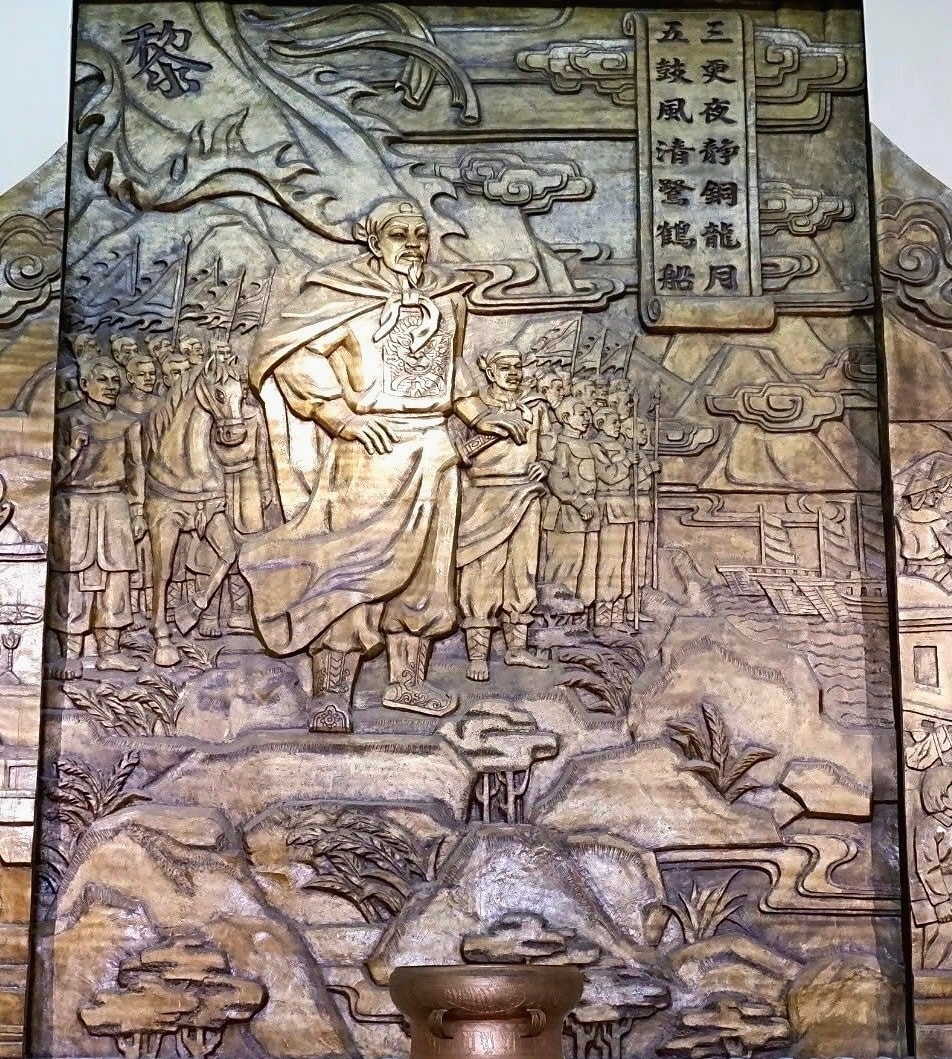
3. King Le Thanh Tong's southern campaign also left behind in literary history a poem describing the first day of spring in the border region. On the first moonlit night of spring, the ships of the Dai Viet army were moored closely together in Dong Long Bay. The eloquent king composed "Hai Van Hai Mon Lu Thu," which included two lines: "At the third watch of the night, the moon shines brightly over Dong Long Bay; at the fifth watch, the wind is cool, and the Lo Hac boat bobs gently."
It is quite interesting that the large bas-relief depicting King Le Thanh Tong, currently on display at the Da Nang Museum, chose to engrave those two lines of Chinese poetry. Many researchers generally agree that Dong Long is Da Nang Bay. But there is still some debate about "Lo Hac." Is it the name of a country (Locac, the Malay Peninsula, or Lavois, an ancient kingdom in the lower reaches of the Chao Praya River) or the Hac Cape, the Hac promontory in Nam O? From afar, Hac Cape looks like a boat – "Lo Hac boat"…
The old border region has so many inviting places; you should set out to explore. From the summit of Hai Van Pass, looking towards Da Nang Bay, you can spot Hac Point, then gradually head south. You can continue all the way to Thach Bi Mountain, where King Le Thanh Tong established the territory of Dai Viet and marked the boundary for the new territory of the 13th administrative region: Quang Nam.
Source: https://baoquangnam.vn/du-xuan-qua-mien-phen-giau-3147837.html

![[Image] A brilliant symphony and explosive power in the skies of Da Nang.](https://vphoto.vietnam.vn/thumb/1200x675/vietnam/resource/IMAGE/2026/05/31/1780196945787_anh-man-hinh-2026-05-31-luc-10-08-51.png)















![[Video] Sunset at Lap An Lagoon – Where the sun sets over the fishing nets](https://vphoto.vietnam.vn/thumb/340x192/vietnam/resource/IMAGE/2026/05/31/1780192137701_beach-landscape-sea-water-nature-grass-745871-pxhere-com.jpeg)



































































Comment (0)