

EVN has requested the Ministry of Industry and Trade to consider and submit to the competent authorities a plan to import more electricity from Laos to increase supply for the North by 2025.
According to the Power Development Plan VIII and the 2019 cooperation agreement between Vietnam and Laos, Vietnam will purchase 3,000 MW of electricity from Laos by 2025 and approximately 5,000 MW by 2030, potentially increasing to 8,000 MW if conditions permit.
Vietnam Electricity Group (EVN) recently proposed to the Ministry of Industry and Trade to expedite the import of electricity from Laos, and to promptly submit to competent authorities for approval the policy of importing electricity from wind and hydropower plants such as Nam Mo and Houay Koauan with a total capacity of over 225 MW, and the plan for connecting with the Savan 1 and 2 wind power projects.
This situation arises because no major power generation projects are expected to be operational between now and 2025, leading to the risk of electricity shortages in the North during the peak dry season in the next two years.
According to updated calculations, EVN stated that the North could face a shortage of over 3,630 MW and approximately 6.8 billion kWh during the peak dry season (May-July) in 2025 due to the limited number of new power sources coming online, mostly towards the end of the year.
Therefore, according to EVN, importing more than 225 MW of electricity from Laos will significantly supplement the power supply, ensuring electricity provision for the North in the coming years. The proposed electricity projects will connect to existing 220 kV lines, eliminating the need for additional investment in the Vietnamese power grid to receive the electricity.
On the other hand, the price of electricity purchased from Laos' hydropower plants is around 6.95 cents per kWh, which is more competitive than some domestic power sources, such as solar power (7.09-9.35 cents per kWh), wind power (8.5-9.8 cents per kWh), gas power from domestic plants (8.24 cents per kWh), and coal power (7.23-8.45 cents per kWh).
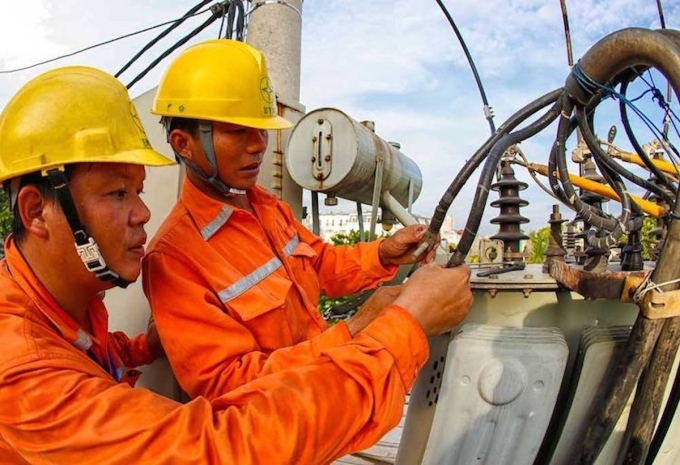
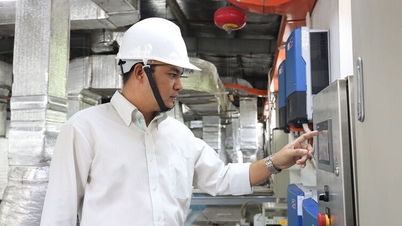
Electrical workers maintain equipment and systems at a substation. Photo: EVN
Regarding EVN's proposal for a connection plan with the Savan 1 and 2 wind power plants, the Ministry of Industry and Trade stated that it will be considered concurrently with the policy of importing electricity from these plants. The assignment of the investor to construct the connecting transmission line will be carried out after the competent authority approves the power purchase agreement and adds related grid projects to the power development plan. The Ministry of Industry and Trade also urged EVN and the investor to study and propose a connection plan that is consistent with the approved Power Development Plan VIII.
The ministry also requested EVN to complete the dossier for approval of the electricity purchase and sale policy for submission to the competent authority for consideration and decision.
By August, the Prime Minister had approved the policy of importing approximately 2,698 MW of electricity from Laos, of which EVN had signed power purchase agreements (PPAs) with investors for a total capacity of 2,240 MW.
Currently, the Prime Minister has approved the import of electricity from Laos for six power plants, with a total capacity of 449 MW. Of these, four projects (249 MW) are currently undergoing Power Purchase Agreement (PPA) negotiations with investors by the Electricity Trading Company – a subsidiary of EVN. The investors of the remaining two hydropower plants, Nam Kong 1 (160 MW) and Nam Mouan (100 MW), have announced they will cease selling electricity.
Besides Laos, Vietnam also buys electricity from China via the 110 kV power line. During the recent peak of the hot season in the North, the amount of electricity imported from Laos and China was about 11 million kWh per day, equivalent to 1/10 of the region's electricity demand.
Source link
![[Photo] Explore the US Navy's USS Robert Smalls warship](/_next/image?url=https%3A%2F%2Fvphoto.vietnam.vn%2Fthumb%2F1200x675%2Fvietnam%2Fresource%2FIMAGE%2F2025%2F12%2F10%2F1765341533272_11212121-8303-jpg.webp&w=3840&q=75)













































































Comment (0)