

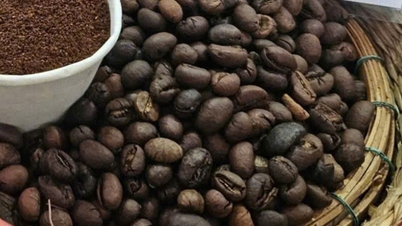
Coffee prices rose slightly.
On the morning of December 12th, the global market showed that coffee prices reversed course and started rising again in the most recent trading session.
In London, Robusta coffee futures for January 2026 delivery rose by $57/tonne to $4,278/tonne; the March 2026 contract increased by $45/tonne to $4,183/tonne.

Illustrative image. Photo: Internet
On the New York exchange, Arabica coffee futures for December 2025 delivery rose 4.7 cents/lb to 405.5 cents/lb; contracts for March 2026 delivery increased 7.2 cents/lb to 379.5 cents/lb.
Domestically, coffee prices in the Central Highlands region on the morning of December 12, 2025 also increased slightly by 500-600 VND, trading around 101,300-102,000 VND/kg.
In Lam Dong province , the prices in Di Linh, Bao Loc, and Lam Ha all increased by 600 VND/kg compared to yesterday, reaching 101,300 VND/kg.
In Dak Lak , the Cu M'gar area recorded a purchase price of 101,800 VND/kg, an increase of 500 VND/kg; while Ea H'leo and Buon Ho both reached 101,700 VND/kg.
In Dak Nong, the price increased by 500 VND/kg in Gia Nghia and Dak R'lap, reaching 102,000 and 101,900 VND/kg respectively.
In Gia Lai, the Chu Prong area traded at 101,300 VND/kg, while Pleiku and La Grai both increased by 500 VND/kg, reaching 101,200 VND/kg.
The Vietnam Coffee and Cocoa Association believes that the reason for the previous continuous decline in coffee prices stemmed from supply and demand factors and developments in the international market. Vietnam is entering its peak harvest season with abundant production, creating downward pressure on prices.
According to the Association's assessment, coffee prices on the exchange have stopped falling and begun to rise slightly again due to the influence of financial investment capital flows and changes in the supply-demand balance. However, after the recent sharp increase, coffee prices may cool down if there are no unfavorable factors such as weather affecting the supply.
In reality, in coffee-growing regions, even with rising prices, many farmers still choose to sell immediately after harvest to mitigate the risk of prices falling again. The majority of coffee is now consumed fresh rather than being stored as in previous years.
Nevertheless, with current prices remaining high and this season's yield being good, many farmers are still reaping significant profits, enabling them to maintain production and reinvest for the next season.
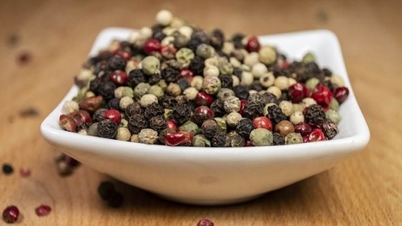
Pepper prices remain at high levels.
Domestic pepper prices on the morning of December 12, 2025, continued to remain high at 150,000 VND/kg. In Dak Lak, the purchase price remained at 150,000 VND/kg, unchanged from yesterday. Pepper prices in Chu Se (Gia Lai) stayed at 148,000 VND/kg, while Dak Nong maintained 150,000 VND/kg.
In the Southeast region, the price of pepper from Ba Ria - Vung Tau and Binh Phuoc both reached 148,500 VND/kg, unchanged from the previous day.
According to the International Pepper Association (IPC), at the close of the most recent trading session, the price of Lampung black pepper (Indonesia) reached US$6,989 per ton, up 0.11%, while the price of Muntok white pepper increased by 0.12%, to US$9,636 per ton.
The price of Brazilian ASTA 570 black pepper is currently at $6,075 per ton. In Malaysia, ASTA black pepper is priced at $9,000 per ton and ASTA white pepper at $12,000 per ton.
Today, Vietnamese black pepper is trading at US$6,500/ton for the 500 g/l grade and US$6,700/ton for the 550 g/l grade; white pepper is priced at US$9,250/ton.
Reduced supply puts upward pressure on pepper prices.
The supply of pepper from farmers has decreased significantly as many growers tend to hold onto their stock, waiting for higher prices. This reduced supply has contributed to a short-term price increase. At the same time, improved export activity has led businesses and dealers to actively purchase pepper to fulfill year-end orders, further driving up prices by approximately 500 VND today.
According to experts, pepper prices may remain stable or continue to rise slightly in the coming days. High export demand and the hoarding mentality of consumers are likely to cause a temporary supply shortage, providing support for prices.
However, prices could still adjust if supply unexpectedly increases again. When farmers ramp up sales to lock in profits, prices may fall slightly depending on actual market developments.
Overall, the trend in pepper prices in the coming period will still largely depend on the farmers' willingness to hold onto their stock and signals regarding export orders at the end of the year.
Source: https://doanhnghiepvn.vn/kinh-te/gia-nong-san-ngay-12-12-2025-ca-phe-tang-nhe-ho-tieu-duy-tri-o-nguong-cao/20251212094011558

















![[Photo] Prime Minister Pham Minh Chinh holds a phone call with the CEO of Russia's Rosatom Corporation.](/_next/image?url=https%3A%2F%2Fvphoto.vietnam.vn%2Fthumb%2F1200x675%2Fvietnam%2Fresource%2FIMAGE%2F2025%2F12%2F11%2F1765464552365_dsc-5295-jpg.webp&w=3840&q=75)










































Comment (0)