

Vietnam's startup ecosystem is not yet attractive enough to draw many foreign investment funds into the market for the long term, and the number of funds with more than five deals can be counted on the fingers of one hand.

Ms. Le Han Tue Lam, CEO of VinVentures - Photo: Provided by the interviewee.
VinVentures, a technology investment fund with total assets of approximately $150 million under Vingroup , has just released its report on the Vietnamese startup ecosystem in 2024.
Ms. Le Han Tue Lam, CEO of VinVentures Fund, shared with Tuoi Tre Online about notable market trends.
Decline for the fourth consecutive year
* In your opinion, what are the key takeaways from the Vietnam Startup Ecosystem Report 2024 published by VinVentures?
There are two points worth noting.
Firstly, this is the fourth consecutive year (2021-2024) that Vietnam has witnessed a decline in the total value of investment deals in startups.
The second noteworthy point is that in 2024, the market witnessed the "rise" of previously neglected sectors, notably agricultural technology with prominent deals such as Techcoop, Kamereo, and DTrack.
In addition, startups in the ESG (environmental, social, and governance) sector have also thrived through notable deals such as Nami Energy, Dat Bike, EBoost, and PVA PRO.
* What do these two notable points indicate?
- The first point reflects the challenges in attracting investment capital into the ecosystem, but also presents opportunities for startups to boost innovation and improve their business models.
The second point is that it indicates investors are gradually shifting their priorities towards sustainable sectors with long-term growth potential.
* In your opinion, why did the total transaction value decrease sharply in 2024 while the number of transactions remained largely unchanged?
- The number of transactions remained stable in 2024, primarily driven by early-stage investments (before Series A), accounting for approximately 82% of total transactions, with values ranging from $1 million to $5 million.
This reflects the overall development picture of Vietnam's ecosystem, an emerging market with the rise of many sectors and young start-ups, most of which are under three years old.
The value of each investment deal remains limited because most of the products and services offered by startups are in their early stages of development and have not yet reached scale.
This situation underscores the urgent need to enhance development capacity and foster innovation to attract more capital and create breakthroughs in the ecosystem.

Consumers participate in a DatBike electric vehicle experience - Photo: DATBIKE
Not many foreign funds have been involved in the market for a long time.
* Why has the market trend over the past year seen an increase in the number of large-scale deals, while the average value in this round has decreased?
- Rising interest rates are causing risk-takers around the world and in the region to reduce their risk-taking, especially in large-value transactions.
Transactions exceeding $10 million (from Series B onwards) mainly come from foreign investment funds. However, the number of foreign investors who remain committed to the Vietnamese market for a sufficient period of time is still limited.
Meanwhile, domestic funds with more modest capital sizes tend to focus on early-stage deals.
This reality creates a significant gap for potential large-scale deals, as the market lacks sufficient suitable investors to tap into and support startups during their more rapid growth phase.
* What can be quantified to support the view that the number of foreign investors who remain committed to the market for the long term is still low?
- The total number of active venture capital and private equity funds in Vietnam is approximately 60; of which up to 60% are foreign funds.
However, the number of foreign funds with more than five investments in Vietnam can be counted on the fingers of one hand.
For a foreign fund to fully understand the domestic market, it requires both time and proactiveness, and they can consider many factors such as the number of deals they have invested in.
Furthermore, most foreign investors started paying attention to Vietnam around 2018-2019 and really ramped up investment around 2021-2022, which is only in the last 3-4 years.
Therefore, the number of foreign investors with a good understanding of the market remains very low.
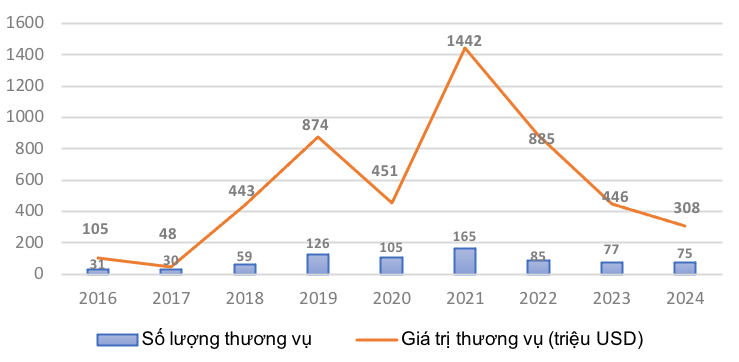
Number and value of investment deals in start-ups in Vietnam from 2016-2024 - Photo: HONG PHUC
* International investors tend to focus more on later-stage transactions, while local investors tend to stick with early-stage deals. How does this actually play out in Vietnam?
- This view is quite true in Vietnam, because foreign investors have more abundant capital, and their average fund size is several hundred million USD, so their transaction scale is also larger.
Meanwhile, domestic funds are mostly small and medium-sized funds, typically under $50 million.
In reality, very few funds reach a size of $50 million because the actual amount disbursed by LPs (Limited Partners - the fund's investors) is based on investment performance.
With limited capital, a strategy focused on early-stage startups is considered quite suitable for domestic investors.
 Has the 'winter fundraising' season ended?
Source: https://tuoitre.vn/giam-doc-quy-vinventures-nha-dau-tu-dan-chuyen-huong-uu-tien-vao-nhung-linh-vuc-ben-vung-20250117190952248.htm


![[Photo] Prime Minister Pham Minh Chinh holds a phone call with the CEO of Russia's Rosatom Corporation.](/_next/image?url=https%3A%2F%2Fvphoto.vietnam.vn%2Fthumb%2F1200x675%2Fvietnam%2Fresource%2FIMAGE%2F2025%2F12%2F11%2F1765464552365_dsc-5295-jpg.webp&w=3840&q=75)


































































Comment (0)