


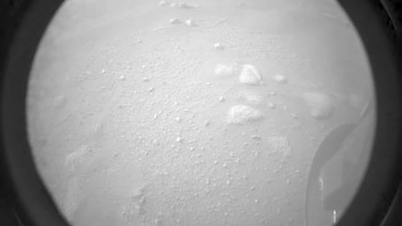
A bleached white rock on Mars. On Earth, rocks like this only form after millions of years in warm, humid conditions - Photo: NASA
A unique collection of rocks gathered by NASA's Perseverance probe at the Jezero crater suggests that Mars may have once had a hot, humid climate, possibly even resembling tropical regions on Earth.
These rock formations appear with characteristic bright spots and are suspected to contain kaolinite, an aluminum-rich clay that forms on Earth after millions of years of rain washing away other minerals. The presence of kaolinite on a cold and arid planet like Mars today is a strong indication that it once had abundant water and a long rainfall cycle.
In a study published in the journal Communications Earth & Environment, the team of experts compared rock samples collected by Perseverance with kaolinite clay found in San Diego and South Africa. The striking similarities suggest that ancient Mars may have once possessed geological conditions very close to those of tropical environments on Earth.
According to Professor Briony Horgan of Purdue University (USA), these kaolinite-rich rocks "require enormous amounts of water to form," which can only happen if the planet has a warm, rainy climate for extended periods.
On Earth, this type of clay is found primarily in tropical rainforests, so its presence on Mars offers a strong indication of a completely different climate in the past.
Perseverance discovered fragments of kaolinite scattered along its course across the Jezero crater, a site scientists believe was once a vast lake. This raises a crucial question: where did they come from? Could they have been carried into the area by an ancient river that formed a sedimentary plain, or were they agitated by a meteorite impact?
To get a clearer answer, scientists need access to larger rocks that share the same characteristic bright color. However, this requires Perseverance to venture deeper into an area with complex terrain.
Commenting on the biological potential of this discovery, researcher Adrian Broz suggested that an environment created by prolonged rainfall on Mars would be "an extremely ideal place for life if it ever existed." Water has always been considered a core element of all life forms, so traces of ancient water cycles are crucial clues in the search for extraterrestrial life.
Besides hinting at the possibility of an ancient tropical oasis, this discovery also helps shed light on how Mars transitioned from a humid planet to its current cold, dry desert. The gradual loss of its atmosphere due to changes in its magnetic field is suspected to be the primary cause, but the detailed process remains a mystery.
Source: https://tuoitre.vn/bat-ngo-phat-hien-bang-chung-oc-dao-tren-sao-hoa-20251212001950326.htm



















![[Photo] Prime Minister Pham Minh Chinh holds a phone call with the CEO of Russia's Rosatom Corporation.](/_next/image?url=https%3A%2F%2Fvphoto.vietnam.vn%2Fthumb%2F1200x675%2Fvietnam%2Fresource%2FIMAGE%2F2025%2F12%2F11%2F1765464552365_dsc-5295-jpg.webp&w=3840&q=75)













































Comment (0)