

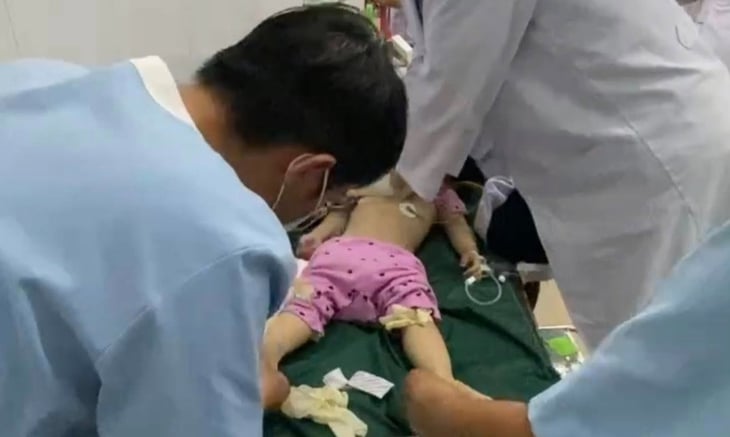
Despite 70 minutes of cardiopulmonary resuscitation (CPR), the 3-year-old girl could not be saved after choking on food at daycare - Photo: Provided by doctor.
On December 12th, Dr. Nguyen Thang Nhat Tue, head of the Emergency Department at Gia An 115 Hospital (Ho Chi Minh City), reported a heartbreaking incident at a daycare center where a 3-year-old girl choked on food, fell into a coma, stopped breathing, and unfortunately passed away.
Before calling emergency services (115), the child had been transferred to two medical stations. When the medical team arrived, the child was in cardiac arrest, respiratory arrest, dilated pupils, and unresponsive. Despite the medical team's efforts to perform cardiopulmonary resuscitation for 70 minutes, the child could not be saved.
"It's a heartbreaking loss. The concern isn't just about the incident itself, but also about the 'gaps' in the initial detection, treatment, and support process. The first few minutes are crucial, and sadly, they've slipped away," shared Dr. Nhat Tue.
From this heartbreaking case, Dr. Nhat Tue sends an important reminder to the community and educational institutions about the skills needed to handle situations when children choke.
Therefore, when an accident occurs, immediately call 115 for guidance. Absolutely do not give the child water to drink or try to remove the object from their throat, as this may push the foreign object deeper. Instead, immediately perform the "5 back blows - 5 chest thrusts" technique and repeat until the foreign object is expelled.
If the child is cyanotic and unresponsive, cardiopulmonary resuscitation (CPR) should be started immediately under the guidance of a 115 emergency coordinator, and the child should not be moved around without an initial assessment.
In preschools, teachers and caregivers need regular training in first aid for choking, gagging, and foreign body aspiration, as well as chest compressions and artificial respiration techniques. They should also closely monitor children during mealtimes, as this is when risks are most likely to occur.
At the primary healthcare level, maintaining on-call staff, providing initial emergency support, and updating procedures for managing respiratory and cardiac arrest in children is crucial, because the first few minutes in the community can make a life-or-death difference.
Procedures for managing asphyxiation issued by the Ministry of Health .
When a child chokes, immediate and correct treatment is crucial.
For children under 1 year old:
Alternately perform the "5 back taps - 5 chest presses" motion. Specifically, place the child face down on your forearm with their head lower than their body, firmly support the jaw and chin area, and use the base of your hand to tap 5 times between the shoulder blades.
Next, turn the child onto their back with their head still low, and use the heel of your hand to press down five times on the lower third of the sternum with moderate but firm pressure. Repeat these two steps until the child cries, coughs violently, or the foreign object is expelled.
For children aged 1 year and older:
The first step is to have the child stand slightly bent forward and firmly pat the area between the shoulder blades five times. Next, perform five Heimlich maneuvers by standing behind the child, wrapping your arms around their abdomen, making a fist with one hand, placing it between the navel and the sternum, and then pulling inward and upward. Alternate between five back pats and five abdominal thrusts until the foreign object is dislodged.
If the child is unconscious, cyanotic, or stops breathing, this is a critical condition and you need to call 115 immediately. Simultaneously perform chest compressions: use one hand or the two-thumb technique to cup the chest for small children, and two hands for older children. Chest compressions and artificial respiration must be continued until medical personnel arrive or the foreign object is removed.
Even after the foreign object has been removed and the child regains consciousness, caregivers should closely monitor the child for 24 hours and take them to a medical facility for checks for airway or lung damage.
Source: https://tuoitre.vn/tu-vu-be-3-tuoi-tu-vong-vi-sac-thuc-an-o-nha-tre-bac-si-neu-cach-xu-tri-dung-ngay-tai-cho-2025121214415332.htm




















![[Photo] Prime Minister Pham Minh Chinh holds a phone call with the CEO of Russia's Rosatom Corporation.](/_next/image?url=https%3A%2F%2Fvphoto.vietnam.vn%2Fthumb%2F1200x675%2Fvietnam%2Fresource%2FIMAGE%2F2025%2F12%2F11%2F1765464552365_dsc-5295-jpg.webp&w=3840&q=75)
















































Comment (0)